 flip
flipArtos zymitès, the leavened bread that breathes
Artos zymitès, the leavened bread that breathes
Why this dish? Anaximenes held air (pneuma) as the principle of all things: dough that swells with leaven is his thesis made edible — trapped air lifting matter. What better festive dish for the philosopher who blew air into a leather bag to show it has force?
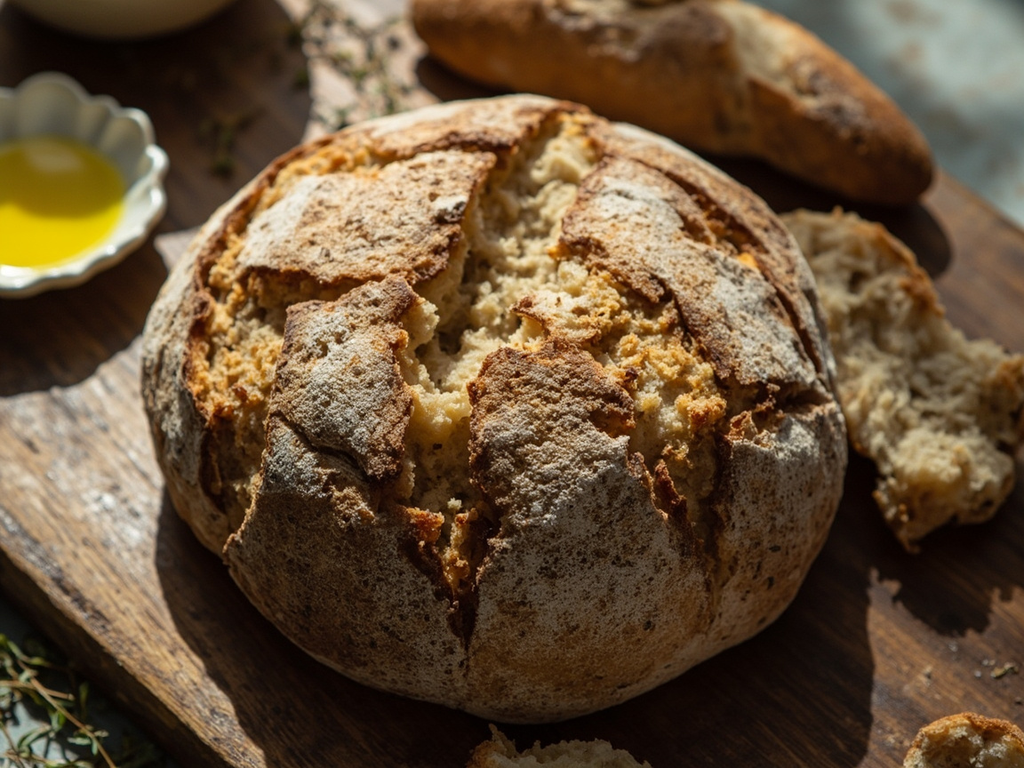
A wheat bread leavened with wild sourdough, soft and airy, reserved for feast days and the symposion. Its aerated crumb illustrates, by happy accident, the cosmology of Anaximenes.
Do you see those bubbles in the dough? It is the air working, the pneuma, that same force that rarefies into flame and condenses into water. I leave the wild yeast — a little must, a little flour — to blow up the mass all night, and by morning it has doubled without anyone touching it. I once inflated a leather bag to show skeptics that air, though invisible, has force; this bread proves it with every bite. Break it warm, dip it in mixed wine: it is a philosopher's feast.
- •Wheat flour (fine semolina) — a large bowl (base)
- •Wild sourdough (zymè) from grape must — a handful (fermentation)
- •Spring water — as needed (binder)
- •Sea salt — a pinch (seasoning)
- •Olive oil — a drizzle (finish)
Artos zymitès, the leavened bread that breathes
A wheat bread leavened with wild sourdough, soft and airy, reserved for feast days and the symposion. Its aerated crumb illustrates, by happy accident, the cosmology of Anaximenes.
Why this dish? Anaximenes held air (pneuma) as the principle of all things: dough that swells with leaven is his thesis made edible — trapped air lifting matter. What better festive dish for the philosopher who blew air into a leather bag to show it has force?
Do you see those bubbles in the dough? It is the air working, the pneuma, that same force that rarefies into flame and condenses into water. I leave the wild yeast — a little must, a little flour — to blow up the mass all night, and by morning it has doubled without anyone touching it. I once inflated a leather bag to show skeptics that air, though invisible, has force; this bread proves it with every bite. Break it warm, dip it in mixed wine: it is a philosopher's feast.
Ingredients (period version)
- Wheat flour (fine semolina) — a large bowl (base)
- Wild sourdough (zymè) from grape must — a handful (fermentation)
- Spring water — as needed (binder)
- Sea salt — a pinch (seasoning)
- Olive oil — a drizzle (finish)
Ingredients
- Wheat flour T65 — 400 g (base)
- Active natural sourdough starter — 100 g (fermentation)
- Warm water — 240 ml (binder)
- Salt — 8 g (seasoning)
- Olive oil — 1 tbsp (finish)
Method
- Dissolve the sourdough in warm water, then incorporate the flour and salt; knead for 10 minutes until smooth and elastic.
- Cover and let rise at room temperature for 4 to 6 hours, until doubled — it is the air lifting it.
- Gently deflate, shape into a ball, then let rise again for 1 to 2 hours.
- Score the top, brush with a little olive oil.
- Bake at very hot oven (240 °C) for 30 to 35 minutes, until golden crust sounds hollow when tapped. Let cool slightly before breaking.
How it was made : The Greeks leavened their bread with zymè — a sourdough maintained from grape must or fermented bran — long before beer yeast. White leavened bread remained expensive and associated with special occasions, while barley fed the everyday. Baking was done under a clay bell (klibanos) or in a communal oven.
The contemporary twist : Baked as a crown and presented sliced around a bowl of thyme oil, dubbed "the bread of pneuma" — a nod to the philosopher of air.
Sources : Andrew Dalby, Food in the Ancient World from A to Z, Routledge, 2003 · Aristophanes, mentions of leavened bread and bakers
Anaximenes · Charactorium