 flip
flipKuài with Jiang: Thin Slices of Fish and Their Fermented Sauce
Kuài with Jiang: Thin Slices of Fish and Their Fermented Sauce
Why this dish? The Analects (X) detail Confucius's exacting table manners: 'meat improperly cut, he would not eat; without the proper sauce, he would not eat.' Kuài (膾)—finely sliced raw meat—was the refined dish of banquets, and the correct pairing with its jiang was a matter of ritual as much as taste.
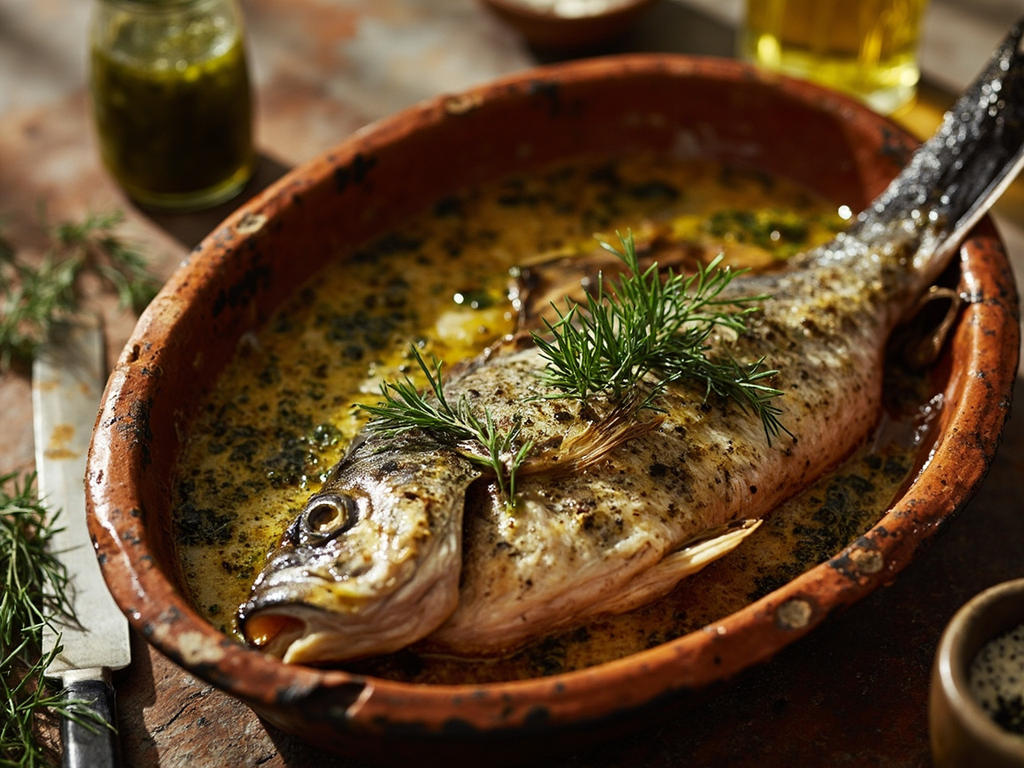
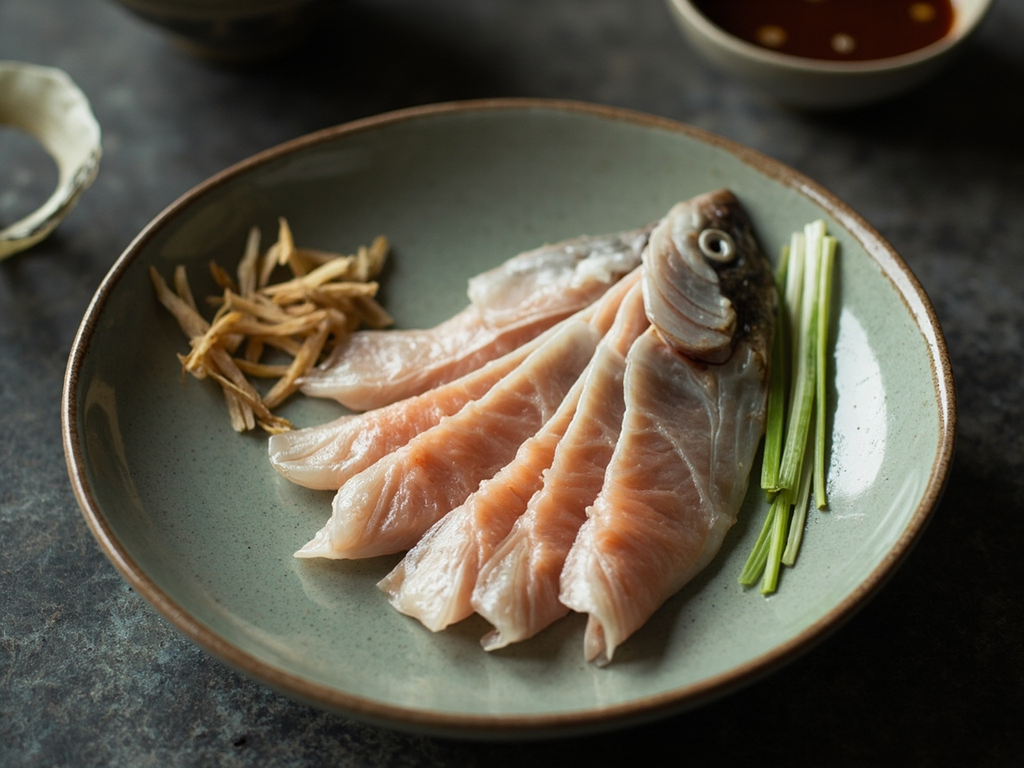
Very thin slices of river fish, carefully trimmed, arranged in a fan with a dark fermented sauce, salty and umami, brightened with ginger and scallion. A festive dish where perfection of cutting matters as much as flavor.
See how the flesh is sliced: the finer it is, the more it pleases me. I do not touch it if the knife has cut it poorly, nor if it arrives without its proper sauce—for each dish has its jiang, and none should be confused. Bring the ginger, arrange the pieces in order, and do not help yourself to excess. To eat thus, in just measure and just form, is still to honor the rite.
- •Very fresh river fish (carp) — one fish (sliced flesh, the kuài)
- •Hǎi / jiang (fermented grain or meat sauce) — one small bowl (paired sauce, signature)
- •Ginger (薑) — one finger (purifying aromatic)
- •Chinese scallion — a few stalks (aromatic)
- •Grain vinegar — a dash (tangy note)
Kuài with Jiang: Thin Slices of Fish and Their Fermented Sauce
Very thin slices of river fish, carefully trimmed, arranged in a fan with a dark fermented sauce, salty and umami, brightened with ginger and scallion. A festive dish where perfection of cutting matters as much as flavor.
Why this dish? The Analects (X) detail Confucius's exacting table manners: 'meat improperly cut, he would not eat; without the proper sauce, he would not eat.' Kuài (膾)—finely sliced raw meat—was the refined dish of banquets, and the correct pairing with its jiang was a matter of ritual as much as taste.
See how the flesh is sliced: the finer it is, the more it pleases me. I do not touch it if the knife has cut it poorly, nor if it arrives without its proper sauce—for each dish has its jiang, and none should be confused. Bring the ginger, arrange the pieces in order, and do not help yourself to excess. To eat thus, in just measure and just form, is still to honor the rite.
Ingredients (period version)
- Very fresh river fish (carp) — one fish (sliced flesh, the kuài)
- Hǎi / jiang (fermented grain or meat sauce) — one small bowl (paired sauce, signature)
- Ginger (薑) — one finger (purifying aromatic)
- Chinese scallion — a few stalks (aromatic)
- Grain vinegar — a dash (tangy note)
Ingredients
- Extra-fresh freshwater fish fillet (trout or sashimi-grade sea bream) — 300 g (sliced flesh)
- Fermented soybean paste (mild doubanjiang or brown miso) — 3 tbsp (the jiang, signature sauce)
- Fresh ginger — 1 piece (3 cm), cut into fine matchsticks (aromatic)
- Scallion — 2 stalks, sliced (aromatic)
- Rice vinegar — 1 tbsp (acidity)
- A little water — 1 to 2 tbsp (to thin the sauce)
Method
- Mix the fermented paste with rice vinegar and a little water until a coating sauce forms; pour into a small bowl.
- Chill the fish, then slice it as thinly as possible with a sharp knife, on the bias, against the grain.
- Arrange the slices in a regular fan on a cold plate—the beauty of the cut makes the dish.
- Scatter with ginger matchsticks and scallion.
- Serve immediately, each guest dipping a slice into the jiang. (For the cautious, sear the slices for 30 seconds in a very hot pan.)
How it was made : Kuài—raw meat or fish finely sliced—was a prestige dish in China for two millennia before nearly disappearing; it is the common ancestor of Japanese sashimi and Korean hoe. Ancient jiang were legion: fermented pastes of grains (醬) or of meat and fish (醢, hǎi), long matured in salt. It is to this repertoire of sauces that Confucius's requirement refers.
The contemporary twist : Present the slices in a rosette on a cold slate, the jiang in a celadon dipping bowl, ginger in fine slivers: a minimalist homage to the Master's exacting standards.
Sources : Entretiens de Confucius (Lunyu), book X 'Xiang Dang' · Françoise Sabban, 'De la main à la pâte: réflexion sur l'origine de la cuisine chinoise', L'Homme, 1993
Confucius · Charactorium