 flip
flipTuscan bread soup of exile
Tuscan bread soup of exile
Why this dish? Tarkovsky shot Nostalghia in Tuscany, notably at Bagno Vignoni, and spent his final years in exile between Italy and Paris. This soup of stale bread and vegetables, the humble ribollita of Tuscan peasants, evokes the Russian filmmaker seated far from home, finding in a poor kitchen of another country the same dignity of little — that of the shchi of his childhood.
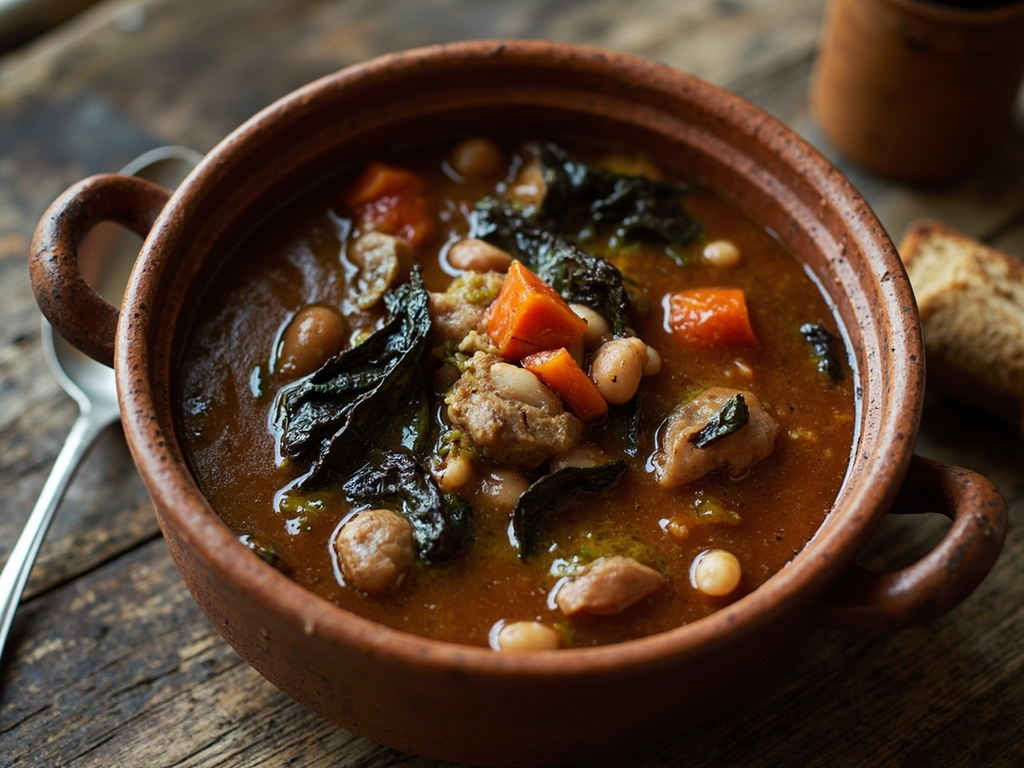
A thick soup, almost a stew, where stale bread is "resurrected" (ri-bollita, "reboiled") in a broth of vegetables and beans, bound with a generous drizzle of olive oil. A dish of economy turned into a dish of soul, halfway between Russia left behind and Italy of welcome.
Exile has this strange quality: you search everywhere for the taste of home, and sometimes you find it in the kitchen of another. Here, in Tuscany, the peasants make a soup from yesterday's bread, which they reboil with vegetables and beans from the garden. It is poor, it is slow, it is unpretentious — and yet it spoke to me like a mother tongue. The bread resurrected in the broth, the green oil poured at the end, the silence around the table: I recognized in it, far from Russia, the same nostalgia nourished by almost nothing.
- •Stale Tuscan bread — several slices (thickener and heart of the dish)
- •Cannellini beans — a good handful (protein and binder)
- •Black kale (cavolo nero) — one bunch (signature vegetable)
- •Onion, carrot, celery — to hand (aromatic base (soffritto))
- •Olive oil — generously (binding and finish)
Tuscan bread soup of exile
A thick soup, almost a stew, where stale bread is "resurrected" (ri-bollita, "reboiled") in a broth of vegetables and beans, bound with a generous drizzle of olive oil. A dish of economy turned into a dish of soul, halfway between Russia left behind and Italy of welcome.
Why this dish? Tarkovsky shot Nostalghia in Tuscany, notably at Bagno Vignoni, and spent his final years in exile between Italy and Paris. This soup of stale bread and vegetables, the humble ribollita of Tuscan peasants, evokes the Russian filmmaker seated far from home, finding in a poor kitchen of another country the same dignity of little — that of the shchi of his childhood.
Exile has this strange quality: you search everywhere for the taste of home, and sometimes you find it in the kitchen of another. Here, in Tuscany, the peasants make a soup from yesterday's bread, which they reboil with vegetables and beans from the garden. It is poor, it is slow, it is unpretentious — and yet it spoke to me like a mother tongue. The bread resurrected in the broth, the green oil poured at the end, the silence around the table: I recognized in it, far from Russia, the same nostalgia nourished by almost nothing.
Ingredients (period version)
- Stale Tuscan bread — several slices (thickener and heart of the dish)
- Cannellini beans — a good handful (protein and binder)
- Black kale (cavolo nero) — one bunch (signature vegetable)
- Onion, carrot, celery — to hand (aromatic base (soffritto))
- Olive oil — generously (binding and finish)
Ingredients
- Stale country bread — 200 g (thickener)
- Cooked white beans (cannellini) — 400 g (protein, part mashed)
- Black kale or curly kale — 300 g (main vegetable)
- Onion, carrot, celery — 1 each (soffritto)
- Garlic — 2 cloves (aromatic)
- Vegetable broth — 1.2 L (liquid)
- Extra virgin olive oil — 6 tbsp (cooking and final drizzle)
- Salt, pepper — to taste (seasoning)
Method
- Gently sauté chopped onion, carrot, celery, and garlic in olive oil (the soffritto).
- Coarsely mash half the beans, add all with shredded kale and broth; simmer 30 minutes.
- Stir in torn stale bread and let it dissolve into the soup for 15-20 minutes, until thick.
- Season with salt and pepper, let rest off the heat (the soup improves when reheated, hence its name).
- Serve warm, drizzled generously with raw olive oil.
How it was made : Ribollita was born from Tuscan peasant economy: stale bread was never thrown away, but "reboiled" the next day with leftover vegetable and bean soup. A quintessential poor dish, without meat, it is traditionally eaten reheated, which develops its flavors. Cavolo nero (Tuscan black cabbage) is its signature ingredient.
The contemporary twist : Serve the zuppa in an earthenware bowl, the drizzle of olive oil catching the light, a leaf of black kale placed on top — monastic sobriety for a contemplative exile dish.
Andrei Tarkovsky · Charactorium