 flip
flipThe Hérétique Ration
The Hérétique Ration
Why this dish? This is the heart of Alain Bombard's experience: in 1952, aboard the inflatable dinghy *L'Hérétique*, he crossed the Atlantic without provisions, eating only raw fish caught with a harpoon and drinking the juice pressed from its flesh. He recorded everything in his account *Naufragé volontaire*.
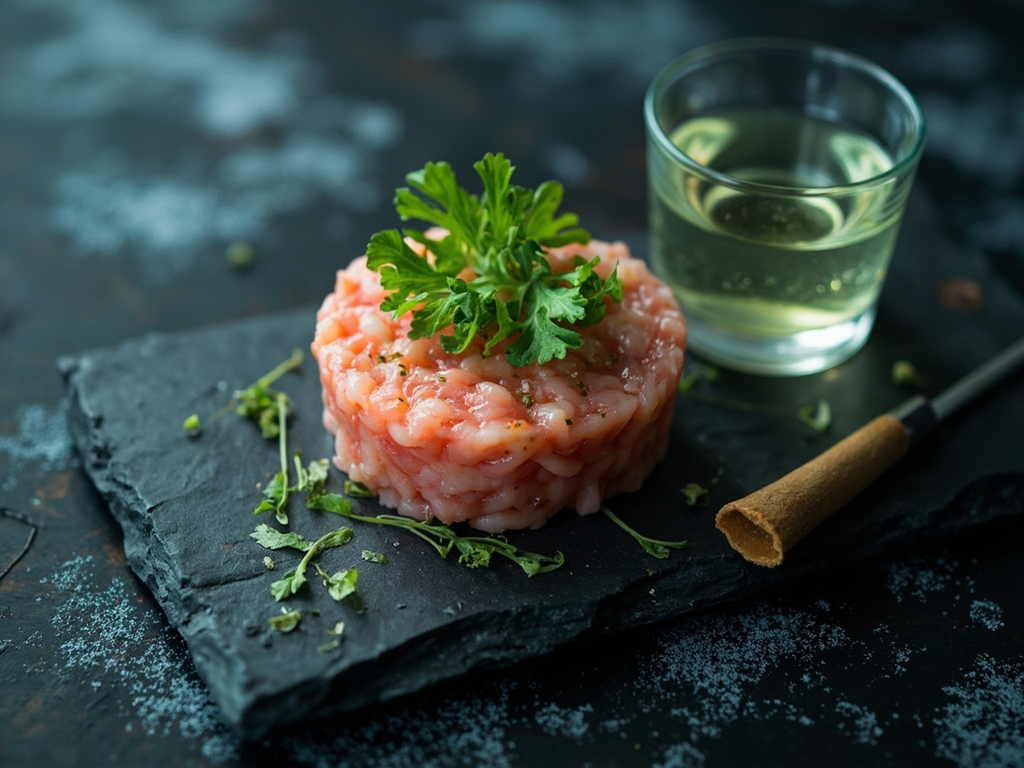
Not a dish, but a survival lesson turned into tartare: ultra-fresh raw fish flesh, knife-cut, whose pressed juice is carefully kept for drinking. Saline, iodized, raw — the castaway's table that refuses to die.
Understand what I'm telling you: a castaway doesn't die of hunger, he dies of terror. On my dinghy, I had neither fresh water nor biscuit — just the harpoon and my two hands. I took the fish, cut it alive, and above all I pressed its flesh between my palms to extract that clear juice that kept me alive; that was my water, that was my bread. Never believe the sea is stronger than human will.
- •Raw high-sea fish (dorado coryphène, flying fish) — the day's catch (flesh and vital liquid)
- •Plankton harvested with a net — a few spoonfuls (nutritious supplement)
- •Collected rainwater — according to rainfall (drink)
The Hérétique Ration
Not a dish, but a survival lesson turned into tartare: ultra-fresh raw fish flesh, knife-cut, whose pressed juice is carefully kept for drinking. Saline, iodized, raw — the castaway's table that refuses to die.
Why this dish? This is the heart of Alain Bombard's experience: in 1952, aboard the inflatable dinghy *L'Hérétique*, he crossed the Atlantic without provisions, eating only raw fish caught with a harpoon and drinking the juice pressed from its flesh. He recorded everything in his account *Naufragé volontaire*.
Understand what I'm telling you: a castaway doesn't die of hunger, he dies of terror. On my dinghy, I had neither fresh water nor biscuit — just the harpoon and my two hands. I took the fish, cut it alive, and above all I pressed its flesh between my palms to extract that clear juice that kept me alive; that was my water, that was my bread. Never believe the sea is stronger than human will.
Ingredients (period version)
- Raw high-sea fish (dorado coryphène, flying fish) — the day's catch (flesh and vital liquid)
- Plankton harvested with a net — a few spoonfuls (nutritious supplement)
- Collected rainwater — according to rainfall (drink)
Ingredients
- Extra-fresh mackerel or sea bream fillet (sashimi quality) — 200 g (flesh)
- Lime — 1 (acidity and food safety)
- Shredded nori or sea lettuce — 1 tsp (iodized reminder of plankton)
- Fleur de sel and crushed pepper — to taste (seasoning)
- Drizzle of olive oil — 1 tsp (modern binder)
Method
- Choose a fish of impeccable freshness, sashimi quality; freeze for 24 hours for safety, then thaw in the fridge.
- Finely dice the flesh with a knife into small, even cubes.
- Season with fleur de sel, pepper, lime juice, and a drizzle of olive oil; add the shredded seaweed for an iodized note.
- Shape into a quenelle, without masking the simplicity of the flesh: here, the raw product is honored.
How it was made : At sea, Bombard had no cooking: he harpooned the fish, ate it raw, and pressed its flesh (with a cloth or by hand) to extract a liquid drunk in addition to rainwater and brief intakes of seawater — the latter point highly contested by doctors. Plankton, collected with a fine net, provided a vitamin supplement.
The contemporary twist : Serve the tartare quenelle on a slate stone with a small glass of lemon-seawater (very diluted) beside it: a pedagogical nod to the castaway's glass, without danger.
Sources : Alain Bombard, *Naufragé volontaire*, Éditions de Paris, 1953
Alain Bombard · Charactorium