 flip
flipKydōnáton — quince paste with honey
Kydōnáton — quince paste with honey
Why this dish? Anna directed the great orphanotropheion-hospital of Constantinople and read the ancient physicians. Quince cooked in honey, kydōnáton, appeared in the Byzantine pharmacopoeia as a digestive and remedy for stomach disorders: a sweet that the learned princess prescribed as much as she enjoyed.
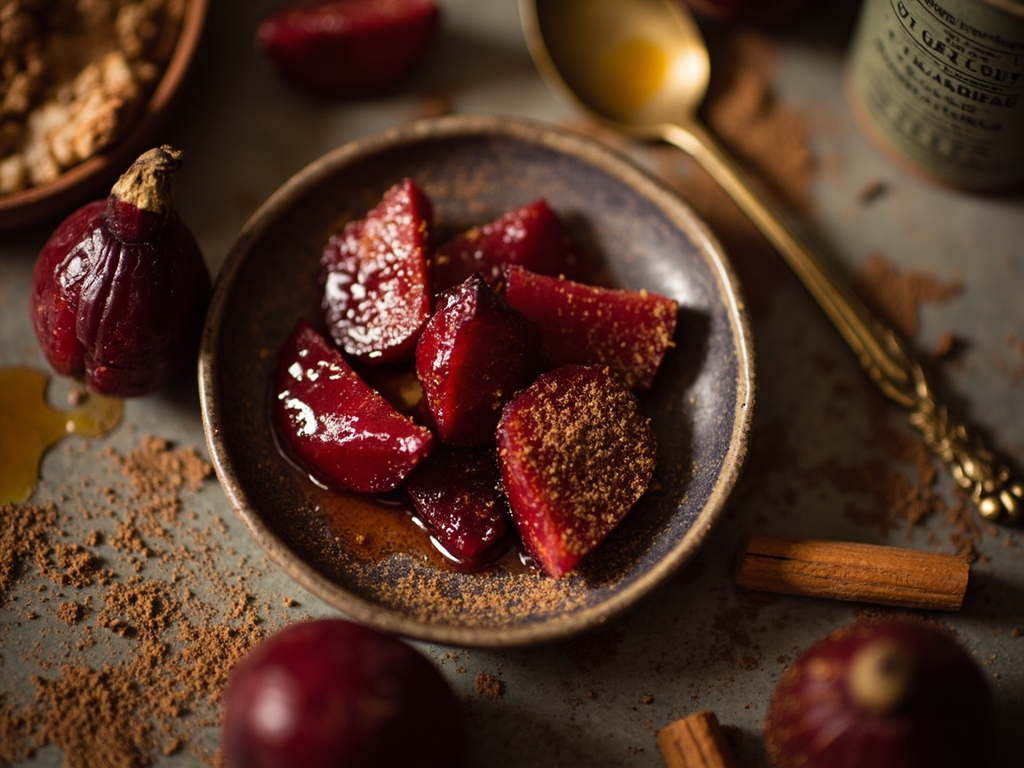
A fragrant paste of quinces long-cooked in honey, spiced with sweet spices. At once an end-of-meal treat and a digestive remedy, it combines the fruit's acidity with honey's roundness.
You who suffer from the stomach, pay me attention, for I have watched over many sick in our hospital and read what the Ancients said about it. Take the quince, that tart and fragrant fruit that no one eats raw, and let it melt gently in honey until it reddens and thickens. A spoonful after the meal tightens the humors and soothes the belly — pleasure and care reside here in the same mouthful. Thus our science willed it: that the remedy should be as sweet as the cure.
- •Quinces — several, ripe (base fruit)
- •Honey — in generous parts (cooking and preservation)
- •Pepper, ginger, or cinnamon — a pinch (digestive spices)
- •Nard or mastic — a trace (perfume)
Kydōnáton — quince paste with honey
A fragrant paste of quinces long-cooked in honey, spiced with sweet spices. At once an end-of-meal treat and a digestive remedy, it combines the fruit's acidity with honey's roundness.
Why this dish? Anna directed the great orphanotropheion-hospital of Constantinople and read the ancient physicians. Quince cooked in honey, kydōnáton, appeared in the Byzantine pharmacopoeia as a digestive and remedy for stomach disorders: a sweet that the learned princess prescribed as much as she enjoyed.
You who suffer from the stomach, pay me attention, for I have watched over many sick in our hospital and read what the Ancients said about it. Take the quince, that tart and fragrant fruit that no one eats raw, and let it melt gently in honey until it reddens and thickens. A spoonful after the meal tightens the humors and soothes the belly — pleasure and care reside here in the same mouthful. Thus our science willed it: that the remedy should be as sweet as the cure.
Ingredients (period version)
- Quinces — several, ripe (base fruit)
- Honey — in generous parts (cooking and preservation)
- Pepper, ginger, or cinnamon — a pinch (digestive spices)
- Nard or mastic — a trace (perfume)
Ingredients
- Quinces — 1 kg (peeled, cored) (base fruit)
- Honey — 300 g (cooking and preservation)
- Ground ginger + cinnamon — 1/2 tsp each (digestive spices)
- Juice of half a lemon (substitute for acidity) — — (balance)
Method
- Peel and cut quinces into pieces, remove cores and seeds (keep the seeds in a muslin bag: they add pectin).
- Cook quinces in a little water until soft, then mash into a purée.
- Add honey and spices, and cook over low heat for 40–60 minutes, stirring often.
- Cook until the paste reddens, thickens, and pulls away from the bottom of the pan.
- Pour into a mold or jars; let set. Keeps long thanks to honey.
- Serve in thin slices or by the spoonful at the end of the meal.
How it was made : Quince with honey descends from Greek melómeli and Roman cydonitum; Byzantines made attested medical use of it, in the line of Dioscorides, as an astringent and digestive. The dense quince paste (ancestor of cotognata and membrillo) kept for months — hence its place at the crossroads of treat, remedy, and preserve.
The contemporary twist : Cut into small cubes rolled in sesame seeds, like fruit jellies, to offer with coffee — a "learned princess's loukoum".
Sources : Andrew Dalby, Flavours of Byzantium, Prospect Books, 2003 · Dioscoride, De Materia Medica (medical tradition inherited in Byzantium)
Anna Komnene · Charactorium