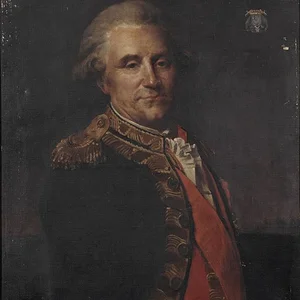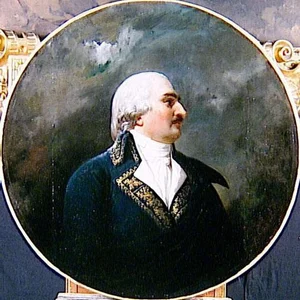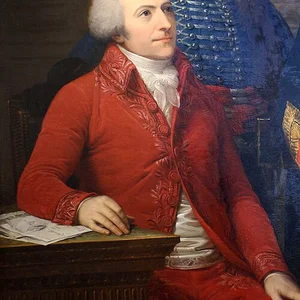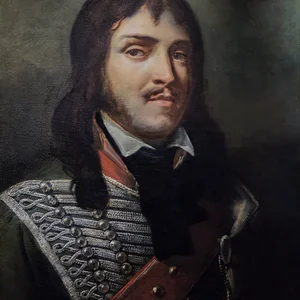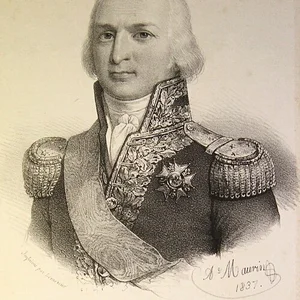

French admiral born in 1741, he commanded the Brest squadron during the Revolution and took part in the Irish Expedition of 1796. Appointed senator of the First Empire by Napoleon, he died in 1809.
Justin Bonaventure Morard de Galles(1741 — 1809)
Justin Bonaventure Morard de Galles
France
7 min read
Frequently asked questions
Key Facts
- Born on 15 March 1741 in Aups (Var)
- Commanded the Brest squadron in 1796
- Led the Irish Expedition (1796) alongside Hoche, which was aborted by a storm
- Appointed senator of the First Empire by Napoleon Bonaparte
- Died on 16 July 1809 in Paris
Works & Achievements
Morard de Galles assumed command-in-chief of the Atlantic fleet during a critical period, keeping the squadron operational despite the British blockade, revolutionary purges, and chronic lack of resources.
Naval command of the largest French amphibious expedition in decades, aimed at opening a second front in Ireland against Great Britain. The meteorological failure does nothing to diminish the strategic ambition of the operation.
Appointed by Bonaparte among the founding members of the Conservative Senate, Morard de Galles represented the military establishment and naval expertise within the new imperial regime until his death.
Anecdotes
In December 1796, Morard de Galles commanded a fleet of 43 ships and 14,000 soldiers bound for Ireland to support the United Irishmen's rebellion against the British. As the squadron left Brest, a violent storm scattered it and separated his flagship, *La Fraternité*, from the rest of the fleet. He drifted at sea for several days, unable to rejoin his troops, making the expedition impossible to coordinate.
During the Irish expedition, General Hoche — commander of the land forces — was aboard the flagship *La Fraternité* with Morard de Galles. When the storm cut them off from the rest of the fleet, both leaders of the expedition found themselves powerless, drifting far from Bantry Bay where their own soldiers waited in vain for orders to land.
A naval officer of the Ancien Régime, Morard de Galles had to navigate carefully through the political storms of the Revolution. Unlike many of his noble colleagues, who were arrested or guillotined during the Terror, he managed to hold his position by demonstrating loyalty to successive governments, from the constitutional monarchy to the Republic.
Appointed senator of the First Empire by Napoleon, Morard de Galles exemplifies the trajectory of an Ancien Régime sailor reinvented as an imperial notable. A man who had once sailed under the king's orders now found himself sitting in the Sénat conservateur alongside revolutionary generals — a symbol of the military elite that Napoleon skillfully co-opted into the service of the new order.
Primary Sources
The squadron, scattered by contrary winds off Ushant, was unable to regroup. The flagship La Fraternité, separated from the convoy, could not reach the coast of Ireland within the prescribed timeframe.
Citizen Morard de Galles, vice-admiral, is appointed member of the Conservative Senate by virtue of the powers conferred upon the First Consul by the Constitution of Year VIII.
We were separated from the squadron by a dreadful squall. The admiral and I have been waiting five days to rejoin our vessels. The coast of Ireland is within reach and yet we cannot land.
Entered service in 1757, promoted vice-admiral in 1793, commanding the Brest squadron from 1793 to 1797. Participated in the Ireland expedition as commander-in-chief of naval forces.
Key Places
A town in Provence where Morard de Galles was born in 1741. This small Provençal town, known for its fountains, was the birthplace of the officer who would build his entire career in the royal and later republican navy.
The main French Atlantic naval base, where Morard de Galles commanded the fleet during the Revolution. It was from Brest that the 43 ships of the Irish expedition set sail in December 1796.
A bay on the south-west coast of Ireland that was the target of the 1796 expedition. The French fleet, scattered by storms, was never able to carry out its landing despite waiting for several days.
The seat of the Conservative Senate, where Morard de Galles sat as an imperial senator appointed by Napoleon. He ended his days there as a notable of the Empire, far from the storms of the Atlantic.
Typical Objects

A navigation instrument used to measure the altitude of celestial bodies in order to calculate a ship's position at sea. Essential for any naval officer to determine latitude and, with nautical tables, longitude.

A portable telescope used at sea to observe coastlines, enemy vessels, and signals. The everyday tool of any fleet commander for monitoring his squadron and scanning the horizon.

A sea chart detailing coastlines, water depths, currents, and harbors. Morard de Galles had access to charts of the Irish coast to prepare the Bantry Bay expedition in 1796.

A navy blue embroidered coat with gold epaulettes, marking the rank of vice-admiral. During the Revolution, uniforms were simplified to strip away overly aristocratic insignia, before being re-gilded under the Empire.

The regulation side arm carried by naval officers as a badge of command and in boarding actions. As much a symbol of authority as a weapon of war.

A record kept daily by the ship's commander, noting the course sailed, weather conditions, notable events, and orders issued. An essential primary source for reconstructing naval operations.
School Curriculum
Vocabulary & Tags
Key Vocabulary
Daily Life
Morning
Aboard his flagship La Fraternité, Morard de Galles rises at dawn with the crew. The day begins with the inspection of the watch logs, the reading of reports from the watch officers, and the observation of weather conditions using his sextant and spyglass. Course decisions are made early to take advantage of favorable winds.
Afternoon
The afternoon is devoted to squadron maneuvers, navigation drills, and command meetings with his captains. Morard de Galles dictates his orders of the day, consults the nautical charts, and drafts his official correspondence with the Minister of the Navy in Paris, often entrusted to a dispatch vessel.
Evening
In the evening, the admiral dines with his senior officers in the stern cabin, a space reserved for the command. Meals, though frugal on campaign, observe a certain military etiquette. He then spends the night studying the Sailing Directions and preparing orders for the following day.
Food
Food aboard is dominated by hardtack, salt pork, dried vegetables (beans, peas), and red wine diluted with water. Senior officers enjoy a slightly better table, with preserved goods, cheese, and occasionally poultry during the first days at sea. On extended campaigns, rations deteriorate and scurvy becomes a constant threat.
Clothing
On duty, the admiral wears the uniform of a vice-admiral of the National Navy: a royal-blue coat with red facings and gold embroidery, white waistcoat, breeches and white stockings, and a bicorne hat with a tricolor cockade. At sea in rough weather, he dons a heavy wool cloak and waterproof leather boots. During the Revolution, overly aristocratic insignia were temporarily removed.
Housing
Ashore, Morard de Galles resides in the official apartments made available to flag officers at the port of Brest, or in his private townhouse in Paris when sitting in the Senate. His senatorial residence offers the bourgeois comfort of the Consular era: Empire furniture, personal valets, and receptions for notable guests.
Historical Timeline
Period Vocabulary
Liens externes & ressources
Références
Œuvres
Mandat de sénateur du Premier Empire
1801-1809