 flip
flipQuindim
Quindim
Why this dish? A lavish patron fond of receptions, Chateaubriand offered his guests the gleaming doces of Brazilian tradition. Quindim, a little golden flan of egg yolks and coconut, a crossbred legacy of Portuguese convents and Afro-Brazilian cooking, shone on the buffets of the elite to which he belonged.
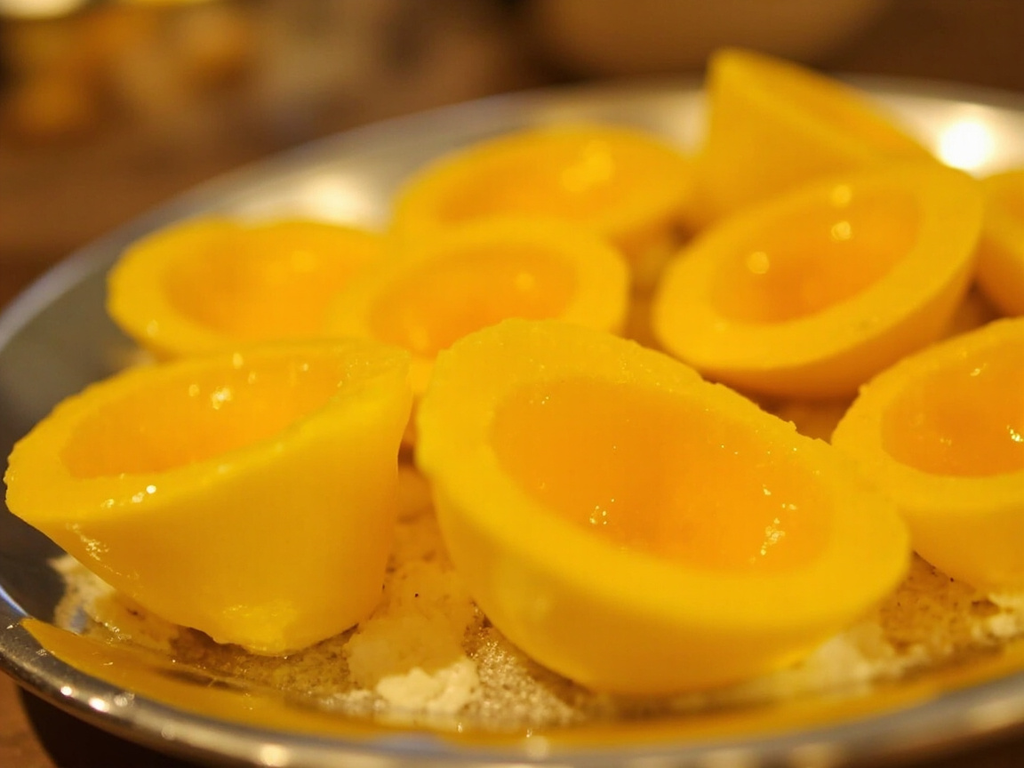
A small molded dessert of brilliant golden yellow, made from egg yolks, sugar, and grated coconut, baked in a water bath. Smooth, glossy surface, melting center, and coconut at the bottom. An intense, shiny sweetness, queen of festive tables.
When I gave a reception, the table had to dazzle the eye before the palate — and nothing shines like a quindim, golden as a ingot, smooth as a mirror. It is a convent sweet, born from the patient hands of Portuguese nuns and Brazilian cooks who beat egg yolks until exhaustion. You unmold it trembling, set it on the silver, and it makes its little impression on the ladies. Sugar, my dear, is also an art of governing guests.
- •Egg yolks — a good dozen (structure and golden color)
- •Sugar — in generous parts (sweetness and binder)
- •Fresh grated coconut — a bowl (texture and fragrance)
- •Butter — a knob (tenderness)
Quindim
A small molded dessert of brilliant golden yellow, made from egg yolks, sugar, and grated coconut, baked in a water bath. Smooth, glossy surface, melting center, and coconut at the bottom. An intense, shiny sweetness, queen of festive tables.
Why this dish? A lavish patron fond of receptions, Chateaubriand offered his guests the gleaming doces of Brazilian tradition. Quindim, a little golden flan of egg yolks and coconut, a crossbred legacy of Portuguese convents and Afro-Brazilian cooking, shone on the buffets of the elite to which he belonged.
When I gave a reception, the table had to dazzle the eye before the palate — and nothing shines like a quindim, golden as a ingot, smooth as a mirror. It is a convent sweet, born from the patient hands of Portuguese nuns and Brazilian cooks who beat egg yolks until exhaustion. You unmold it trembling, set it on the silver, and it makes its little impression on the ladies. Sugar, my dear, is also an art of governing guests.
Ingredients (period version)
- Egg yolks — a good dozen (structure and golden color)
- Sugar — in generous parts (sweetness and binder)
- Fresh grated coconut — a bowl (texture and fragrance)
- Butter — a knob (tenderness)
Ingredients
- Egg yolks — 10 (base, color)
- Sugar — 200 g (sweetness)
- Grated coconut (preferably fresh) — 100 g (fragrance, texture)
- Melted butter — 1 tablespoon (tender binder)
- Butter + sugar — for the molds (unmolding)
Method
- Preheat oven to 160°C and butter and sugar small individual molds.
- Gently mix egg yolks and sugar without beating too much air to avoid bubbles.
- Strain the mixture through a sieve to remove chalaza, then fold in coconut and melted butter.
- Let the mixture rest for 15 minutes, then divide among the molds.
- Bake in a water bath in the oven for 35 to 45 minutes: the surface should be set and golden.
- Let cool slightly, then unmold gently: the coconut rises to the bottom and forms the base, the surface is smooth and glossy.
How it was made : Quindim descends from Portuguese doces de ovos, egg-yolk confections developed in convents (where whites were used to starch habits). Transplanted to Brazil, the recipe was enriched with coconut and refined by Afro-Brazilian cooks. The name may come from a Bantu word. It was a prestige doce, a sign of opulence on tables.
The contemporary twist : Unmold the quindins on a mirror of passion fruit (maracujá) coulis: the acidity cuts the rich sweetness and brings out the flan's gold.
Sources : Gilberto Freyre, Açúcar: uma sociologia do doce, 1939 · Luís da Câmara Cascudo, História da Alimentação no Brasil, 1967
Assis Chateaubriand · Charactorium