 flip
flipGrilled Fish of Tyre with Brine and Herbs
Grilled Fish of Tyre with Brine and Herbs
Why this dish? Tyre and Sidon, cities of Astarte, lived by the sea. A banquet in honor of the goddess — and thus, by medieval inversion, of the great duke Astaroth — had to offer the finest fish, glistening with oil and enhanced with the famous fermented fish sauce of the Punic coasts.
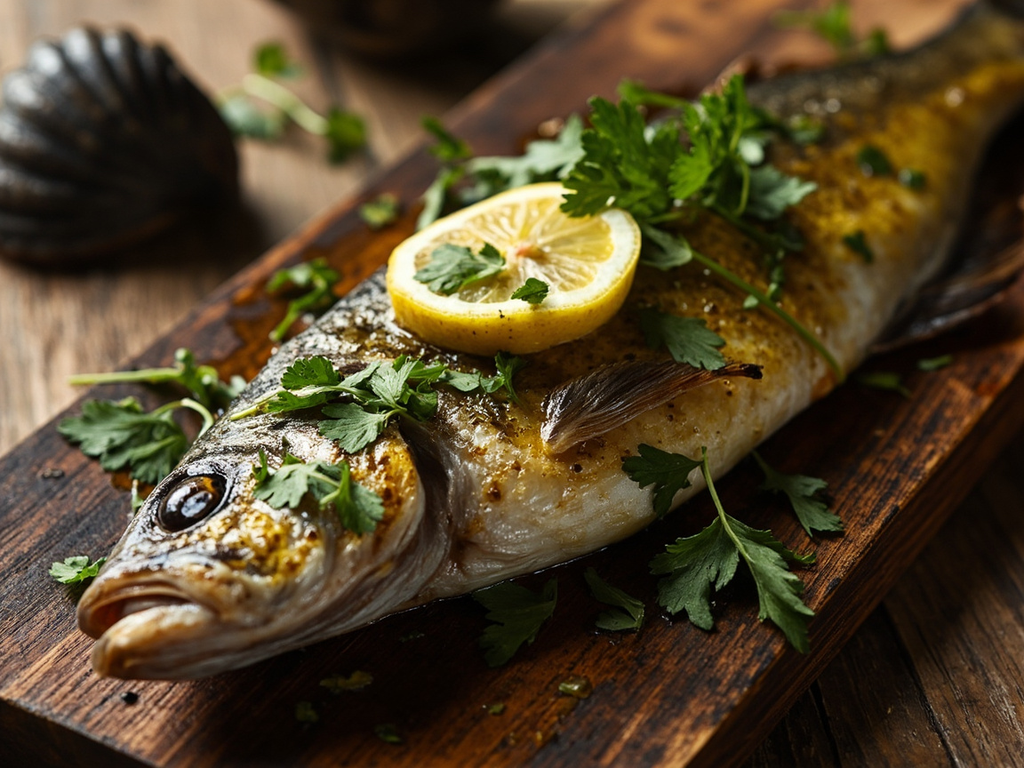
A whole fish (sea bream or sea bass) grilled over embers, brushed with olive oil and a dash of fermented fish brine, then covered with coriander and cumin. Tender flesh, crispy skin, marine and deeply umami flavor.
Sailor, listen to the prince. At my table in Tyre, no nobler dish was served than the fish pulled that very morning from the purple nets. It was opened, rubbed with oil and that golden brine whose mere scent makes the mouth water, then laid upon the red embers. A rain of coriander, a hint of cumin from the caravans, and behold: a feast worthy of a goddess — that is, of me.
- •Whole coastal fish (sea bream, sea bass) — one fine fish, gutted (centerpiece)
- •Fermented fish brine (garum) — a dash (umami signature)
- •Olive oil — generously (cooking and shine)
- •Fresh coriander — a bunch (freshness)
- •Cumin — a pinch (caravan spice)
- •Lemon (originally citron) — a few drops (acidity)
Grilled Fish of Tyre with Brine and Herbs
A whole fish (sea bream or sea bass) grilled over embers, brushed with olive oil and a dash of fermented fish brine, then covered with coriander and cumin. Tender flesh, crispy skin, marine and deeply umami flavor.
Why this dish? Tyre and Sidon, cities of Astarte, lived by the sea. A banquet in honor of the goddess — and thus, by medieval inversion, of the great duke Astaroth — had to offer the finest fish, glistening with oil and enhanced with the famous fermented fish sauce of the Punic coasts.
Sailor, listen to the prince. At my table in Tyre, no nobler dish was served than the fish pulled that very morning from the purple nets. It was opened, rubbed with oil and that golden brine whose mere scent makes the mouth water, then laid upon the red embers. A rain of coriander, a hint of cumin from the caravans, and behold: a feast worthy of a goddess — that is, of me.
Ingredients (period version)
- Whole coastal fish (sea bream, sea bass) — one fine fish, gutted (centerpiece)
- Fermented fish brine (garum) — a dash (umami signature)
- Olive oil — generously (cooking and shine)
- Fresh coriander — a bunch (freshness)
- Cumin — a pinch (caravan spice)
- Lemon (originally citron) — a few drops (acidity)
Ingredients
- Whole sea bream or sea bass — 1 (approx. 600 g) (centerpiece)
- Fish sauce (nuoc-mam or colatura, substitute for garum) — 1 tbsp (umami signature)
- Olive oil — 3 tbsp (cooking and shine)
- Fresh coriander — 1 bunch (freshness)
- Ground cumin — 1 tsp (spice)
- Lemon — 1/2 (acidity)
Method
- Score the fish skin diagonally on both sides, then rub with oil, cumin and a dash of fish sauce.
- Stuff the cavity with coriander.
- Grill on a barbecue or under the oven broiler, 6 to 8 minutes per side, until the skin is golden and crispy.
- Drizzle with a little oil, sprinkle with fresh coriander and a squeeze of lemon just before serving.
- Present whole at the center of the table, to be shared by hand.
How it was made : On the Phoenician and Punic coasts, fish was grilled over embers or preserved in brine. Fermented fish sauce — which the Romans would call garum but which the Carthaginians already produced on a large scale — served as a universal condiment: it enhanced meats, vegetables and fish. Lemon was originally replaced by citron, the oldest known citrus fruit in the Mediterranean basin.
The contemporary twist : Serve on a charred olive-wood board, with a half murex shell (or a dark seashell) placed beside it as a nod to Tyrian purple.
Sources : Pliny the Elder, Natural History (on garum and Punic salted fish)
Astaroth · Charactorium