 flip
flipDate Hays of Passage
Date Hays of Passage
Why this dish? The date accompanies passage in the Islamic tradition that Azrael embodies: it is placed in the mouth of the newborn, used to break the fast, and offered during death vigils. Hays, a sweet paste of dates kneaded with butter and breadcrumbs, was prepared in Baghdad for significant days—birth, marriage, and the memory of the dead.
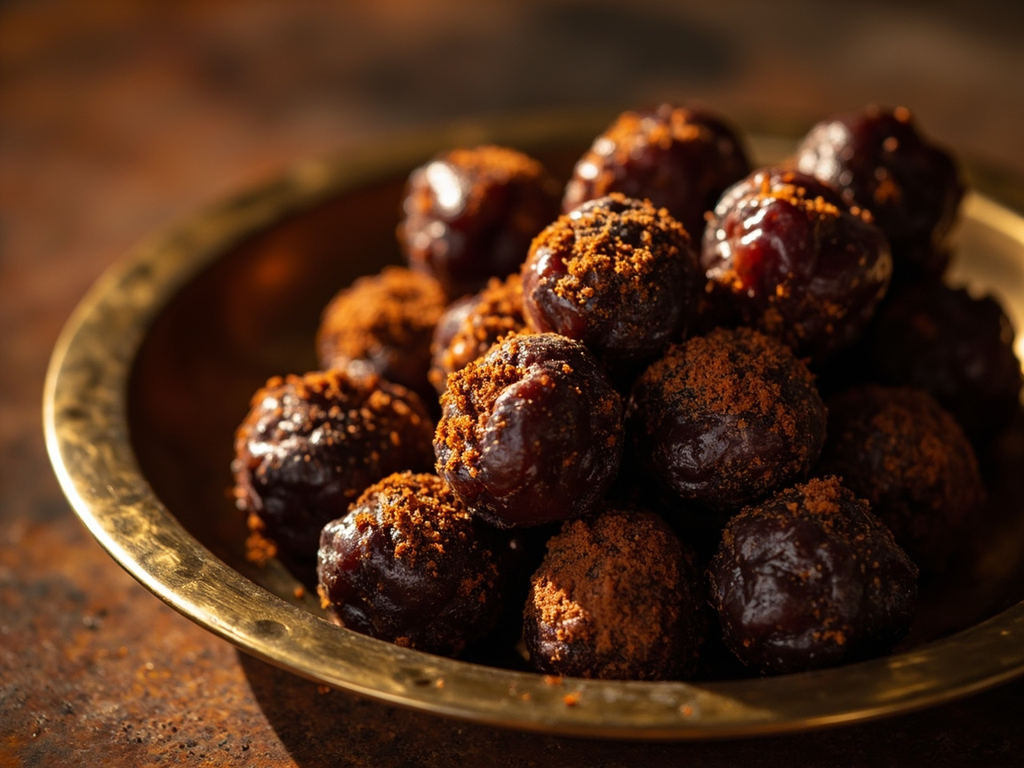
A dense, melt-in-the-mouth paste of pitted dates kneaded with clarified butter, breadcrumbs, and a little fresh cheese, rolled into small balls perfumed with cinnamon. Sweet, rich, comforting—the sweetness shared when death has struck.
See the date: I place it on the lips of the newborn child, and I find it again on the table of those who weep for the deceased—for the threshold of life and that of death are the same door, and I stand on both sides. In Baghdad, pious hands kneaded these dates with melted butter and crumbled bread, rolled them into balls under my gaze, and gave them to the poor in the name of the one I had taken. Taste this sweetness, mortal: it is offered so that my passing may be less bitter.
- •Ripe pitted dates — two large handfuls (sweet base of the threshold)
- •Clarified butter (samn) — a good piece, melted (fat binder)
- •Dried and crushed breadcrumbs (fatit) — a handful (texture)
- •Fresh curd cheese — a spoonful (softness)
- •Cinnamon — a pinch (flavor)
Date Hays of Passage
A dense, melt-in-the-mouth paste of pitted dates kneaded with clarified butter, breadcrumbs, and a little fresh cheese, rolled into small balls perfumed with cinnamon. Sweet, rich, comforting—the sweetness shared when death has struck.
Why this dish? The date accompanies passage in the Islamic tradition that Azrael embodies: it is placed in the mouth of the newborn, used to break the fast, and offered during death vigils. Hays, a sweet paste of dates kneaded with butter and breadcrumbs, was prepared in Baghdad for significant days—birth, marriage, and the memory of the dead.
See the date: I place it on the lips of the newborn child, and I find it again on the table of those who weep for the deceased—for the threshold of life and that of death are the same door, and I stand on both sides. In Baghdad, pious hands kneaded these dates with melted butter and crumbled bread, rolled them into balls under my gaze, and gave them to the poor in the name of the one I had taken. Taste this sweetness, mortal: it is offered so that my passing may be less bitter.
Ingredients (period version)
- Ripe pitted dates — two large handfuls (sweet base of the threshold)
- Clarified butter (samn) — a good piece, melted (fat binder)
- Dried and crushed breadcrumbs (fatit) — a handful (texture)
- Fresh curd cheese — a spoonful (softness)
- Cinnamon — a pinch (flavor)
Ingredients
- Medjool dates, pitted — 300 g (base)
- Clarified butter or ghee — 60 g, melted (binder)
- Fine toasted breadcrumbs — 80 g (texture)
- Ricotta or fresh cheese — 2 tbsp (softness)
- Ground cinnamon — 1/2 tsp (flavor)
Method
- Mash the pitted dates into a paste with a fork or pestle.
- Lightly toast the breadcrumbs in a dry pan.
- Knead the dates with the melted clarified butter, breadcrumbs, fresh cheese, and cinnamon until a smooth, pliable paste forms.
- Roll into small walnut-sized balls between your palms.
- Chill for half an hour to firm up, then serve at room temperature, optionally dusted with a veil of cinnamon.
How it was made : Hays appears in al-Warraq's Kitab al-Tabikh (Baghdad, 10th century), a collection of caliphal cuisine: dates kneaded with butter, breadcrumbs (fatit), and sometimes cheese or almonds. It was a dish for great occasions, including funerary commemorations, where distributing sweets as alms (sadaqa) in the name of the deceased was a common practice.
The contemporary twist : Rolled in toasted sesame seeds and lined up on a dark slate, these balls become an elegant, sober end-of-meal mignardise.
Sources : al-Warraq, Kitab al-Tabikh (Baghdad, 10th century) · Charles Perry (trans.), Annals of the Caliphs' Kitchens (2007) · Maxime Rodinson, Recherches sur les documents arabes relatifs à la cuisine (1949)
Azrael · Charactorium