 flip
flipAsh-baked grass seed damper
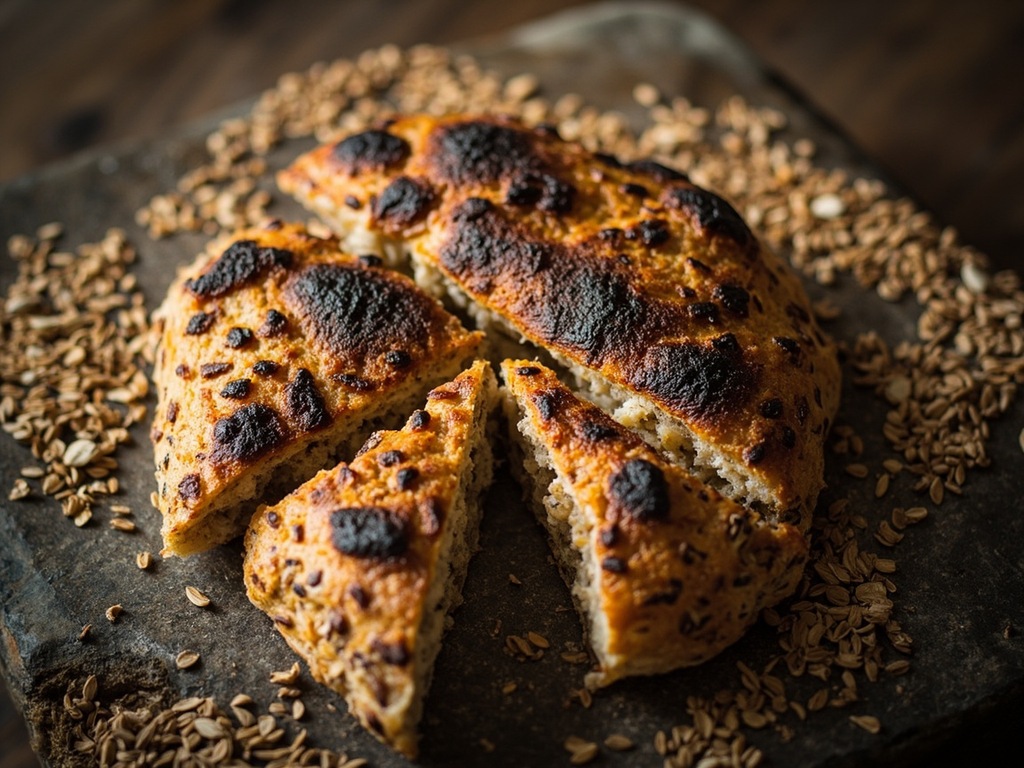
Ash-baked grass seed damper
Why this dish? Baiame instituted the Law that divides tasks: to women the gathering and the millstone. In his Kamilaroi and Wiradjuri country, wild grass seeds were harvested, ground on stone and baked into a dense damper — the daily bread born from the soil that the Father ordered.
A thick, rustic damper made from wild seed flour, baked under the ashes until it forms a dark crust and a soft, nutty heart. The nourishing daily bread, simple and filling.
Woman of my people, remember what I have established: the seed that I make grow in the plain is yours to harvest. You beat it, you winnow it in the wind, then you lay it on the hollow stone and grind it to flour. Mix it with a little water, lay the dough under the hot ash, and you will have the bread that holds the clan's belly all day — this is my Law, and it is good.
- •Native grass seeds (native millet, panic grass) — a well-filled basket (flour base)
- •Water — enough to bind (binder)
- •Ash and embers — the hearth (cooking)
Ash-baked grass seed damper
A thick, rustic damper made from wild seed flour, baked under the ashes until it forms a dark crust and a soft, nutty heart. The nourishing daily bread, simple and filling.
Why this dish? Baiame instituted the Law that divides tasks: to women the gathering and the millstone. In his Kamilaroi and Wiradjuri country, wild grass seeds were harvested, ground on stone and baked into a dense damper — the daily bread born from the soil that the Father ordered.
Woman of my people, remember what I have established: the seed that I make grow in the plain is yours to harvest. You beat it, you winnow it in the wind, then you lay it on the hollow stone and grind it to flour. Mix it with a little water, lay the dough under the hot ash, and you will have the bread that holds the clan's belly all day — this is my Law, and it is good.
Ingredients (period version)
- Native grass seeds (native millet, panic grass) — a well-filled basket (flour base)
- Water — enough to bind (binder)
- Ash and embers — the hearth (cooking)
Ingredients
- Ancient grain flour (rye, barley, buckwheat blend) — 250 g (accessible substitute for wild seeds)
- Ground flax or chia seeds — 2 tablespoons (echo of wild seeds)
- Warm water — approx. 150 ml (binder)
- Salt — 1 pinch (seasoning)
Method
- Mix the flours, ground seeds and salt in a bowl.
- Add warm water little by little and knead into a dense dough, neither sticky nor dry.
- Form a thick cake about 2 cm thick.
- Cook in a very hot cast-iron pan (or under a cloche, failing ash) for 6-8 minutes per side, until a dark crust forms.
- Let cool slightly, then break by hand to share.
How it was made : Native grass seeds (notably Panicum decompositum, native millet) were harvested, dried, winnowed and ground on sandstone millstones. The oldest seed-grinding stones known in the world come from Australia. A paste was formed with a little water and baked under ash or on a hot stone. It was women's work, central to the food economy of southeastern Australia.
The contemporary twist : Ancient seed damper served warm, split and drizzled with a little bush honey — to recall the sweetness of nectar-laden flowers.
Sources : Bruce Pascoe, Dark Emu (2014) · Beth Gott, ethnobotanical research on Aboriginal food plants · Isabel McBryde, archaeological work on Kamilaroi country
Baiame · Charactorium