 flip
flipHalvaitar (Toasted Flour Halva)
Halvaitar (Toasted Flour Halva)
Why this dish? Flour halva is a dish of celebration and funerary offering in the Central Asian Islamic world. Bibi Khanym, whose death shortly preceded Tamerlane's, is buried in the Shah-e-Zindeh funerary complex in Samarkand. Halvaitar is traditionally prepared for commemoration ceremonies and religious festivals — it would have accompanied the funerary rites at the very necropolis where she rests.
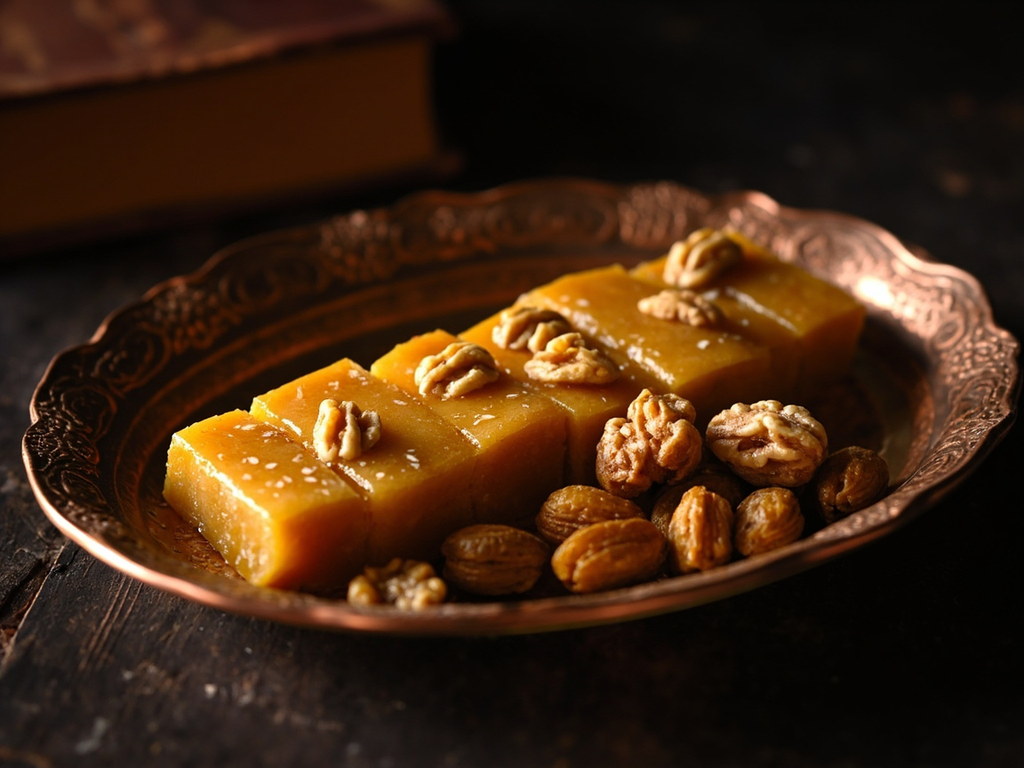
A dense and fragrant halva made from wheat flour slowly toasted in clarified butter, then moistened with a saffron and cardamom syrup. A solemn sweet served at commemorations and religious festivals.
Halvaitar, we prepare it to honor those who have left us and to welcome blessed days. In Samarkand, when visiting the tombs of Shah-e-Zindeh, we bring it on a tray covered with a white cloth. The flour must toast long in the butter, with patience, until it takes the color of amber — that is where the nutty fragrance is born. The saffron and cardamom, we received them from merchants coming from India, and their aroma sanctifies this simple dish.
- •Fine wheat flour — a good measure (base)
- •Clarified butter (roghan) — almost as much as the flour (fat)
- •Honey or raw cane sugar — a measure (sweetener)
- •Water — a little (syrup)
- •Saffron — a few threads (flavor and color)
- •Cardamom — a few crushed seeds (flavor)
- •Pistachios or almonds — a handful (garnish)
Halvaitar (Toasted Flour Halva)
A dense and fragrant halva made from wheat flour slowly toasted in clarified butter, then moistened with a saffron and cardamom syrup. A solemn sweet served at commemorations and religious festivals.
Why this dish? Flour halva is a dish of celebration and funerary offering in the Central Asian Islamic world. Bibi Khanym, whose death shortly preceded Tamerlane's, is buried in the Shah-e-Zindeh funerary complex in Samarkand. Halvaitar is traditionally prepared for commemoration ceremonies and religious festivals — it would have accompanied the funerary rites at the very necropolis where she rests.
Halvaitar, we prepare it to honor those who have left us and to welcome blessed days. In Samarkand, when visiting the tombs of Shah-e-Zindeh, we bring it on a tray covered with a white cloth. The flour must toast long in the butter, with patience, until it takes the color of amber — that is where the nutty fragrance is born. The saffron and cardamom, we received them from merchants coming from India, and their aroma sanctifies this simple dish.
Ingredients (period version)
- Fine wheat flour — a good measure (base)
- Clarified butter (roghan) — almost as much as the flour (fat)
- Honey or raw cane sugar — a measure (sweetener)
- Water — a little (syrup)
- Saffron — a few threads (flavor and color)
- Cardamom — a few crushed seeds (flavor)
- Pistachios or almonds — a handful (garnish)
Ingredients
- All-purpose flour — 200 g (base)
- Clarified butter (ghee) — 150 g (fat)
- Sugar — 150 g (syrup)
- Water — 200 ml (syrup)
- Saffron threads — a pinch (0.2 g) (flavor and color)
- Ground cardamom — ½ tsp (flavor)
- Unsalted pistachios, crushed — 30 g (garnish)
Method
- Prepare the syrup: heat the water with the sugar over medium heat until dissolved. Add the saffron and cardamom, infuse off the heat.
- In a large heavy-bottomed pan, melt the clarified butter over medium-low heat.
- Add the flour all at once and stir constantly with a wooden spatula. Cook for 20 to 25 minutes, stirring continuously, until the flour turns golden brown and emits a nutty fragrance. Do not burn.
- Remove from heat. Gradually pour in the hot syrup while stirring vigorously — beware of splatters. The mixture will thicken quickly.
- Return to low heat for 2 to 3 minutes, continuing to stir, until a smooth, homogenous paste forms that pulls away from the sides.
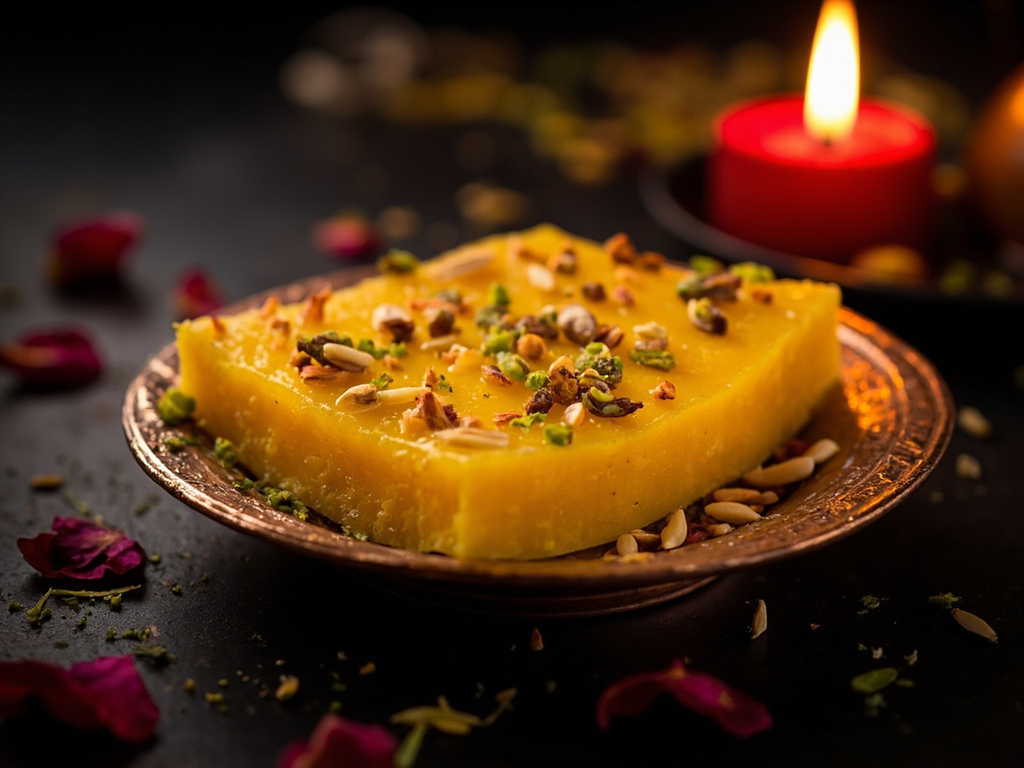
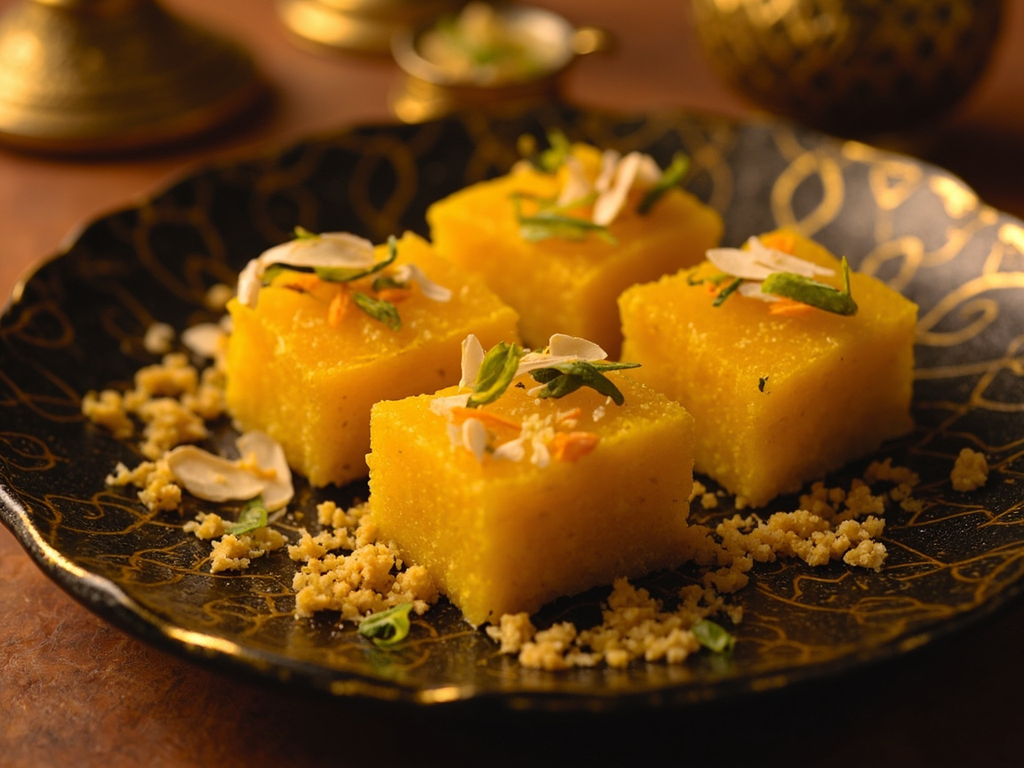
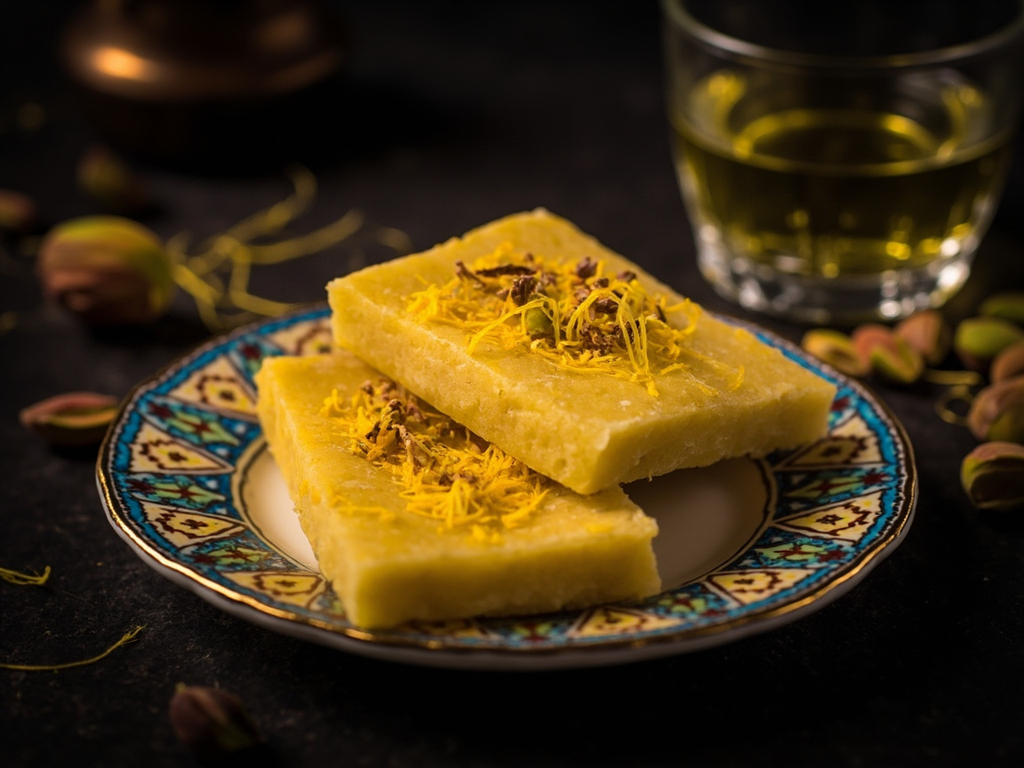
- Spread in an oiled dish to 2 cm thickness. Sprinkle with crushed pistachios, pressing lightly. Let cool slightly, then cut into diamonds.
How it was made : Flour halva is one of the oldest confections in the Islamic world, mentioned in Arabic culinary treatises as early as the 10th century (Kitab al-Tabikh by Ibn Sayyar al-Warraq, 940). In Central Asia, it is inseparable from funerary and religious ceremonies. Saffron arrived via the Silk Road through trade with India and Persia, while cardamom came from South India — both prestige spices signaling a court or ceremonial dish.
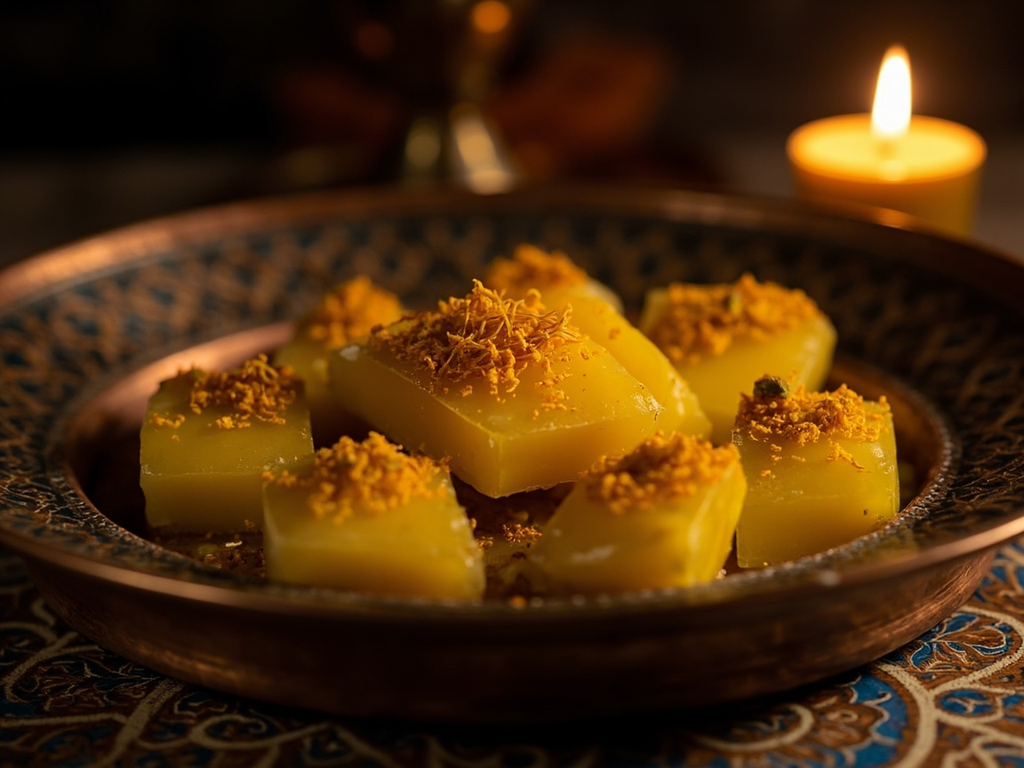
The contemporary twist : Cut into diamonds and arrange on a plate with a veil of pistachio powder, accompanied by Uzbek green tea — the diamonds evoke the geometric tile patterns of the Bibi-Khanym Mosque.
Sources : Al-Warraq, Ibn Sayyar. Kitab al-Tabikh (10th c.), trans. Nasrallah, Annals of the Caliph's Kitchens (2007) · Perry, Charles. A Baghdad Cookery Book (2005) · Mack, Glenn R. & Surina, Asele. Food Culture in Russia and Central Asia (2005)
Bibi Khanym · Charactorium