 flip
flipThe Bishop's Blue-Veined Cheese
The Bishop's Blue-Veined Cheese
Why this dish? Notker the Stammerer recounts a famous anecdote: hosted by a bishop on a fast day, Charles was served a blue-veined cheese. He first removed the mold; the bishop taught him that it was the best part. Charles tasted, relished it, and ordered that two cartloads be sent to him each year. This cheese literally entered his legend.
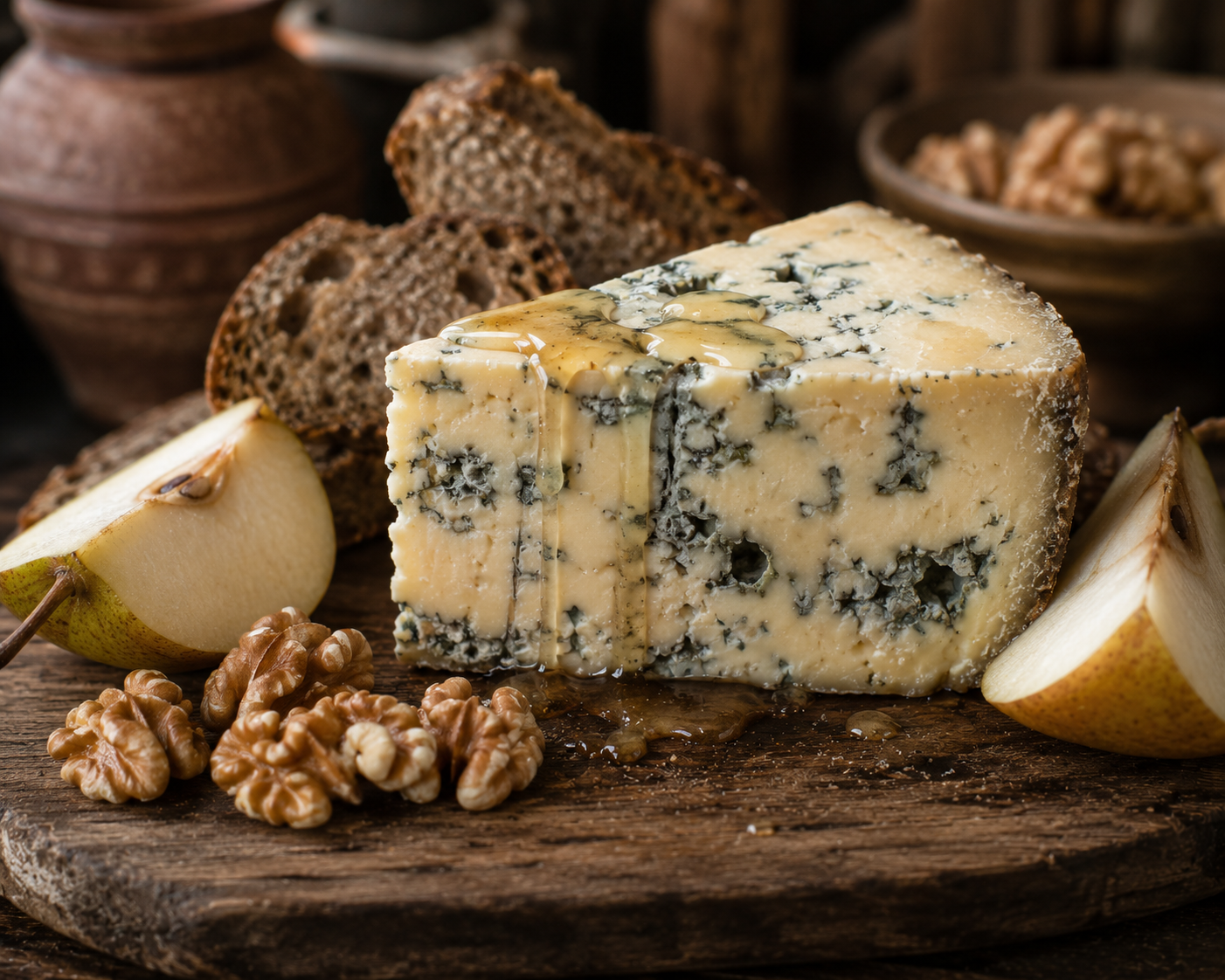
A whole-milk cheese aged until veined with blue, served with bread and walnuts—the preserved food that lasted through winter and, according to legend, won over the emperor himself.
Listen to this story, for I still laugh at it. One fast day, a bishop served me a cheese all veined with green; I scraped off the mold and threw it away, thinking I was doing right. He said to me: 'Lord, you are discarding the best!' I tasted, and by my faith, it was true—rich, pungent, savory as no other. I ordered that two cartloads be brought to me each year at Aachen. Learn, then, not to judge a dish by its appearance.
- •Blue-veined whole-milk cheese — one wheel (aged cheese, winter store)
- •Dark bread — as desired (accompaniment)
- •Walnuts — a bowl (estate accompaniment)
- •Honey — a drizzle (sweet contrast)
The Bishop's Blue-Veined Cheese
A whole-milk cheese aged until veined with blue, served with bread and walnuts—the preserved food that lasted through winter and, according to legend, won over the emperor himself.
Why this dish? Notker the Stammerer recounts a famous anecdote: hosted by a bishop on a fast day, Charles was served a blue-veined cheese. He first removed the mold; the bishop taught him that it was the best part. Charles tasted, relished it, and ordered that two cartloads be sent to him each year. This cheese literally entered his legend.
Listen to this story, for I still laugh at it. One fast day, a bishop served me a cheese all veined with green; I scraped off the mold and threw it away, thinking I was doing right. He said to me: 'Lord, you are discarding the best!' I tasted, and by my faith, it was true—rich, pungent, savory as no other. I ordered that two cartloads be brought to me each year at Aachen. Learn, then, not to judge a dish by its appearance.
Ingredients (period version)
- Blue-veined whole-milk cheese — one wheel (aged cheese, winter store)
- Dark bread — as desired (accompaniment)
- Walnuts — a bowl (estate accompaniment)
- Honey — a drizzle (sweet contrast)
Ingredients
- Blue-veined cheese (bleu, fourme, Roquefort) — 200 g (star of the board)
- Rye or country bread — a few slices (support)
- Walnut halves — 1 handful (crunch)
- Honey — 1 tbsp (sweet contrast)
- Fresh pears — 1, quartered (freshness (period fruit))
Method
- Take the cheese out 1 hour before serving to let it release its aromas.
- Lightly toast the bread slices.
- Arrange the cheese on a board, surrounded by walnuts and pear quarters.
- Drizzle a thread of honey over the cheese to soften the pungency.
- Serve as is, to share—never remove the blue, as Charlemagne learned!
How it was made : Before refrigeration, aging cheese was a way to preserve milk for months. Molds, long feared, turned out to be delicious: blues were born in damp cellars where the fungus developed naturally. Notker's anecdote is one of the earliest written testimonies of a taste for blue-veined cheese.
The contemporary twist : Present the cut cheese with a small slate reading 'Keep the blue—by order of the emperor': a direct nod to Notker's anecdote.
Sources : Notker the Stammerer (Monk of St. Gall), Gesta Karoli Magni, Book I (anecdote of the blue cheese)
Charlemagne · Charactorium