 flip
flipManjar blanco (Almond and Chicken Blancmange)
Manjar blanco (Almond and Chicken Blancmange)
Why this dish? When Columbus returned triumphant in 1493 and was received by the Catholic Monarchs in Barcelona, it was this type of court dish — white, sweet, spiced with cinnamon — that crowned the noble banquets. Manjar blanco was THE prestige dish of Renaissance Spain and Italy, a symbol of wealth through its costly almond and sugar.
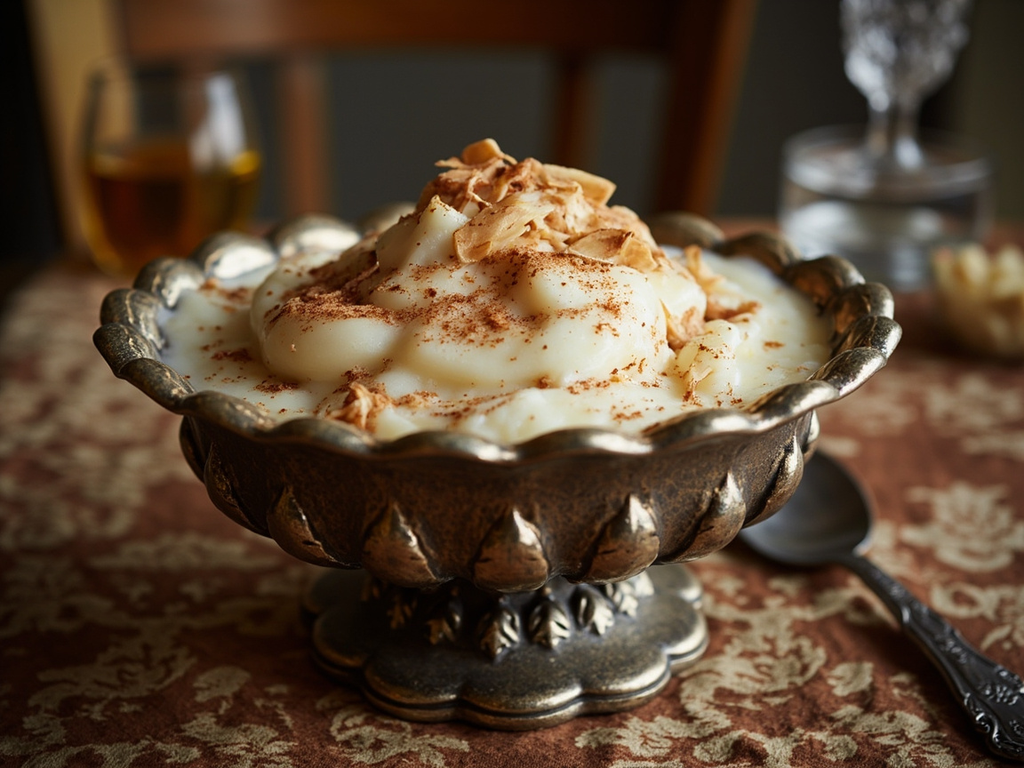
A creamy, delicate pure white cream made of shredded chicken breast, almond milk, pounded rice, and sugar, perfumed with rose water and dusted with cinnamon. Half-savory, half-sweet, surprising to today's palate, it is the pinnacle of refined medieval and Renaissance cuisine.
When Their Highnesses, King Ferdinand and Queen Isabella, did me the honor of receiving me at their table after my return from the Indies, they served this blancmange worthy of the greatest princes. See what a marvel: chicken flesh become soft as cream, whitened with almond milk, sweetened and perfumed with rose water, and crowned with that cinnamon of the East that I dreamed of fetching beyond the ocean. It is a dish of peace and glory, served only on blessed days. Taste it and you will understand why men cross the seas for such spices.
- •Cooked chicken breast — finely shredded (protein base)
- •Almond milk — abundant (liquid and binder)
- •Pounded rice (rice flour) — for thickening (binder)
- •Sugar — generous (sweetness)
- •Rose water — a dash (perfume)
- •Cinnamon — for dusting (signature spice)
Manjar blanco (Almond and Chicken Blancmange)
A creamy, delicate pure white cream made of shredded chicken breast, almond milk, pounded rice, and sugar, perfumed with rose water and dusted with cinnamon. Half-savory, half-sweet, surprising to today's palate, it is the pinnacle of refined medieval and Renaissance cuisine.
Why this dish? When Columbus returned triumphant in 1493 and was received by the Catholic Monarchs in Barcelona, it was this type of court dish — white, sweet, spiced with cinnamon — that crowned the noble banquets. Manjar blanco was THE prestige dish of Renaissance Spain and Italy, a symbol of wealth through its costly almond and sugar.
When Their Highnesses, King Ferdinand and Queen Isabella, did me the honor of receiving me at their table after my return from the Indies, they served this blancmange worthy of the greatest princes. See what a marvel: chicken flesh become soft as cream, whitened with almond milk, sweetened and perfumed with rose water, and crowned with that cinnamon of the East that I dreamed of fetching beyond the ocean. It is a dish of peace and glory, served only on blessed days. Taste it and you will understand why men cross the seas for such spices.
Ingredients (period version)
- Cooked chicken breast — finely shredded (protein base)
- Almond milk — abundant (liquid and binder)
- Pounded rice (rice flour) — for thickening (binder)
- Sugar — generous (sweetness)
- Rose water — a dash (perfume)
- Cinnamon — for dusting (signature spice)
Ingredients
- Poached chicken breast — 200 g (protein base)
- Unsweetened almond milk — 500 ml (liquid and binder)
- Rice flour — 40 g (binder)
- Sugar — 80 g (sweetness)
- Rose water — 1 tsp (perfume)
- Ground cinnamon — for dusting (signature spice)
- Toasted slivered almonds — 1 handful (decoration)
Method
- Poach the chicken breast, let it cool slightly, then shred as finely as possible (or briefly blend).
- Dissolve the rice flour in a little cold almond milk to avoid lumps.
- Gently heat the remaining almond milk with the sugar, add the dissolved rice flour, and stir until thickened.
- Stir in the shredded chicken and cook over low heat for 10 minutes, stirring, for a creamy, homogeneous texture.
- Off the heat, perfume with rose water and adjust the sugar.
- Spoon into small bowls, smooth the tops, dust with cinnamon, and decorate with toasted almonds. Serve warm or chilled.
How it was made : Manjar blanco (blancmange) appears in almost every major European culinary collection of the late Middle Ages and Renaissance. Almond, sugar, and Eastern spices made it an expensive dish, reserved for nobles and feast days. Over the centuries, the poultry disappeared and it became a simple sweet dessert — the direct ancestor of dessert blancmange.
The contemporary twist : Served in a glass, topped with a cinnamon stencil of a compass rose — the navigator's compass in the plate.
Sources : Ruperto de Nola, Libro de Cozina (c. 1520) · Maestro Martino, Libro de arte coquinaria (15th century)
Christopher Columbus · Charactorium