 flip
flipTravel Pumpernickel
Travel Pumpernickel
Why this dish? Clara spent her life touring Europe, eating frugally at inns or with hosts. Pumpernickel, a compact rye bread that keeps for weeks, was the ideal companion for long journeys by stagecoach and later by train.
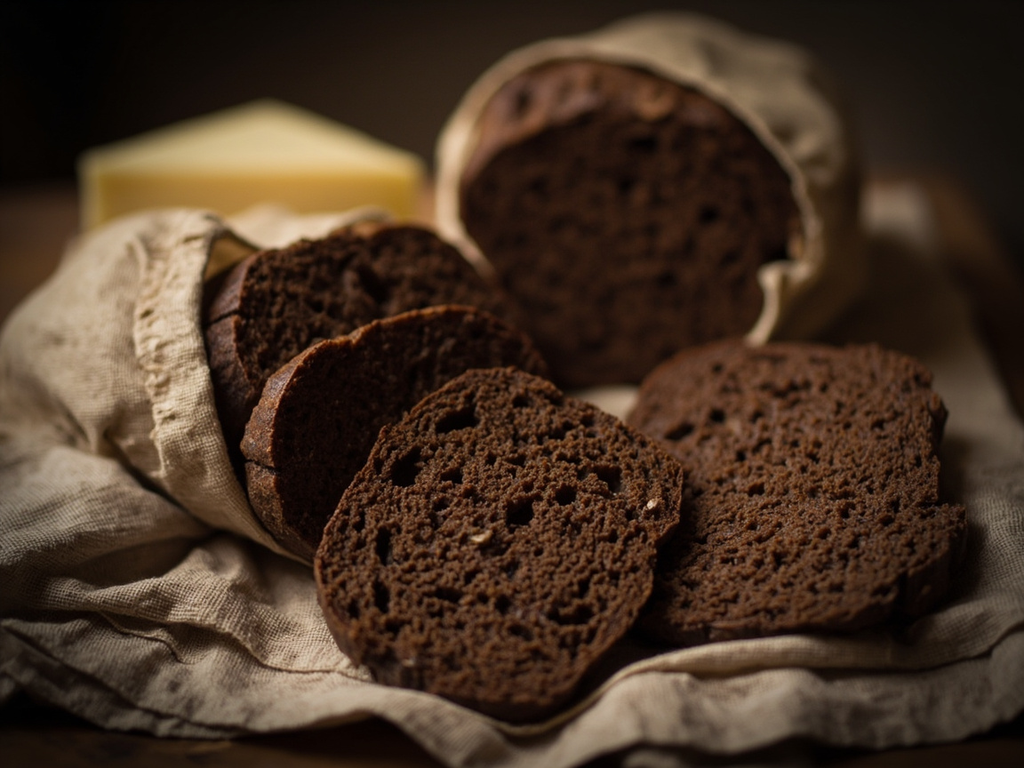
A very dense whole rye bread, baked long at low temperature, almost black and slightly sweet-sour, that keeps for days without going stale — perfect to take along with a piece of cheese and some lard.
You never know what you'll find at a country inn, so I always carry my pumpernickel wrapped in a cloth. This bread fears neither the road nor the passing days: the older it gets, the better it is. A thin slice, a bit of cheese, and I am satisfied between two towns without depending on anyone. Robert said it tasted of the earth — I find in it the taste of freedom.
- •Whole rye flour and cracked grains — a lot (base)
- •Rye sourdough — a little (fermentation, acidity)
- •Water — as needed (hydration)
- •Salt — a pinch (seasoning)
Travel Pumpernickel
A very dense whole rye bread, baked long at low temperature, almost black and slightly sweet-sour, that keeps for days without going stale — perfect to take along with a piece of cheese and some lard.
Why this dish? Clara spent her life touring Europe, eating frugally at inns or with hosts. Pumpernickel, a compact rye bread that keeps for weeks, was the ideal companion for long journeys by stagecoach and later by train.
You never know what you'll find at a country inn, so I always carry my pumpernickel wrapped in a cloth. This bread fears neither the road nor the passing days: the older it gets, the better it is. A thin slice, a bit of cheese, and I am satisfied between two towns without depending on anyone. Robert said it tasted of the earth — I find in it the taste of freedom.
Ingredients (period version)
- Whole rye flour and cracked grains — a lot (base)
- Rye sourdough — a little (fermentation, acidity)
- Water — as needed (hydration)
- Salt — a pinch (seasoning)
Ingredients
- Whole rye flour — 400 g (base)
- Cracked rye grains — 150 g (texture)
- Active rye sourdough — 150 g (fermentation)
- Warm water — 400 ml (hydration)
- Salt — 10 g (seasoning)
- Beet molasses (optional) — 1 tbsp (color, sweetness)
Method
- Soak the cracked rye grains the night before.
- Mix flour, grains, sourdough, water, and salt into a thick, sticky dough.
- Let ferment for 12 to 16 hours at room temperature.
- Pour into a lined and covered mold.
- Bake very long at low temperature (110-120 °C, 4 to 16 hours depending on tradition).
- Cool completely, wrap in a cloth: it keeps for several days.
How it was made : Pumpernickel, a Westphalian specialty, was baked for many hours at very low temperature, which caramelizes the rye sugars and gives it its dark color and characteristic flavor. Its density and natural acidity made it a long-lasting bread, ideal for travelers.
The contemporary twist : Sliced very thinly and served with salted butter and a radish, as a mineral amuse-bouche.
Clara Schumann · Charactorium