 flip
flipBroken Bread of the Agape and Fennel Olives
Broken Bread of the Agape and Fennel Olives
Why this dish? Clement, in his Epistle to the Corinthians, insists on harmony and order within the Christian community. The agape, this shared meal where bread was broken together, embodied that brotherhood. Bread and olives, simple and accessible to all, were its heart — inspired by this communal meal, not the Eucharistic rite itself.
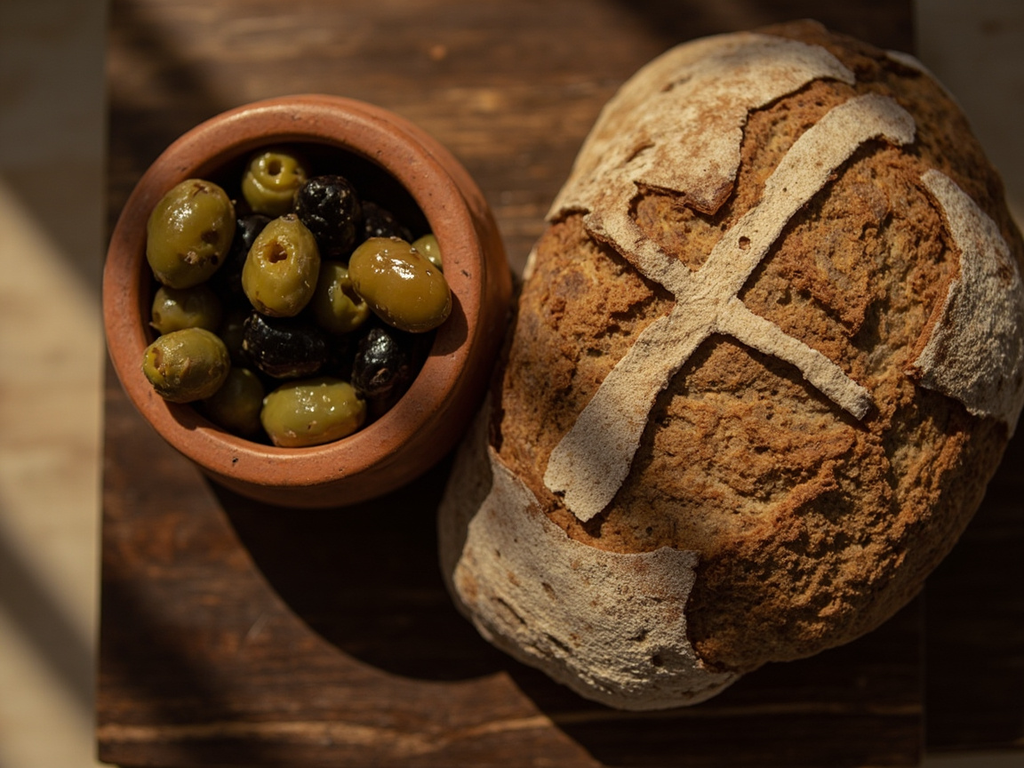
A round loaf of spelt and wheat, with a golden crust, served with olives marinated in wild fennel and oil. The bread that is broken and passed from hand to hand.
When the prayer ends, we gather, rich and poor alike, and I break the bread so that each may receive his share. Knead your dough with care, let it rise near the hearth for as long as it needs, for hurried bread is failed bread. See these olives perfumed with fennel: they come from the Trastevere market, and we eat them without shame while others feast. It is not abundance that gladdens the brother, but the table shared in peace.
- •Spelt and wheat flour — according to the number of guests (bread base)
- •Natural sourdough starter — a piece from the day before (fermentation)
- •Water — as needed for the dough (hydration)
- •Salt — a pinch (seasoning)
- •Green and black olives — a full bowl (accompaniment)
- •Wild fennel and olive oil — to flavor (marinade)
Broken Bread of the Agape and Fennel Olives
A round loaf of spelt and wheat, with a golden crust, served with olives marinated in wild fennel and oil. The bread that is broken and passed from hand to hand.
Why this dish? Clement, in his Epistle to the Corinthians, insists on harmony and order within the Christian community. The agape, this shared meal where bread was broken together, embodied that brotherhood. Bread and olives, simple and accessible to all, were its heart — inspired by this communal meal, not the Eucharistic rite itself.
When the prayer ends, we gather, rich and poor alike, and I break the bread so that each may receive his share. Knead your dough with care, let it rise near the hearth for as long as it needs, for hurried bread is failed bread. See these olives perfumed with fennel: they come from the Trastevere market, and we eat them without shame while others feast. It is not abundance that gladdens the brother, but the table shared in peace.
Ingredients (period version)
- Spelt and wheat flour — according to the number of guests (bread base)
- Natural sourdough starter — a piece from the day before (fermentation)
- Water — as needed for the dough (hydration)
- Salt — a pinch (seasoning)
- Green and black olives — a full bowl (accompaniment)
- Wild fennel and olive oil — to flavor (marinade)
Ingredients
- Spelt flour — 250 g (bread base)
- T80 wheat flour — 250 g (bread base)
- Active sourdough starter — 100 g (fermentation)
- Warm water — 320 ml (hydration)
- Salt — 9 g (seasoning)
- Mixed olives (green and black) — 250 g (accompaniment)
- Fennel seeds — 1 tsp (marinade flavor)
- Olive oil — 4 tbsp (marinade)
- Lemon zest — 1/2 (flavor (optional))
Method
- Mix the flours, starter, water, and salt; knead until a supple dough forms.
- Let rise for 3–4 hours at room temperature, with a few folds, until doubled.
- Shape into a ball, let rise for another hour, then score a cross on top.
- Bake at 230°C for 40 minutes with a pan of water in the oven for steam, until golden crusted.
- Marinate the olives with lightly crushed fennel seeds, oil, and zest; let flavor for a few hours.
- Serve the whole loaf, to be broken by hand, with the bowl of olives at the center of the table.
How it was made : Leavened bread, baked in communal ovens or bought from the pistor (baker), was Rome's central food. Olives, preserved in brine or marinated with herbs, accompanied every meal. Among the early Christians, the fraternal meal (agape) preceded or followed the celebration and materialized the equality desired within the community.
The contemporary twist : Present the bread on a rough wooden board with olives in a small earthenware bowl, and invite each person to break it with their hands rather than slicing — the gesture makes the sharing.
Sources : Clement of Rome, Epistle to the Corinthians · Apicius, De Re Coquinaria
Clement of Rome · Charactorium