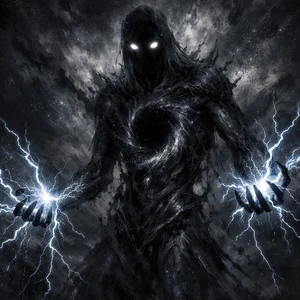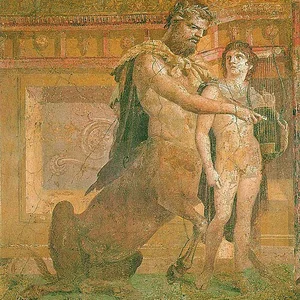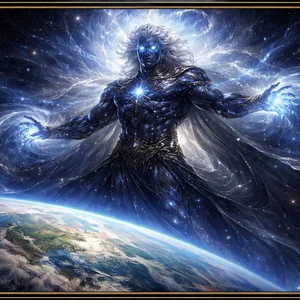

Titan of Greek mythology, son of Uranus and Gaia, Coeus personifies heavenly intelligence and the axis of the world. Husband of Phoebe, he is the father of Leto and Asteria, and thus the grandfather of Apollo and Artemis.
Coeus
Coeus
9 min read
Frequently asked questions
Key Facts
- Son of Uranus (the Sky) and Gaia (the Earth), he belongs to the first generation of Titans
- His name (Koios) is associated with questioning, inquiry, and intellect in the Greek tradition
- He personifies the northern axis of the sky and the celestial pole according to certain ancient sources
- Husband of his sister Phoebe, Titaness of the moon and prophecy
- Father of Leto, who would unite with Zeus to give birth to Apollo and Artemis
Works & Achievements
In Greek cosmology, Coeus embodies the power of the intellect that governs the movement of the stars. He represents the divine capacity to understand and order the cosmos from the celestial axis.
Through his marriage to Phoebe, Titaness of light and oracular wisdom, Coeus helps give rise to a divine lineage bound to prophecy and celestial beauty, culminating in Apollo and Artemis.
Coeus is the father of Leto, one of Zeus's consorts and mother of Apollo and Artemis. Through Leto, Coeus becomes the ancestor of two of the twelve Olympian gods — his most enduring cosmic legacy.
Coeus is also the father of Asteria, goddess of shooting stars and nocturnal astrology. Asteria transformed herself into an island (the future Delos) to escape Zeus, thereby becoming the birthplace of her own divine nephews.
Coeus presided over the celestial north pole, the fixed point around which the starry vault revolves. This cosmic function ensured the stability of the movement of the stars and the order of the universe before the rise of the Olympians.
Anecdotes
The name Coeus most likely derives from the ancient Greek κοῖος, meaning “who questions” or “intelligence.” This etymology is no coincidence: in archaic Greek cosmology, each Titan personifies a fundamental cosmic force. Coeus thus embodies the power of celestial intellect — the divine faculty of understanding the world from the summit of the cosmic axis.
Coeus is the husband of Phoebe, the Titaness of prophetic brilliance and oracular light. Their union produces two daughters: Leto, gentle and serene, and Asteria, mistress of shooting stars. These Titanic pairings are not random: they reflect cosmic complementarities, with intelligence joining prophetic light to give rise to celestial beauty.
After the Titanomachy — the terrible ten-year war between the Titans and the Olympian gods — Coeus was cast down into Tartarus along with his defeated brothers. According to the Latin author Hyginus, Coeus once attempted to escape from that subterranean abyss, but was driven back by Cerberus, the three-headed dog who guards the Underworld. This episode illustrates the permanence of the Titans' defeat at the hands of the Olympians.
Although Coeus himself is a shadowy figure in mythological narratives, his legacy is immense: his daughter Leto, after wandering in search of refuge while fleeing the wrath of a jealous Hera, finally gave birth on the floating island of Delos. There she brought into the world two of the most venerated gods of the Greek pantheon: Apollo, god of the sun and the arts, and Artemis, goddess of the hunt and the moon. Coeus is therefore the grandfather of two major deities.
In the cosmology of the Titans, Coeus was associated with the north celestial pole — the invisible axis around which the starry sky appears to revolve. This connection with the axis mundi makes him a being linked to cosmic order and the stability of the universe, a role the Olympians would strip from him after their victory, confining him to the darkness of Tartarus.
Primary Sources
Uranus first begot the glorious Titans [...] Coeus, Crius, Hyperion, and Iapetus, Theia, Rhea, Themis, and Mnemosyne, golden-crowned Phoebe, and lovely Tethys.
Phoebe came to the longed-for bed of Coeus; and having conceived, the goddess gave birth to much-loved Leto of the dark garment, always gentle, gentle with men and the immortal gods.
Coeus attempted to escape from Tartarus but was driven back by Cerberus, who guarded the gates of the Underworld.
Leto wandered from land to land, seeking a place where her son Apollo might be born; no region dared receive her, fearing the wrath of Hera.
The Titans are: Oceanus, Coeus, Hyperion, Crius, Iapetus, and the youngest of all, Cronus; and the Titanesses: Tethys, Rhea, Themis, Mnemosyne, Phoebe, Dione, and Theia.
Key Places
A subterranean abyss located beneath the realm of the dead (Hades), the eternal prison of the defeated Titans, including Coeus. According to Hesiod, it would take a bronze anvil nine days and nine nights to fall from the sky down to Tartarus.
The dwelling of the victorious Olympian gods. It was from this summit that Zeus hurled the Titans into Tartarus following his victory in the Titanomachy, claiming the cosmic throne that Coeus and his brothers had held.
An island in the Cyclades where Leto, daughter of Coeus, gave birth to Apollo and Artemis after wandering without finding refuge. Delos became one of the most sacred sanctuaries in the Greek world, a pilgrimage site dedicated to Apollo.
The great oracular sanctuary of Apollo, grandson of Coeus. The gift of prophecy that defined the lineage of Coeus and Phoebe was passed down to Apollo, whose oracle at Delphi was the most celebrated in the ancient world.
An oracle and sanctuary of Zeus in Epirus, one of the oldest sacred sites in Greece. The prophetic tradition embodied by Coeus and Phoebe lives on in these oracular centers, where the gods revealed their will to mortals.
Typical Objects

Coeus is associated with the north pole of the celestial vault, the invisible axis around which the stars appear to rotate. This axis symbolizes the cosmic order and universal stability that the Titan embodies.

Associated with his wife Phoebe and their descendants, the torch symbolizes the transmission of oracular light that Coeus helped generate through his union with the Titaness of prophecy.

After the Titanomachy, Coeus and the defeated Titans were bound in the depths of Tartarus. These chains of indestructible celestial metal symbolize the final subjugation of the ancient cosmic powers.

This instrument representing the celestial vault with its rings and axis is the closest emblem of Coeus's cosmic role. It illustrates the axis of the world around which the celestial spheres are arranged.

In Titan iconography, Coeus could be depicted adorned with stellar attributes evoking his mastery of the circumpolar axis, where the stars never set.

An emblematic object of the Titan generation, the adamantine sickle was used to overthrow Uranus. It symbolizes the overturning of divine generations in which Coeus took part as a first-generation Titan.
School Curriculum
Vocabulary & Tags
Key Vocabulary
Daily Life
Morning
In the archaic Greek imagination, Coeus and the Titans began their day in the ethereal regions between sky and earth. The Titan of celestial intelligence would contemplate the movement of the stars at dawn, watching over the axis around which the heavens turned. The Greek rhapsodes who sang of primordial tales imagined these beings as immense and majestic powers, far removed from human affairs.
Afternoon
During the reign of the Titans, Coeus held authority over the sphere of intellect and celestial prophecy alongside his wife Phoebe. Together, they deliberated on the cosmic balances that maintained the order of the world. In Greek tradition, these Titan unions were not merely marital but also functional: two complementary cosmic principles working toward the harmony of the universe.
Evening
In the evening, Coeus and Phoebe presided over the appearance of the stars and the revelation of nocturnal omens. The night was especially associated with their offspring — Asteria of shooting stars and Leto of the starlit night. After the Titanomachy, their "eternal evening" became Tartarus, where the defeated Titans remain plunged in darkness, according to Hesiod.
Food
Greek gods and Titans fed on ambrosia, the divine food that granted immortality, and drank nectar, the celestial drink. These divine nourishments were reserved for immortal beings and symbolized their superior nature compared to mortals. No ancient text specifies the particular food of the Titans imprisoned in Tartarus, but tradition imagines them as sharing in this divine and incorruptible nature.
Clothing
In ancient Greek representations, the Titans were imagined wearing draped garments similar to those of the Olympian gods — a linen or wool *chiton*, an *himation* thrown over the shoulder — but of gigantic proportions, reflecting their nature as primordial forces. Coeus could be depicted with celestial attributes: a crown of constellations or a star-studded cloak evoking his mastery of the cosmic axis.
Housing
Before the Titanomachy, the Titans dwelled in the ethereal regions that Zeus would claim to make his Olympus. Coeus, Titan of the celestial axis, was associated with the circumpolar regions, where the stars never set. After his defeat, his "dwelling" became Tartarus, described by Hesiod as surrounded by bronze walls and guarded by a triple night.
Historical Timeline
Period Vocabulary
Liens externes & ressources
Références
Œuvres
Personnification de l'intelligence céleste
Temps mythique
Union avec Phoibé et fondation d'une lignée prophétique
Règne des Titans
Paternité de Léto
Temps mythique
Paternité d'Astéria
Temps mythique
Gouvernance de l'axe circumpolaire
Règne des Titans