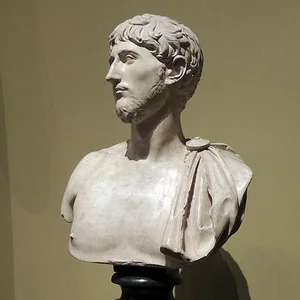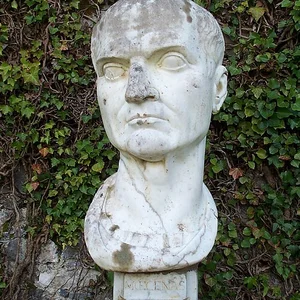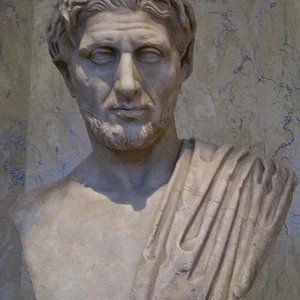

Demetrius of Phalerum was an Athenian philosopher and statesman, a disciple of Aristotle and the Lyceum. As governor of Athens on behalf of Macedonia from 317 to 307 BC, he later took refuge in Alexandria, where he advised Ptolemy I and helped found the Library and the Museum.
Demetrius of Phalerum(349 av. J.-C. — 282 av. J.-C.)
Demetrius of Phalerum
Athènes
6 min read
Frequently asked questions
Key Facts
- Born around 350 BC in Phalerum, the port of Athens; died around 280 BC in Egypt
- Governed Athens from 317 to 307 BC under the protection of Cassander of Macedonia
- Driven from power in 307 BC by Demetrius Poliorcetes, he went into exile
- Took refuge at the court of Ptolemy I in Alexandria, where he became an advisor
- Played a decisive role in the founding of the Library and the Museum of Alexandria
Works & Achievements
Administration of the city with sumptuary laws and magistrates in charge of public morals, blending moral philosophy with political action.
A count of the Athenian population (citizens, metics, slaves), a precious demographic record cited by ancient authors.
As an advisor to Ptolemy I, he worked to gather the books of the world and to organize the great center of knowledge.
A work of history and chronology recording the annual magistrates, useful for dating Greek events.
Writings on the art of oratory that extend Aristotelian teaching; his name was associated with a famous treatise “On Style.”
He is credited with one of the first gatherings of Aesop's fables into a collection, helping their transmission in writing.
Numerous treatises, now lost, of which Diogenes Laërtius draws up a long list, on politics, ethics, and laws.
Anecdotes
Demetrius of Phalerum governed Athens for ten years on behalf of Macedonia. The flattering Athenians erected an extraordinary number of statues in his honor — ancient tradition speaks of 360, one for each day of the year. But when he fell from grace in 307 BC, the crowd toppled almost all of them in a single night.
According to an anecdote reported by Diogenes Laertius, some of his fallen statues were supposedly melted down to be turned into chamber pots, so brutal and humiliating was the reversal of public opinion against him.
Having taken refuge in Alexandria, Demetrius advised King Ptolemy I and played a key role in creating the great Library and the Museum. It is said that he dreamed of gathering all the books in the world in a single place, laying the foundations of what would become the greatest center of learning in antiquity.
A disciple of Aristotle at the Lyceum, Demetrius was one of the few philosophers to actually wield political power. In Athens he established magistrates tasked with overseeing women and curbing extravagance at funerals and banquets, blending moral philosophy with sumptuary laws.
His downfall was as cruel as his death: according to Diogenes Laertius, having become a sidelined adviser at Ptolemy's court, he is said to have died from the bite of an asp, perhaps in disgrace, far from the Athens he had once governed.
Primary Sources
The Athenians set up three hundred and sixty statues of him, most of them on horseback or mounted on chariots; and it took no more than three hundred days to erect them, such was the haste.
Demetrius of Phalerum, having governed the city, did not overthrow the democracy but set it right.
Demetrius of Phalerum fled to Thebes when Demetrius Poliorcetes marched on Athens and restored its freedom.
Demetrius of Phalerum, put in charge of the king's library, received large sums to gather, as far as possible, all the books in the world.
Key Places
Ancient port of Athens and birthplace of Demetrius, from which he takes his surname “of Phalerum”.
School founded by Aristotle where Demetrius was trained in Peripatetic philosophy.
City that he governed for ten years on behalf of Macedonia, at the heart of political and cultural life.
City where Demetrius took refuge after the capture of Athens by Demetrius Poliorcetes in 307 BC.
Capital of the Ptolemies where he advised Ptolemy I and contributed to the founding of the Library and the Museum.
Great center of Hellenistic learning in whose creation Demetrius played a decisive part.
Typical Objects

A rolled writing surface on which texts were copied; the thousands of scrolls gathered together formed the heart of the Library of Alexandria.

A small board coated with wax on which notes were scratched with a pointed stylus, then erased with its flat end.

The Athenians raised hundreds of them in honor of Demetrius, then tore them down at his fall — a symbol of the fragility of public favor.

A large woolen cloak draped over the shoulder, the typical garment of Greek citizens and philosophers.

A small engraved seal used to authenticate decrees and official documents during his governance of Athens.

A water clock used in Greek courts and schools to measure speaking time and structure study.
School Curriculum
Vocabulary & Tags
Key Vocabulary
Daily Life
Morning
During his time in government, Demetrius began the day early by receiving citizens and officials, reading decrees and reports unrolled on scrolls. As a philosopher trained at the Lyceum, he also devoted a moment to reflection and to reading the texts of Aristotle.
Afternoon
The afternoon was spent at the Agora or in the public buildings, dispensing justice, overseeing the enforcement of the laws, and conversing with other learned men. In Alexandria, these hours were taken up with advising the king and organizing the collection of books for the Library.
Evening
In the evening, he often took part in banquets (symposia) where wine diluted with water mingled with music and philosophical conversation. Demetrius, renowned for his taste for luxury despite his austere laws, enjoyed these moments of exchange among cultivated men.
Food
His diet rested on the Mediterranean triad: barley or wheat bread, olive oil, and wine. To these were added fish, vegetables, cheeses, figs, and honey, with meat remaining reserved for festivals and sacrifices.
Clothing
He wore the tunic (chiton) of linen or wool, covered by the large draped cloak (himation) that marked out the citizen and the philosopher. Leather sandals completed the outfit, and it is said that he took care of his appearance, perfuming himself and dyeing his hair.
Housing
Demetrius lived in the house of a well-to-do citizen, arranged around an inner courtyard, with reception rooms for banquets. In Alexandria, he lived among the entourage of the Ptolemaic royal court, close to the palace and the Museum.
Historical Timeline
Period Vocabulary
Liens externes & ressources
Références
Œuvres
Gouvernement d'Athènes (lois et réformes)
317-307 av. J.-C.
Recensement de l'Attique
vers 317-307 av. J.-C.
Contribution à la fondation de la Bibliothèque d'Alexandrie
vers 295 av. J.-C.
Liste des archontes d'Athènes
fin du IVe siècle av. J.-C.
Sur la rhétorique / traités de style
fin du IVe - début du IIIe siècle av. J.-C.
Recueils de fables et d'apophtegmes
fin du IVe siècle av. J.-C.
Écrits philosophiques et politiques (péripatéticiens)
fin du IVe - début du IIIe siècle av. J.-C.