 flip
flipMillet porridge and mallow potage with fermented soybeans (粟飯葵羹)
Millet porridge and mallow potage with fermented soybeans (粟飯葵羹)
Why this dish? Deng Sui's table was said to be exemplarily frugal: millet, seasonal vegetables, little meat. During the famines that struck her reign, she imposed even more meager meals on the entire court, refusing to feast while the people suffered. This bowl of millet and mallow, the leaf-vegetable king of the Han, is the very image of that regent's table.
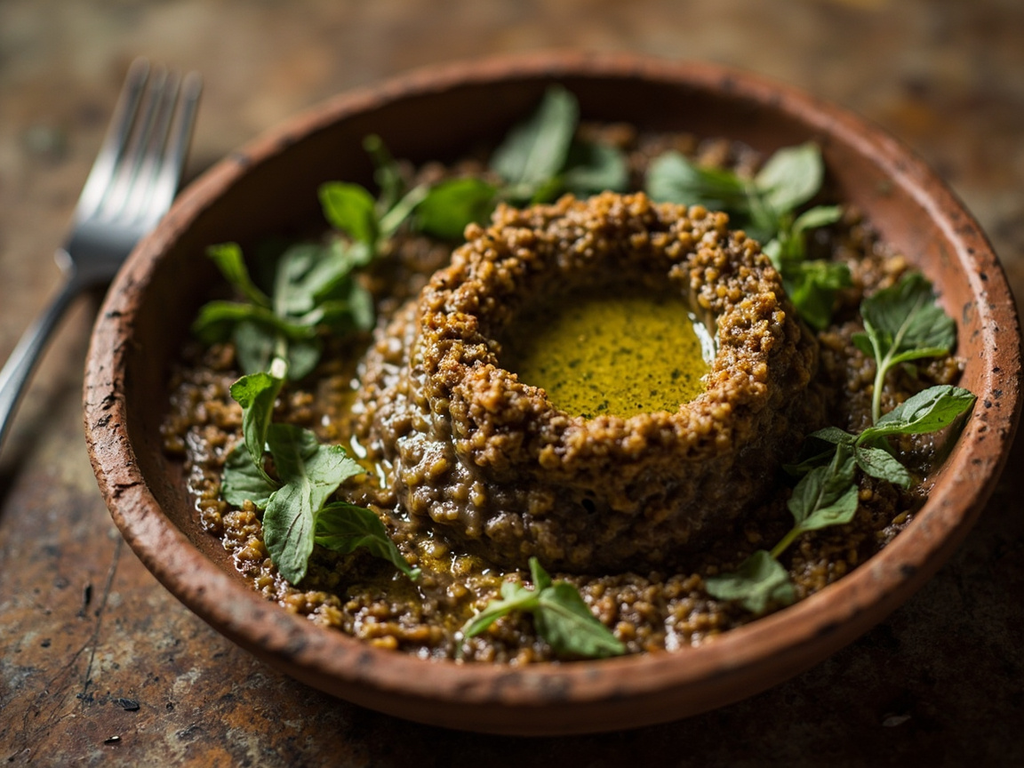
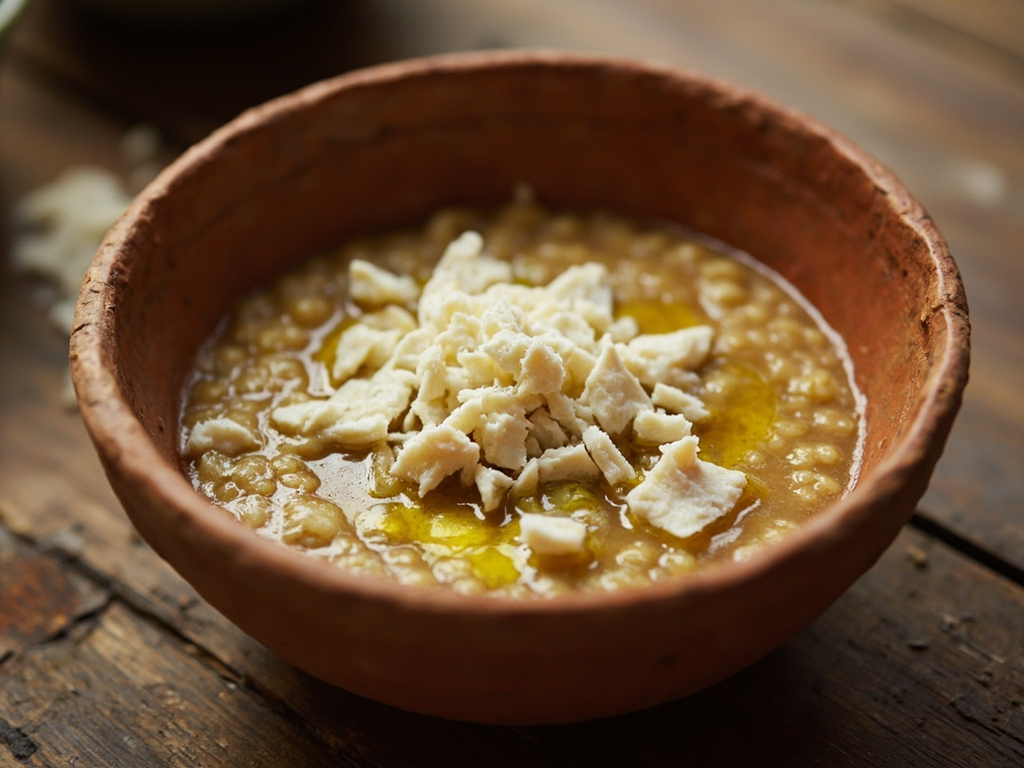
A bowl of steamed yellow millet, accompanied by a creamy mallow potage (the most consumed leafy green of ancient China), thickened and flavored by a handful of fermented soybeans. Simple, nourishing, deeply rooted in Han daily life.
I wanted my table to be the mirror of my governance. When drought emptied the granaries and officials came to announce famine, I had the meats removed and kept only millet and mallow from the garden. A ruler who feasts while his people hunger is no longer worthy of the Mandate; this I repeated to the palace ladies. Taste this broth: it is a small thing, yet it is enough for those who know that measure is a virtue.
- •Hulled millet (粟) — one bowl per diner (base grain, the fàn)
- •Mallow leaves (葵) — a large handful per bowl (potage vegetable)
- •Fermented black soybeans (豉) — a small handful (umami and salty seasoning)
- •Scallion (葱) — a few sprigs (aromatic)
- •Salt — to taste (seasoning)
Millet porridge and mallow potage with fermented soybeans (粟飯葵羹)
A bowl of steamed yellow millet, accompanied by a creamy mallow potage (the most consumed leafy green of ancient China), thickened and flavored by a handful of fermented soybeans. Simple, nourishing, deeply rooted in Han daily life.
Why this dish? Deng Sui's table was said to be exemplarily frugal: millet, seasonal vegetables, little meat. During the famines that struck her reign, she imposed even more meager meals on the entire court, refusing to feast while the people suffered. This bowl of millet and mallow, the leaf-vegetable king of the Han, is the very image of that regent's table.
I wanted my table to be the mirror of my governance. When drought emptied the granaries and officials came to announce famine, I had the meats removed and kept only millet and mallow from the garden. A ruler who feasts while his people hunger is no longer worthy of the Mandate; this I repeated to the palace ladies. Taste this broth: it is a small thing, yet it is enough for those who know that measure is a virtue.
Ingredients (period version)
- Hulled millet (粟) — one bowl per diner (base grain, the fàn)
- Mallow leaves (葵) — a large handful per bowl (potage vegetable)
- Fermented black soybeans (豉) — a small handful (umami and salty seasoning)
- Scallion (葱) — a few sprigs (aromatic)
- Salt — to taste (seasoning)
Ingredients
- Golden millet — 200 g (base grain)
- Spinach or jute mallow (Jew's mallow) if mallow unavailable — 300 g (potage vegetable)
- Dòuchǐ (fermented black soybeans, from Asian grocery) — 2 tbsp (umami and salt)
- Scallion — 2 stalks (aromatic)
- Water — 1.2 L (potage base)
- Salt — to taste (adjustment)
Method
- Rinse the millet, then steam it (or boil with 2 parts water to 1 part millet) until tender and fluffy. Keep warm.
- Rinse the fermented soybeans and roughly crush them with a knife to release their aroma.
- Bring the water to a simmer, add the dòuchǐ, and let infuse for 5 minutes to flavor the broth.
- Add the washed and roughly chopped greens, cook 3–4 minutes until wilted.
- Season sparingly with salt (the fermented soybeans are already salty), sprinkle with sliced scallion.
- Serve the bowl of millet alongside the potage, letting each diner mix them as they wish.
How it was made : Millet (粟/稷) was the dominant grain of northern China long before rice, steamed in bamboo baskets or boiled. Mallow (葵) was, up to the Chinese Middle Ages, the most cultivated leafy green, before being supplanted by cabbage. Fermented soybeans (豉), found in sealed jars at the Han site of Mawangdui, were the basic seasoning for all classes.
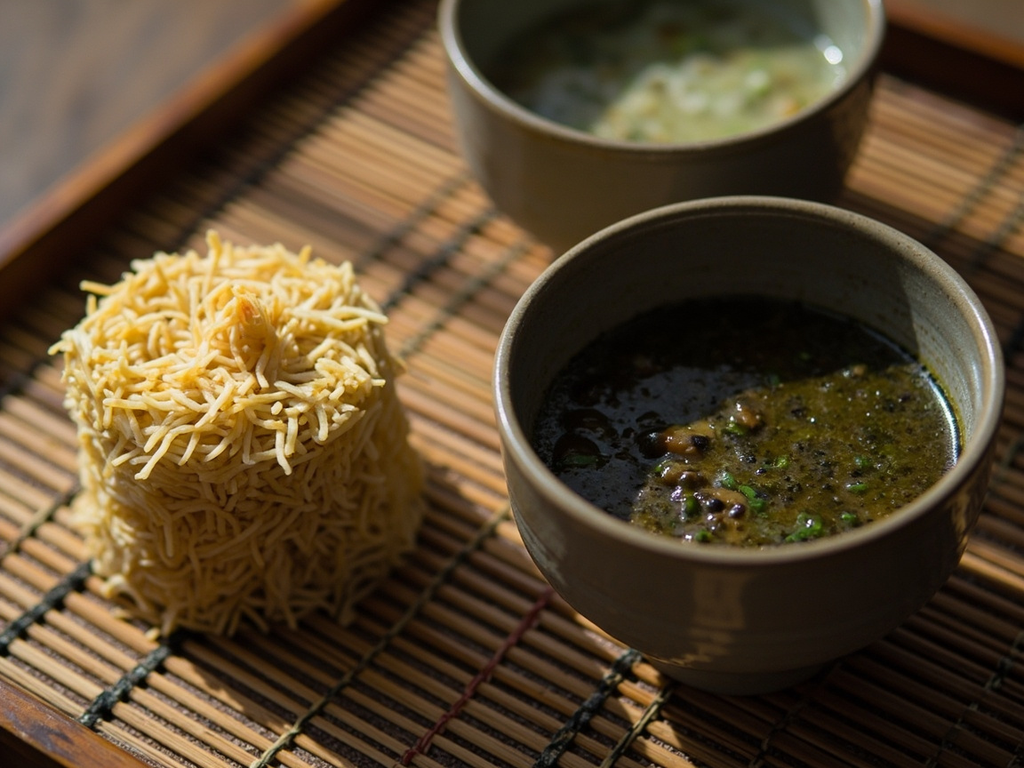
The contemporary twist : Serve the millet pressed into a small bowl and inverted into a dome at the center of the plate, with the green potage poured around it: Han frugality revisited in a minimalist presentation.
Sources : H. T. Huang, Science and Civilisation in China, vol. 6 part 5 : Fermentations and Food Science, Cambridge University Press, 2000 · Découvertes alimentaires du site Han de Mawangdui (馬王堆), Changsha · Françoise Sabban, « Histoire de l'alimentation en Chine », EHESS
Deng Sui · Charactorium