 flip
flipLentil pottage with onion and cumin
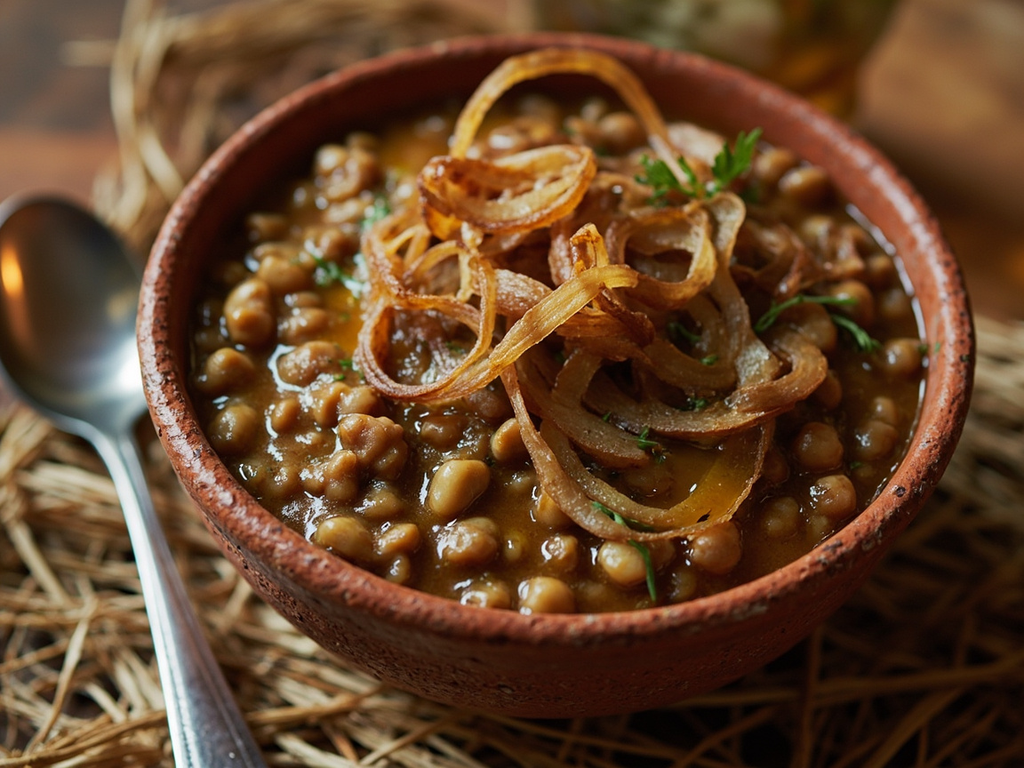
Lentil pottage with onion and cumin
Why this dish? Lentils, onions, and leeks fed the thousands of workers and scribes at the Step Pyramid construction site of Saqqarah every day. This humble, filling dish is exactly what made its way, richer and slow-cooked, to Djoser's table between two loaves of emmer bread.
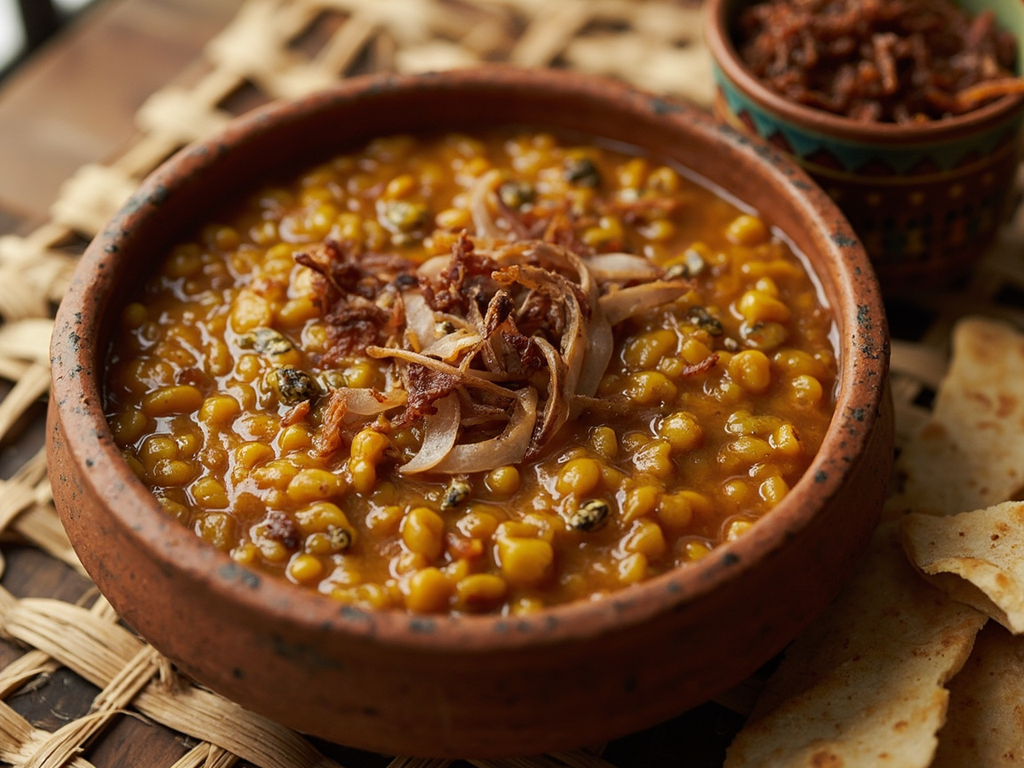
A thick stew of soft lentils, flavored with golden onion, coriander, and cumin, bound with a drizzle of oil and lifted with a touch of vinegar. Eaten by dipping emmer flatbread into it, like an edible spoon.
I, Netjerikhet, whom you call Djoser, living Horus of the Two Lands, tell you this: a king builds in stone, but a people stands firm on lentils. At the Saqqarah construction site, I had the same mash poured for my builders as graces my table, enhanced with onion and that grain of cumin that warms the belly. Dip the emmer bread into it, as we have done since the time of the ancestors, and give thanks to Ra who makes the harvest rise.
- •Lentils — a good measure (nourishing base)
- •Onions and leeks of the Nile — as much as you like (aromatic foundation)
- •Coriander and cumin seeds — a crushed pinch (flavor)
- •Oil (linseed or moringa) — a drizzle (binder and fat)
- •Salt — to taste (seasoning)
Lentil pottage with onion and cumin
A thick stew of soft lentils, flavored with golden onion, coriander, and cumin, bound with a drizzle of oil and lifted with a touch of vinegar. Eaten by dipping emmer flatbread into it, like an edible spoon.
Why this dish? Lentils, onions, and leeks fed the thousands of workers and scribes at the Step Pyramid construction site of Saqqarah every day. This humble, filling dish is exactly what made its way, richer and slow-cooked, to Djoser's table between two loaves of emmer bread.
I, Netjerikhet, whom you call Djoser, living Horus of the Two Lands, tell you this: a king builds in stone, but a people stands firm on lentils. At the Saqqarah construction site, I had the same mash poured for my builders as graces my table, enhanced with onion and that grain of cumin that warms the belly. Dip the emmer bread into it, as we have done since the time of the ancestors, and give thanks to Ra who makes the harvest rise.
Ingredients (period version)
- Lentils — a good measure (nourishing base)
- Onions and leeks of the Nile — as much as you like (aromatic foundation)
- Coriander and cumin seeds — a crushed pinch (flavor)
- Oil (linseed or moringa) — a drizzle (binder and fat)
- Salt — to taste (seasoning)
Ingredients
- Green or brown lentils — 250 g (base)
- Onion — 2 large (aromatic foundation)
- Leek — 1 white part (vegetable sweetness)
- Ground coriander seeds — 1 tsp (flavor)
- Ground cumin — 1 tsp (flavor)
- Olive oil (or linseed oil) — 3 tbsp (fat)
- Wine vinegar — 1 tsp (acidic touch)
- Salt — to taste (seasoning)
Method
- Finely chop onions and leek, gently sweat them in oil until golden.
- Add coriander and cumin, let them sizzle for a few seconds to release the aromas.
- Pour in the rinsed lentils and cover with water to a depth of three fingers.
- Simmer for 35 to 40 minutes, adding water if needed, until a thick purée forms.
- Season with salt at the end, lightly mash with a spoon, add the vinegar and a drizzle of raw oil before serving.
How it was made : Without tomato or chili (unknown before 1492), the Egyptian stew drew all its depth from alliums, aromatic seeds, and long simmering over embers in a clay pot. Vinegar, a natural by-product of wine and beer, provided acidity.
The contemporary twist : Serve the purée in a small bowl surrounded by flatbread cut into triangles like "rays" — a nod to the pyramid's steps.
Sources : Pierre Tallet, Histoire de la cuisine et de la gastronomie égyptiennes (PUF) · Hilary Wilson, Egyptian Food and Drink (Shire Egyptology)
Djoser · Charactorium