 flip
flipBhoger khichuri — festive khichuri
Bhoger khichuri — festive khichuri
Why this dish? The bhog khichuri is THE festive dish of Durga Puja: cooked in a huge pot in the temple courtyard, first offered to the goddess then distributed to hundreds of devotees sitting together. It is the dish that transforms the offering into a community meal around Durga.
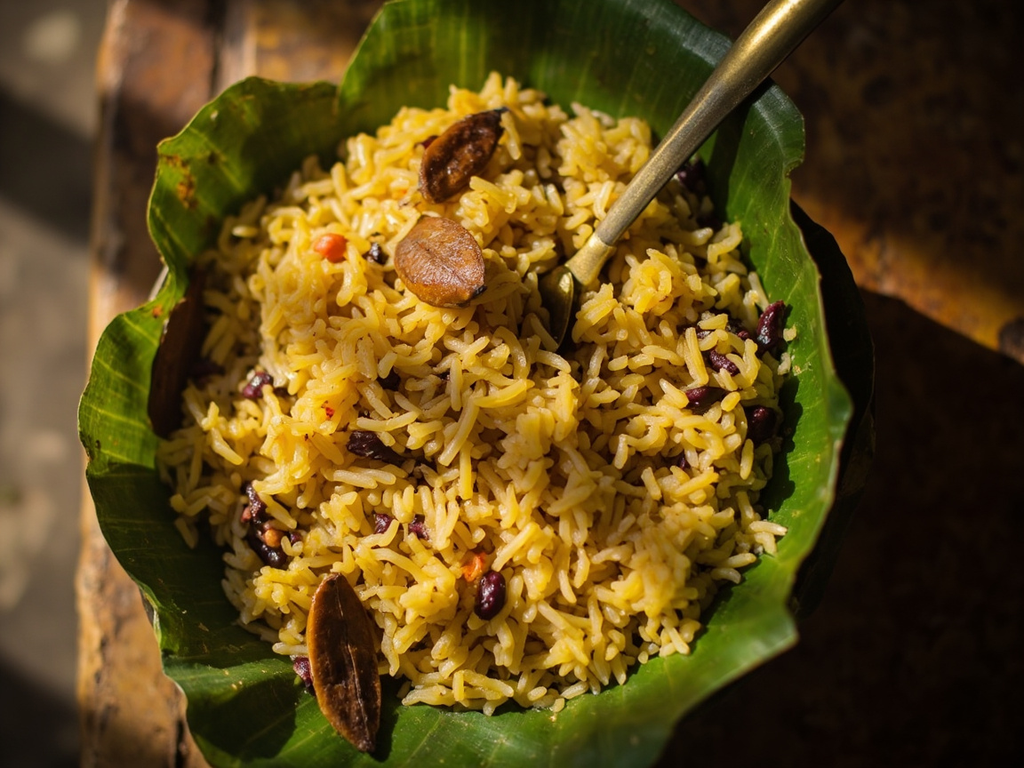
Rice and roasted moong lentils cooked together into a thick, golden porridge, perfumed with ginger, turmeric and ghee, with a mix of whole spices. Nourishing, generous, made to feed a multitude.
The day I descend among you, you do not cook for one belly: you cook for the entire village. Roast the lentil until it smells fragrant, toss it with the rice, and let everything melt together in water until it becomes one golden flesh. Do not skimp on ghee or ginger, for this dish must warm the one who has walked far to see me. Sit on the ground with the others, without rank or caste before me, and eat: this is how I want you, together.
- •Short-grain rice — one measure (base)
- •Dry-roasted moong lentils (dal) — half a measure (legume)
- •Fresh ginger — a piece, pounded (aromatic)
- •Fresh turmeric — a finger (color and flavor)
- •Cumin, Indian bay leaf (tej patta), cinnamon, cardamom — a mix of whole spices (flavor)
- •Ghee — generously (ritual fat)
- •Ginger, long pepper (pippali) — for warmth (spice)
- •Salt — to taste (seasoning)
Bhoger khichuri — festive khichuri
Rice and roasted moong lentils cooked together into a thick, golden porridge, perfumed with ginger, turmeric and ghee, with a mix of whole spices. Nourishing, generous, made to feed a multitude.
Why this dish? The bhog khichuri is THE festive dish of Durga Puja: cooked in a huge pot in the temple courtyard, first offered to the goddess then distributed to hundreds of devotees sitting together. It is the dish that transforms the offering into a community meal around Durga.
The day I descend among you, you do not cook for one belly: you cook for the entire village. Roast the lentil until it smells fragrant, toss it with the rice, and let everything melt together in water until it becomes one golden flesh. Do not skimp on ghee or ginger, for this dish must warm the one who has walked far to see me. Sit on the ground with the others, without rank or caste before me, and eat: this is how I want you, together.
Ingredients (period version)
- Short-grain rice — one measure (base)
- Dry-roasted moong lentils (dal) — half a measure (legume)
- Fresh ginger — a piece, pounded (aromatic)
- Fresh turmeric — a finger (color and flavor)
- Cumin, Indian bay leaf (tej patta), cinnamon, cardamom — a mix of whole spices (flavor)
- Ghee — generously (ritual fat)
- Ginger, long pepper (pippali) — for warmth (spice)
- Salt — to taste (seasoning)
Ingredients
- Rice (gobindobhog or basmati) — 200 g (base)
- Moong dal — 100 g (legume)
- Fresh ginger — 2 tsp grated (aromatic)
- Turmeric powder — 1 tsp (color)
- Cumin seeds — 1 tsp (tempering)
- Indian bay leaf, cinnamon, cardamom, clove — 1 mix (whole garam) (flavor)
- Ghee — 3 tbsp (fat)
- Water — about 1.2 litres (cooking)
- Salt — to taste (seasoning)
Method
- Dry-roast the moong dal in a pan until nutty-smelling, then rinse.
- In ghee, crackle cumin, bay leaf, cinnamon, cardamom and clove.
- Add ginger and turmeric, then rice and dal; coat for 1 min.
- Pour in salted water, bring to a boil then cook covered on low heat ~25 min until thick porridge consistency.
- Finish with a drizzle of ghee; serve hot.
How it was made : Khichari (rice + legume cooked together) is one of the oldest Indian dishes, mentioned by foreign travelers since antiquity; its "bhog" version, richer in ghee and whole spices, without chili or tomato, remains faithful to pre-colonial cuisine. Modern red chili is a post-1492 addition omitted here.
The contemporary twist : Today one often adds potatoes and cauliflower (vegetables that arrived late in India) — to stay period-appropriate, replace them with pieces of Indian pumpkin or omit them, letting ghee and ginger take the lead.
Sources : Chitrita Banerji, Life and Food in Bengal, 1991 · K. T. Achaya, Indian Food: A Historical Companion, Oxford University Press, 1994
Durga · Charactorium