 flip
flipBeetroot borscht with dill
Beetroot borscht with dill
Why this dish? The file mentions the 'taste of stewed dishes and shared meals in conviviality' that Elsa kept from her native Russia. Borscht, a nourishing and fortifying soup, is exactly that everyday dish that simmers for a long time and is shared with family, a thread running through the Slavic cuisine of her Moscow childhood.
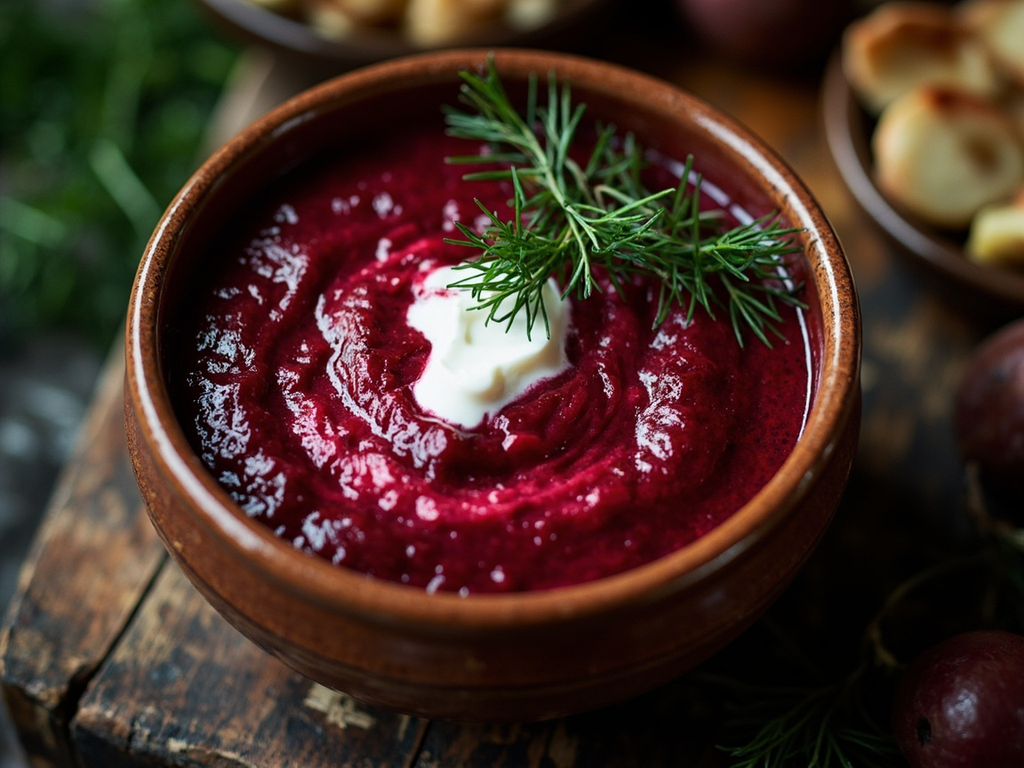
A peasant soup of deep red, based on beetroot, cabbage, and a few root vegetables simmered for a long time, enlivened by a touch of acidity (vinegar or lemon juice) that revives its color. Served boiling hot, blanched with a spoonful of smetana that melts into pink marbling, and sprinkled with dill.
A borscht cannot be rushed: it asks to be forgotten on the corner of the stove and revisited, like an old friend. The secret, which my mother repeated to me, is the touch of sour—a dash of vinegar—that awakens the red of the beet and prevents it from turning a tired brown. It is served so hot that the spoonful of sour cream draws pink clouds, and we talk, and we talk. In Paris, during the winters of scarcity, this borscht kept me warm in body and in memory.
- •Beetroots — several (base, color and sweetness)
- •Cabbage — half a head (body of the soup)
- •Carrots and onion — a few (broth vegetables)
- •Potatoes — a few (substance)
- •Marrow bone or beef shank — one piece (broth (on unrestricted days))
- •Vinegar — a dash (acidity, fixes the color)
- •Smetana and dill — at serving (signature garnish)
Beetroot borscht with dill
A peasant soup of deep red, based on beetroot, cabbage, and a few root vegetables simmered for a long time, enlivened by a touch of acidity (vinegar or lemon juice) that revives its color. Served boiling hot, blanched with a spoonful of smetana that melts into pink marbling, and sprinkled with dill.
Why this dish? The file mentions the 'taste of stewed dishes and shared meals in conviviality' that Elsa kept from her native Russia. Borscht, a nourishing and fortifying soup, is exactly that everyday dish that simmers for a long time and is shared with family, a thread running through the Slavic cuisine of her Moscow childhood.
A borscht cannot be rushed: it asks to be forgotten on the corner of the stove and revisited, like an old friend. The secret, which my mother repeated to me, is the touch of sour—a dash of vinegar—that awakens the red of the beet and prevents it from turning a tired brown. It is served so hot that the spoonful of sour cream draws pink clouds, and we talk, and we talk. In Paris, during the winters of scarcity, this borscht kept me warm in body and in memory.
Ingredients (period version)
- Beetroots — several (base, color and sweetness)
- Cabbage — half a head (body of the soup)
- Carrots and onion — a few (broth vegetables)
- Potatoes — a few (substance)
- Marrow bone or beef shank — one piece (broth (on unrestricted days))
- Vinegar — a dash (acidity, fixes the color)
- Smetana and dill — at serving (signature garnish)
Ingredients
- Raw beetroots — 500 g (colored base)
- Green or white cabbage — 1/4 head (250 g) (body)
- Carrots — 2 (sweetness)
- Onion — 1 large (aromatic base)
- Potatoes — 2 medium (substance)
- Beef shank (or vegetable broth for a lean version) — 400 g (broth)
- Tomato paste — 1 tbsp (depth and color)
- Wine vinegar or lemon juice — 1 to 2 tbsp (signature acidity)
- Thick crème fraîche / sour cream — at serving (garnish)
- Fresh dill — 1 bunch (final flavor)
- Salt, pepper, bay leaf — to taste (seasoning)
Method
- Make broth by simmering the beef shank for 1 hour 30 minutes with bay leaf, salt and pepper (or use vegetable broth for the lean version).
- Meanwhile, coarsely grate the beetroots and carrots, slice the onion, and sauté gently with tomato paste and a dash of vinegar (which fixes the red color).
- Add the shredded cabbage and diced potatoes to the broth, cook 15 min, then add the beetroot mixture and simmer 20 to 30 minutes over low heat.
- Adjust acidity (vinegar/lemon) and seasoning; borscht is better reheated the next day.
- Serve boiling hot with a spoonful of sour cream and a generous pinch of chopped dill.
How it was made : Borscht is a soup shared across Eastern Europe, with countless variations (rich on ordinary days, lean during Lent). The touch of acidity is not just taste: chemically, it preserves the red pigment of beetroot, which otherwise turns brown. It was made in large quantities, as it improves after resting overnight.
The contemporary twist : For a refined and photogenic version, serve it in a white shallow bowl with a swirl of sour cream in the center and dill sprigs—the red 'robe' stands out spectacularly.
Sources : Elena Molokhovets, A Gift to Young Housewives, 1861 · Darra Goldstein, A Taste of Russia: A Cookbook of Russian Hospitality, 1983
Elsa Triolet · Charactorium