 flip
flipVatrushka with quark and raisins
Vatrushka with quark and raisins
Why this dish? Elsa's tea always called for its sweet: the vatrushka, a round bun with quark, is one of the pastries that traditionally accompanied the Russian samovar. This treat for snacks and Sundays extends at her table the ritual of shared tea, between Moscow nostalgia and Parisian conviviality.
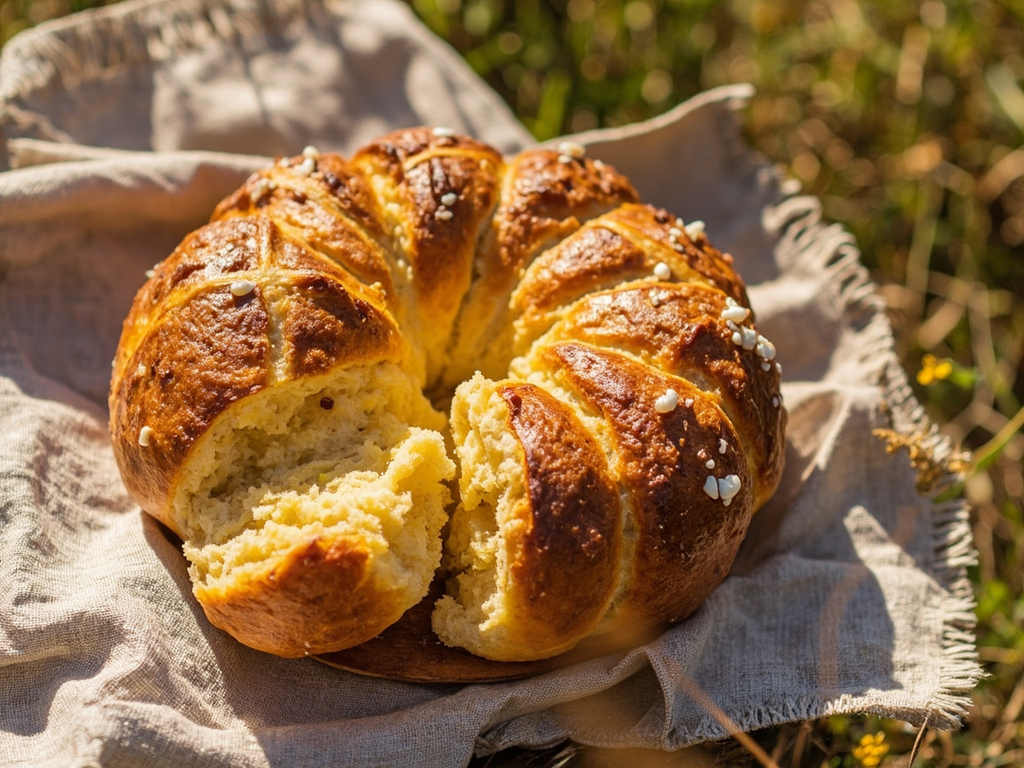
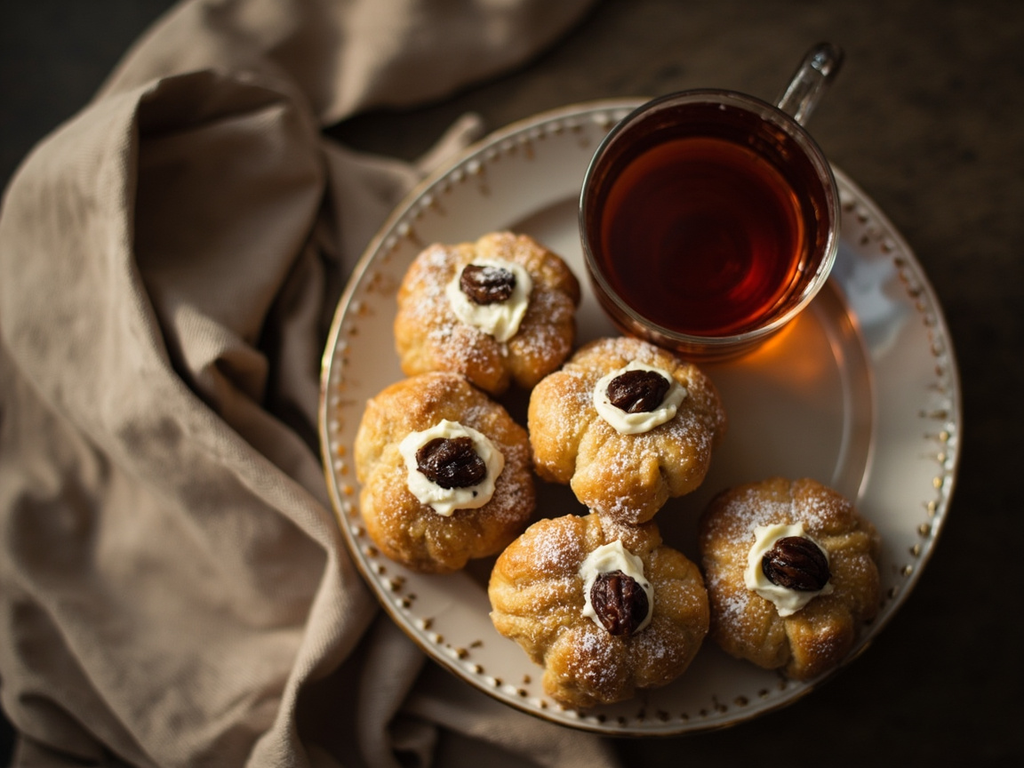
A small round golden bun, hollowed out with a nest of sweetened and vanilla-flavored quark, dotted with raisins. The soft dough and the tangy fresh cheese create a tender contrast, perfect for dipping into boiling tea.
Tea without its sweet is a sentence without a verb. The vatrushka was Sunday: the dough left to rise, the tvorog—this drained quark—beaten with an egg and just enough sugar, for too much sugar stifles the milky tang. We hollowed out the nest with the bottom of an inverted glass, filled it with the cheese, a few raisins, and into the oven. Warm, dipped in tea, it tastes exactly like my childhood—and I never wrote a line without that memory somewhere.
- •Wheat flour — enough (brioche dough)
- •Yeast — a little (leavening)
- •Milk, butter, eggs — for the dough (softness)
- •Tvorog (drained quark) — a good bowlful (filling)
- •Sugar — moderately (sweetness)
- •Raisins — a handful (filling)
- •Egg for glaze — one (golden color)
Vatrushka with quark and raisins
A small round golden bun, hollowed out with a nest of sweetened and vanilla-flavored quark, dotted with raisins. The soft dough and the tangy fresh cheese create a tender contrast, perfect for dipping into boiling tea.
Why this dish? Elsa's tea always called for its sweet: the vatrushka, a round bun with quark, is one of the pastries that traditionally accompanied the Russian samovar. This treat for snacks and Sundays extends at her table the ritual of shared tea, between Moscow nostalgia and Parisian conviviality.
Tea without its sweet is a sentence without a verb. The vatrushka was Sunday: the dough left to rise, the tvorog—this drained quark—beaten with an egg and just enough sugar, for too much sugar stifles the milky tang. We hollowed out the nest with the bottom of an inverted glass, filled it with the cheese, a few raisins, and into the oven. Warm, dipped in tea, it tastes exactly like my childhood—and I never wrote a line without that memory somewhere.
Ingredients (period version)
- Wheat flour — enough (brioche dough)
- Yeast — a little (leavening)
- Milk, butter, eggs — for the dough (softness)
- Tvorog (drained quark) — a good bowlful (filling)
- Sugar — moderately (sweetness)
- Raisins — a handful (filling)
- Egg for glaze — one (golden color)
Ingredients
- All-purpose flour (T45) — 300 g (brioche dough)
- Fresh baker's yeast — 12 g (leavening)
- Warm milk — 12 cl (liquid)
- Soft butter — 50 g (softness)
- Sugar — 60 g (dough + filling) (sweetness)
- Eggs — 2 (+ 1 yolk for glaze) (binder and glaze)
- Well-drained quark or farmer cheese / tvorog — 250 g (signature filling)
- Vanilla sugar — 1 packet (flavor)
- Raisins (soaked) — 50 g (filling)
- Salt — 1 pinch (balance)
Method
- Prepare the dough: dissolve yeast in warm milk, mix with flour, salt, 1 egg, and 30 g sugar, then work in the soft butter; knead and let rise 1 hour.
- Thoroughly drain the quark, beat with 1 egg yolk, 30 g sugar, vanilla sugar, and the plumped raisins.
- Divide the dough into balls, flatten into disks, make a wide nest in the center (with the bottom of a floured glass) and fill with the cheese mixture.
- Let rise 30 min, brush the edges with beaten egg, and bake 18-20 min at 180 °C until the dough is golden and the filling set.
- Serve warm with samovar tea.
How it was made : The vatrushka gets its name from an old Slavic root and existed in peasant form (a large family galette) before becoming these small individual buns. Tvorog, a fresh curd cheese typical of the Slavic world, is its soul: drier and more tangy than French fromage blanc, it holds during baking without releasing water. Vatrushka was served at tea time and during celebrations, always with tea.
The contemporary twist : A grating of lemon zest into the cheese mixture and a dusting of powdered sugar on leaving the oven make it a pretty contemporary tea-room pastry.
Sources : Elena Molokhovets, A Gift to Young Housewives, 1861 · Darra Goldstein, A Taste of Russia: A Cookbook of Russian Hospitality, 1983
Elsa Triolet · Charactorium