 flip
flipMoretum, Goat Cheese Spread with Garlic and Herbs
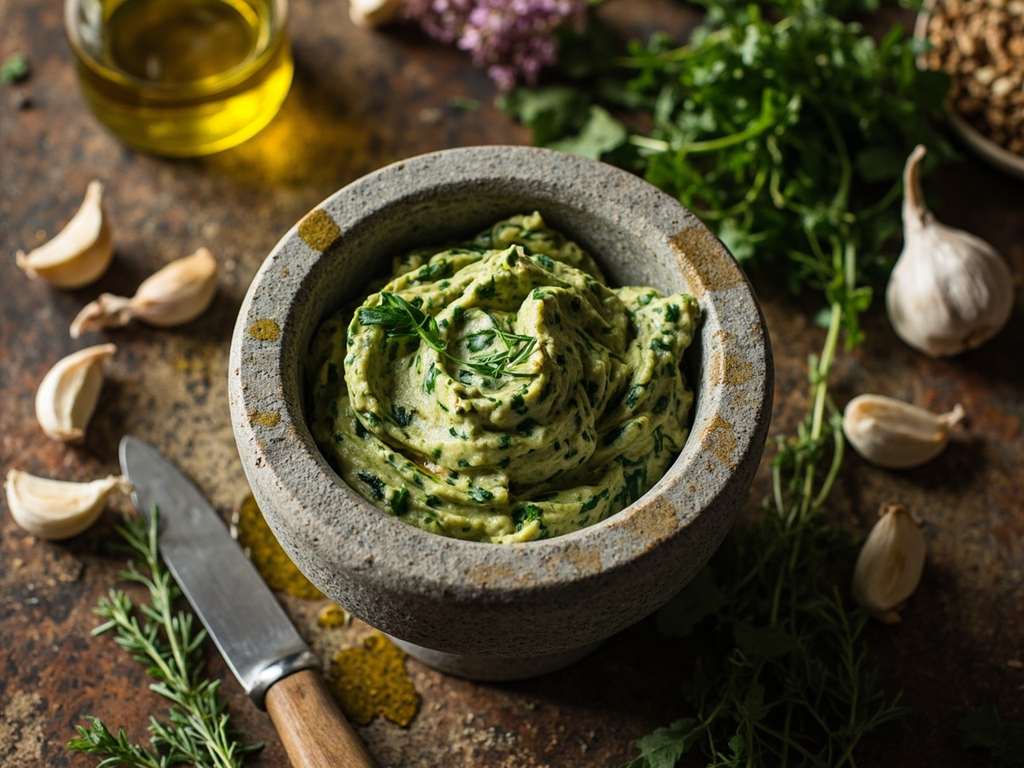
Moretum, Goat Cheese Spread with Garlic and Herbs
Why this dish? Living in Rome and later teaching in Nicopolis, Epictetus knew moretum, a shared dish of simple people. Goat cheese is part of his attested diet: a convivial food when disciples gather.
Fresh goat cheese crushed in a mortar with garlic, fresh herbs, salt, vinegar, and oil, until it forms a fragrant green paste. Spread on maza or bread: it is the food of conversation, shared while talking at length.
When my students stay late to discourse, I have them grind in the mortar this goat cheese with garlic, rue, coriander, and a dash of vinegar. Crush, rub, until everything becomes one — like the soul that gathers its judgments. Spread it on the barley and share: a philosopher does not eat alone what can nourish the discussion. You see, pleasure is not the enemy; it is becoming its slave that is.
- •Fresh goat cheese — a good piece (base)
- •Garlic — a few cloves (pungent aromatic)
- •Fresh herbs (coriander, rue, celery, parsley) — a handful (flavor)
- •Vinegar — a dash (acidity)
- •Olive oil — a drizzle (fat binder)
- •Salt — to taste (seasoning)
Moretum, Goat Cheese Spread with Garlic and Herbs
Fresh goat cheese crushed in a mortar with garlic, fresh herbs, salt, vinegar, and oil, until it forms a fragrant green paste. Spread on maza or bread: it is the food of conversation, shared while talking at length.
Why this dish? Living in Rome and later teaching in Nicopolis, Epictetus knew moretum, a shared dish of simple people. Goat cheese is part of his attested diet: a convivial food when disciples gather.
When my students stay late to discourse, I have them grind in the mortar this goat cheese with garlic, rue, coriander, and a dash of vinegar. Crush, rub, until everything becomes one — like the soul that gathers its judgments. Spread it on the barley and share: a philosopher does not eat alone what can nourish the discussion. You see, pleasure is not the enemy; it is becoming its slave that is.
Ingredients (period version)
- Fresh goat cheese — a good piece (base)
- Garlic — a few cloves (pungent aromatic)
- Fresh herbs (coriander, rue, celery, parsley) — a handful (flavor)
- Vinegar — a dash (acidity)
- Olive oil — a drizzle (fat binder)
- Salt — to taste (seasoning)
Ingredients
- Fresh goat cheese (young log) — 200 g (base)
- Garlic — 2 cloves (aromatic)
- Coriander + parsley + celery leaves — 1 large handful (flavor (rue, toxic, is replaced))
- White wine vinegar — 1 tsp (acidity)
- Extra virgin olive oil — 2 tbsp (binder)
- Salt — 1 pinch (seasoning)
Method
- Peel the garlic and crush it in a mortar with a pinch of salt until it becomes a paste.
- Add the chopped herbs and continue pounding to release the aromas.
- Incorporate the crumbled goat cheese and mash to combine.
- Loosen with vinegar, then olive oil in a stream, until you get a homogeneous spreadable paste.
- Taste, adjust salt, and serve at room temperature with maza or bread for spreading.
How it was made : Moretum is described in a short Latin poem from the Appendix Vergiliana: a farmer, Symilus, grinds in a mortar cheese, garlic, herbs, salt, vinegar, and oil for his morning meal. It was a popular, green, and pungent dish. Sometimes rue (ruta) was added, a bitter herb now discouraged as toxic: it is replaced by other herbs.
The contemporary twist : Shape it into a quenelle on a slate board, sprinkle with borage flowers: the "Stoic pesto" ahead of its time.
Epictetus · Charactorium