 flip
flipPanspermia of the Chytroi
Panspermia of the Chytroi
Why this dish? For the lord below, one does not offer roasted meat on a rising flame, but a pot (*chytra*) of all boiled seeds — the *panspermia*. On the last day of the Anthesteria, the Athenians cooked it for the dead and for chthonian Hermes, guardian of the souls of Hades' realm: the earth returns what is entrusted to it, like the grains.
A vegetable pot-au-feu of whole grains and legumes, lightly sweetened with honey, long-simmered. Food for both the dead and the living: hearty, earthy, humble — exactly what is set down for those who have passed beneath the earth.
Mortal, listen to the master of the depths. Burn nothing for me in the smoke that rises to my brothers of Olympus: what is owed me must descend. Take an earthen pot, throw in barley, fava bean, chickpea, lentil, all the seeds together, and let them groan long over the embers. A trickle of honey, for even my realm knows sweetness. Pour the cooking water into the pit, and let the rest feed the shades — the seed you bury will return to you as a sheaf, just as the soul always returns to me.
- •Hulled barley — a good handful (staple grain)
- •Dried fava beans — a handful (legume)
- •Dried chickpeas — a handful (legume)
- •Lentils — a handful (legume)
- •Wheat berries (spelt) — a handful (grain)
- •Honey — a splash (sweet binder)
- •Sea salt — a pinch (seasoning)
Panspermia of the Chytroi
A vegetable pot-au-feu of whole grains and legumes, lightly sweetened with honey, long-simmered. Food for both the dead and the living: hearty, earthy, humble — exactly what is set down for those who have passed beneath the earth.
Why this dish? For the lord below, one does not offer roasted meat on a rising flame, but a pot (*chytra*) of all boiled seeds — the *panspermia*. On the last day of the Anthesteria, the Athenians cooked it for the dead and for chthonian Hermes, guardian of the souls of Hades' realm: the earth returns what is entrusted to it, like the grains.
Mortal, listen to the master of the depths. Burn nothing for me in the smoke that rises to my brothers of Olympus: what is owed me must descend. Take an earthen pot, throw in barley, fava bean, chickpea, lentil, all the seeds together, and let them groan long over the embers. A trickle of honey, for even my realm knows sweetness. Pour the cooking water into the pit, and let the rest feed the shades — the seed you bury will return to you as a sheaf, just as the soul always returns to me.
Ingredients (period version)
- Hulled barley — a good handful (staple grain)
- Dried fava beans — a handful (legume)
- Dried chickpeas — a handful (legume)
- Lentils — a handful (legume)
- Wheat berries (spelt) — a handful (grain)
- Honey — a splash (sweet binder)
- Sea salt — a pinch (seasoning)
Ingredients
- Pearl barley — 100 g (staple grain)
- Dried fava beans (soaked overnight) — 80 g (legume)
- Dried chickpeas (soaked overnight) — 80 g (legume)
- Green lentils — 80 g (legume)
- Spelt berries — 80 g (grain)
- Honey — 1 tbsp (sweet binder)
- Salt — 1 tsp (seasoning)
- Olive oil — 2 tbsp (final binding)
Method
- The night before, soak fava beans and chickpeas separately in cold water.
- Drain, combine all grains and legumes in a large pot (ideally earthenware).
- Cover generously with cold water, bring to a boil then reduce heat.
- Simmer covered for 1.5 to 2 hours, stirring and adding water as needed, until everything is tender.
- Season with salt only at the end (salt hardens skins), stir in honey and olive oil.
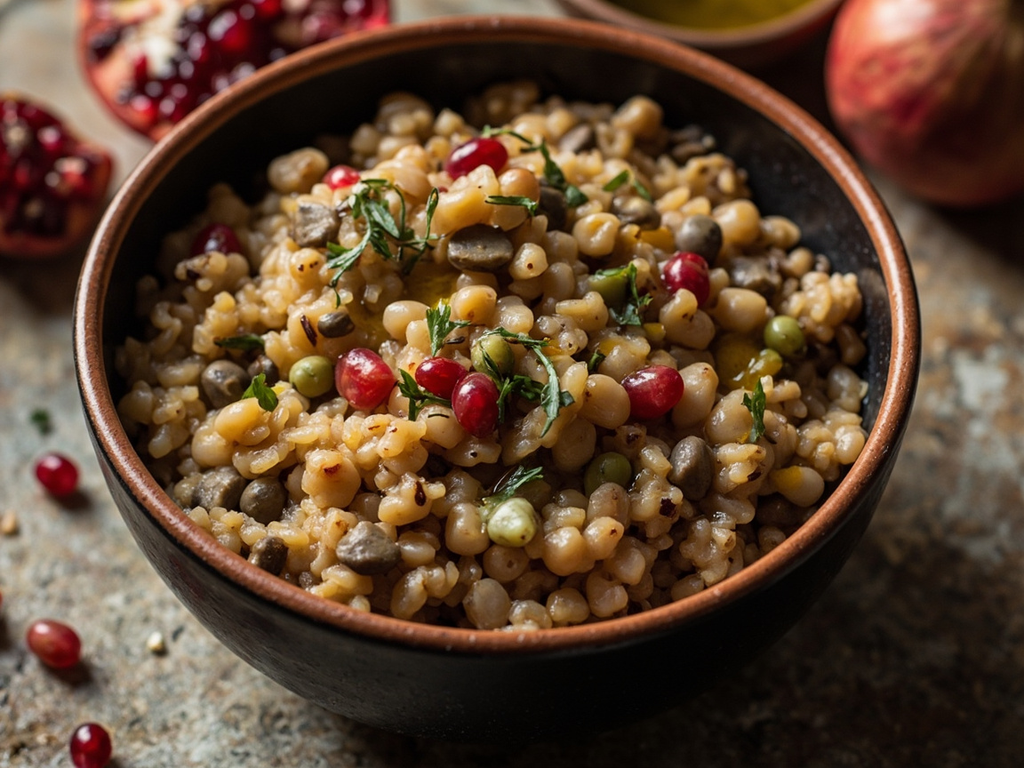
- Serve warm in a terracotta bowl, as a thick porridge.
How it was made : In Athens, the third day of the Anthesteria — the *Chytroi* ('Pots') — involved boiling a mixture of all seeds in earthen pots, an offering to the dead and to Hermes Psychopompos, without any living person freely tasting it. Boiling (rather than roasting) and libations poured to the ground are marks of chthonian cult, opposed to that of the celestial gods.
The contemporary twist : Served as a 'grain bowl of the Underworld': the warm porridge mounded into a dome, sprinkled with blood-red pomegranate arils and a veil of olive oil — a nod to Persephone's pact.
Sources : Aristophanes, The Frogs / scholia on the Chytroi · Andrew Dalby, Siren Feasts: A History of Food and Gastronomy in Greece (1996) · Walter Burkert, Greek Religion: Archaic and Classical (chthonian sacrifice)
Hades · Charactorium