 flip
flipDoro Wat — Imperial Chicken Stew with Eggs
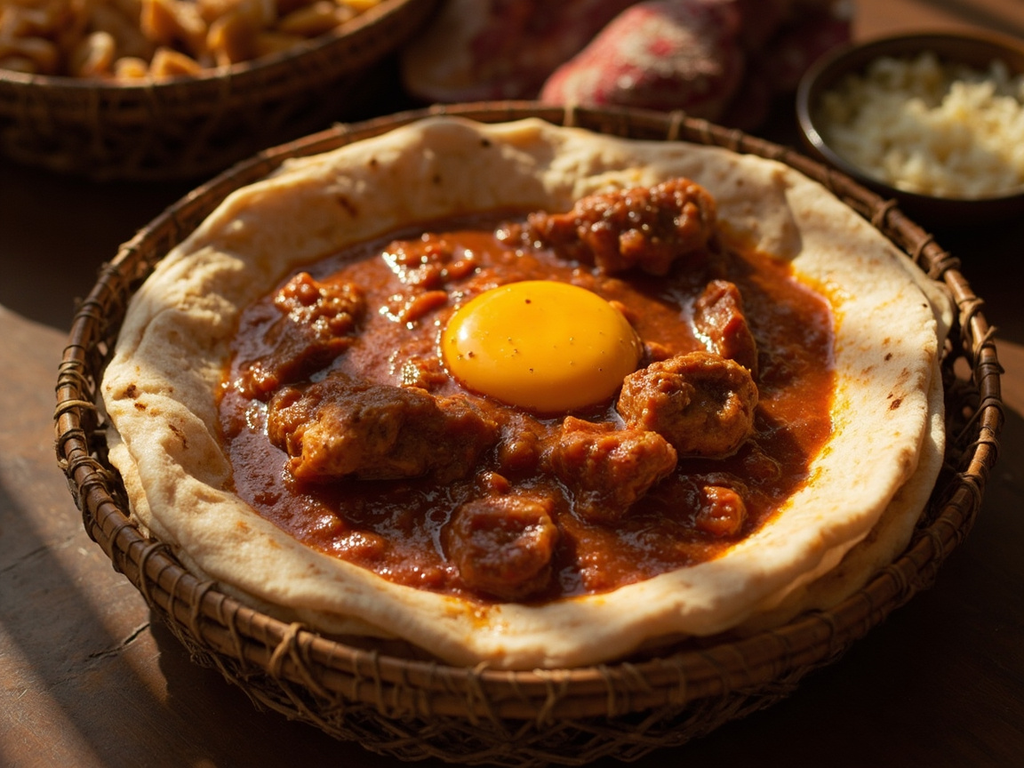
Doro Wat — Imperial Chicken Stew with Eggs
Why this dish? Doro wat is THE dish of glory days in Ethiopia: Christmas (Genna), Easter (Fasika), grand receptions. At the court of Haile Selassie I, at the Jubilee Palace in Addis Ababa, it was the dish that crowned official banquets offered to dignitaries and foreign guests — a slow, rich dish that celebrates the feast and the end of the fast.
Chicken slowly simmered in a sea of melted onions and berbere, bound with spiced butter, with hard-boiled eggs incised to soak up the sauce. Deep, warm, mildly spicy.
Know, you who sit at Our table, that this dish appears only on blessed days, when the fast is broken. One begins with the onions, and the onions alone, letting them melt without a drop of oil until they release their water and sweetness — that is the cook's patience, and I have seen pots watched over for an entire morning. Then comes the berbere, which gives the stew its crimson robe, then the perfumed butter, then the poultry, and finally the eggs which are incised so they drink the sauce. It is brought to the guest on the injera, and one does not forget the gursha, for feeding one's guest by hand is an honor We hold in high esteem.
- •Free-range chicken — 1 whole, cut into pieces (festival meat)
- •Red onions — a large quantity (twice the weight of the chicken) (melting sauce base)
- •Berbere — generously (signature spice, color and heat)
- •Niter kibbeh (spiced butter) — as desired (aromatic fat binder)
- •Fresh garlic and ginger — pounded (aromatics)
- •Eggs — one per guest (garnish that soaks up sauce)
- •Lemon or gesho wine — a splash (chicken marinade)
Doro Wat — Imperial Chicken Stew with Eggs
Chicken slowly simmered in a sea of melted onions and berbere, bound with spiced butter, with hard-boiled eggs incised to soak up the sauce. Deep, warm, mildly spicy.
Why this dish? Doro wat is THE dish of glory days in Ethiopia: Christmas (Genna), Easter (Fasika), grand receptions. At the court of Haile Selassie I, at the Jubilee Palace in Addis Ababa, it was the dish that crowned official banquets offered to dignitaries and foreign guests — a slow, rich dish that celebrates the feast and the end of the fast.
Know, you who sit at Our table, that this dish appears only on blessed days, when the fast is broken. One begins with the onions, and the onions alone, letting them melt without a drop of oil until they release their water and sweetness — that is the cook's patience, and I have seen pots watched over for an entire morning. Then comes the berbere, which gives the stew its crimson robe, then the perfumed butter, then the poultry, and finally the eggs which are incised so they drink the sauce. It is brought to the guest on the injera, and one does not forget the gursha, for feeding one's guest by hand is an honor We hold in high esteem.
Ingredients (period version)
- Free-range chicken — 1 whole, cut into pieces (festival meat)
- Red onions — a large quantity (twice the weight of the chicken) (melting sauce base)
- Berbere — generously (signature spice, color and heat)
- Niter kibbeh (spiced butter) — as desired (aromatic fat binder)
- Fresh garlic and ginger — pounded (aromatics)
- Eggs — one per guest (garnish that soaks up sauce)
- Lemon or gesho wine — a splash (chicken marinade)
Ingredients
- Chicken thighs and drumsticks — 1 kg (meat)
- Red onions — 1 kg, finely sliced (sauce base)
- Berbere — 3 to 4 tbsp (signature spice)
- Niter kibbeh (or clarified butter + 1 tsp spices) — 4 tbsp (aromatic fat)
- Garlic — 4 cloves, grated (aromatic)
- Fresh ginger — 3 cm, grated (aromatic)
- Hard-boiled eggs — 4 to 6 (garnish)
- Lemon juice — 1, for marinating chicken (acidity)
- Water or broth — as needed (sauce consistency)
Method
- Marinate chicken pieces in lemon juice and a little salt for 30 minutes.
- In a dry pot (no fat), sweat the onions over low heat for 25 to 35 minutes, stirring, until they collapse into a golden compote.
- Add niter kibbeh, garlic, and ginger; cook 5 minutes, then stir in berbere and toast for 2 to 3 minutes to awaken the spices.
- Add a little water to form a sauce, add chicken, coat well, cover, and simmer 40 to 50 minutes over low heat, adding water if needed.
- Lightly score the peeled hard-boiled eggs and submerge them in the sauce for the last 10 minutes.
- Serve in the center of a large injera, surrounded by other wats.
How it was made : The secret of doro wat lies in cooking the onions absolutely without fat at the start: the traditional pot (tended by women of the household in relays) allowed the onions to release all their water before the butter was added. The chicken was often cut into twelve symbolic pieces, and the berbere was homemade, sun-dried during the dry season.
The contemporary twist : Serve each portion on its own small injera rolled into a cone, with the egg placed on top, for an individual presentation that honors the spirit of the shared platter.
Haile Selassie · Charactorium