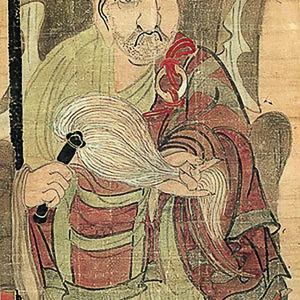

Hakuin Ekaku was a Japanese Buddhist master of the Rinzai school of Zen. Regarded as the reviver of Rinzai in the eighteenth century, he systematized kōan practice and spread Zen beyond the elites. He was also a prolific calligrapher and painter.
Frequently asked questions
Famous Quotes
« What is the sound of one hand clapping?»
Key Facts
- Born in 1686 in Hara, in Suruga Province (Japan)
- Becomes a Rinzai Zen monk and has a first experience of awakening (satori) around 1708
- Reforms the Rinzai school by reorganizing kōan practice and revitalizing monastic discipline
- Creates the famous kōan of “the sound of one hand” (sekishu)
- Died in 1769; leaves behind an abundant body of paintings, calligraphies, and spiritual writings
Works & Achievements
A riddle devised by Hakuin that became the most famous Zen kōan, conceived as a gateway to awakening for beginners.
A treatise describing a method of breathing meditation to cure the “Zen sickness,” still read today.
A collection of teaching letters insisting on meditation at the heart of everyday action rather than in retreat alone.
A series of commentaries on the records of the Chinese master Hsü-t'ang, founding the kōan pedagogy of Hakuin's school.
An account in which Hakuin relates his doubts, his successive awakenings, and his crises — a rare document on the inner journey of a Zen master.
A short poem in Japanese affirming that all beings are already buddhas, still chanted in Rinzai monasteries.
Thousands of ink works — Daruma, Kannon, scenes from everyday life — through which Hakuin taught Zen to ordinary people.
A graded organization of kōan into a pedagogical curriculum, the basis of Japanese Rinzai training to this day.
Anecdotes
As a child, the young Hakuin was terrified by a sermon about the eight burning hells. This fear of damnation became the driving force of his spiritual quest and pushed him, around the age of fifteen, to enter the monastic life to escape this fate.
At 24, while meditating on the kōan “Mu” at Eigan-ji temple, Hakuin experienced his first great awakening: hearing the sound of a morning bell, he felt as though the entire universe was collapsing. Convinced he was finally liberated, he was sharply put back in his place by his master Shōju, who deemed his awakening incomplete.
A legend tells that he was unjustly accused of having gotten a village girl pregnant; the infant was handed over to him. Hakuin only replied “Ah, is that so?” and raised the child. When the truth came out, he gave the child back with the same serenity: “Ah, is that so?” — illustrating his detachment.
Worn out by excessive practice, Hakuin fell into a severe “Zen sickness” (nervous breakdown). He was cured thanks to a hermit named Hakuyū, who taught him a method of meditation through breathing and visualization, which he later described in his book Yasen Kanna.
Hakuin is famous for having formulated the most well-known kōan in the West: “What is the sound of one hand clapping?”. He invented it to offer beginners a more accessible gateway to awakening than the classic “Mu”.
Primary Sources
If a practitioner feels an exhaustion of heart and mind, he must cease his meditation and first seek to restore the vital energy (ki) by drawing it down into the lower abdomen.
Meditation in the midst of activity is infinitely superior to meditation in stillness.
Listen to the sound of a single hand: that is the starting point.
When the bell rang at dawn, it was as if a bowl of ice had shattered; I felt every illusion of self and universe fall away.
Key Places
A modest post-station village on the great Tōkaidō highway, at the foot of Mount Fuji, where Hakuin was born and spent most of his life.
A small, ruined Rinzai temple that Hakuin restored and led; there he taught hundreds of disciples and died in 1768.
The temple where Hakuin, around the age of 24, attained his first great awakening while meditating on the kōan “Mu.”
The retreat of the severe master Dōkyō Etan, known as Shōju Rōjin, who pushed Hakuin to deepen his awakening and became his decisive teacher.
The sacred volcano towering over Hakuin's native region; he made it a recurring motif in his paintings, a symbol of the pure and unchanging mind.
A monastery founded by Hakuin and his disciple Tōrei in 1761, which became a major center of the Rinzai practice he had reformed.
Typical Objects

A soft-bristled brush dipped in black ink, with which Hakuin produced thousands of Zen calligraphies and paintings meant to instruct lay people.

A solid ink stick rubbed with a little water on a hollowed stone to produce ink. It is the material basis of all of Hakuin's zenga output.

A flat or curved stick that the Zen master holds during meditation to symbolically strike the shoulders of drowsy disciples and sharpen their alertness.
A riddle or paradoxical phrase, such as “the sound of one hand,” given to a disciple to short-circuit logical thinking and provoke awakening. Hakuin systematized its use.

The bowl a Zen monk uses to beg for food and to eat his meals according to a precise ritual, a symbol of poverty and detachment.

A round, firm cushion on which the practitioner sits in the zazen posture, back straight and legs crossed, for long hours.

The plain garment of the Buddhist monk, often dark, whose kesa is a stole sewn from patches recalling the humble origins of the community.
School Curriculum
Vocabulary & Tags
Key Vocabulary
Daily Life
Morning
Hakuin would rise well before dawn for seated meditation (zazen), followed by the recitation of sutras in the temple hall. In the cold, the monks moved through long sessions with legs crossed and backs straight, until the sound of the bell.
Afternoon
The afternoon blended manual labor — sweeping, tending the vegetable garden, repairing the dilapidated temple — with one-on-one interviews (dokusan), where each disciple came to present his understanding of a kōan. Hakuin also received laypeople who came seeking advice.
Evening
In the evening, after a period of meditation, Hakuin would write, paint his ink calligraphies, or compose letters of instruction by the glow of an oil lamp. Short nights were the rule of monastic discipline.
Food
Their food was vegetarian and frugal, in keeping with the Buddhist rule: rice, miso soup, pickled vegetables, tofu, and tea. The monks ate in silence from their ritual bowls, never wasting a single grain of rice.
Clothing
Hakuin wore the dark robe of the Zen monk (koromo) and, during ceremonies, the kesa, a stole sewn from pieces of cloth. In winter, several layers piled on top of one another barely protected him from the cold of the unheated temple.
Housing
He lived at Shōin-ji temple, a modest wooden building long in poor repair, with bare rooms covered in tatami, sliding paper partitions, and an altar for the Buddha. Material comfort was deliberately kept to a minimum.
Historical Timeline
Period Vocabulary
Liens externes & ressources
Références
Œuvres
Le kōan « le son d'une seule main » (Sekishu no onjō)
vers 1750
Yasen Kanna (Causerie d'un soir sur un bateau)
1757
Orategama
vers 1749
Sokkō-roku Kaien-fusetsu
1740
Itsumadegusa (autobiographie spirituelle)
vers 1765
Chant de la méditation assise (Zazen wasan)
vers 1760
Peintures et calligraphies zen (zenga)
1716-1768