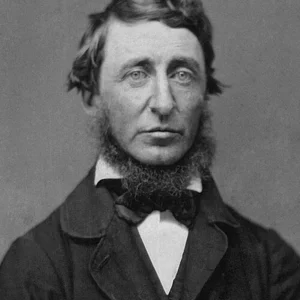

American writer, philosopher, and naturalist, a figure of transcendentalism. He is famous for *Walden; or, Life in the Woods*, an account of his experience of solitary living in close contact with nature, and for his essay *Civil Disobedience*, a plea for individual resistance to the injustice of the State.
Henry David Thoreau(1817 — 1862)
Henry David Thoreau
États-Unis
6 min read
Frequently asked questions
Famous Quotes
« I went to the woods because I wished to live deliberately.»
« That government is best which governs least.»
Key Facts
- Born in 1817 in Concord, Massachusetts, close to Emerson and the transcendentalist circle.
- 1845-1847: lived as a hermit on the shore of Walden Pond, an experience that gave rise to his major work.
- 1846: jailed for one night for refusing to pay his taxes, in protest against slavery and the Mexican-American War.
- 1849: published *Civil Disobedience*, an essay that would inspire Gandhi and Martin Luther King.
- 1854: publication of *Walden; or, Life in the Woods*; died of tuberculosis in 1862.
Works & Achievements
Thoreau's first book, an account of a boat trip interwoven with philosophical digressions. A commercial failure whose unsold copies he kept for years.
A major essay defending the individual's right to disobey an unjust law. It would inspire Gandhi and Martin Luther King.
Thoreau's masterpiece, an account of his experience at Walden and a manifesto for voluntary simplicity and self-reliance in the face of consumer society.
An impassioned speech defending the abolitionist John Brown, marking Thoreau's commitment to the antislavery cause.
A posthumous collection recounting his expeditions into the wild regions of Maine, including the ascent of Mount Katahdin.
A monumental work kept almost daily, blending naturalist observations, meditations, and field notes, published after his death.
Anecdotes
On July 4, 1845, Thoreau moved into a small cabin he had built himself on the shore of Walden Pond, on land owned by his friend and mentor Ralph Waldo Emerson. He would live there for two years, two months, and two days to carry out an "experiment" in simple, self-reliant living.
In July 1846, Thoreau spent a night in jail for having refused for years to pay his poll tax, as a protest against slavery and the war waged against Mexico. He was released the next day because one of his aunts paid the tax on his behalf, against his will. This episode would inspire his famous essay on civil disobedience.
Thoreau was a passionate naturalist and a meticulous observer: he kept a journal of more than two million words in which he recorded, day after day, the dates when plants bloomed and when ponds froze. Today, scientists use these 19th-century records to measure the effects of climate change around Concord.
In 1844, Thoreau and a friend accidentally started a fire that destroyed more than 120 hectares of forest near Concord while they were cooking fish by the river. The townspeople held it against him for a long time, nicknaming him the "woods burner".
Born into a modest family, Thoreau worked in his father's pencil factory and improved the process for making graphite leads, producing pencils regarded as among the best in the United States. He could have made a business of it, but preferred to devote his life to writing and observing nature.
Primary Sources
I went to the woods because I wished to live deliberately, to front only the essential facts of life, and see if I could not learn what it had to teach.
That government is best which governs least. [...] It is not desirable to cultivate a respect for the law so much as for the right.
What is the value of nature if one ceases to set foot on the ground? The mass of men lead lives of quiet desperation.
It is not the number of men that a just man counts, but their quality. A man in the right already forms a majority.
Key Places
Thoreau's birthplace and home of the transcendentalist movement, where Emerson and the Alcotts also lived. He spent most of his life there.
A body of water surrounded by forests where Thoreau lived for two years in his cabin. The place has become a global symbol of the return to nature and voluntary simplicity.
The institution where Thoreau pursued his higher education and trained in classical literature and languages.
A wild summit that Thoreau climbed in 1846 during an expedition recounted in The Maine Woods; there he experienced raw, untamed nature.
The place where Thoreau spent a night in 1846 for refusing to pay his tax, an episode that gave rise to Civil Disobedience.
Liens externes & ressources
Références
Œuvres
Une semaine sur les rivières Concord et Merrimack
1849
La Désobéissance civile
1849
Walden ou la vie dans les bois
1854
Plaidoyer pour le capitaine John Brown
1859
Les Forêts du Maine
1864
Journal
1837-1861