 flip
flipThe Twelve Portions of the Sacrifice: Thyme-Roasted Lamb
The Twelve Portions of the Sacrifice: Thyme-Roasted Lamb
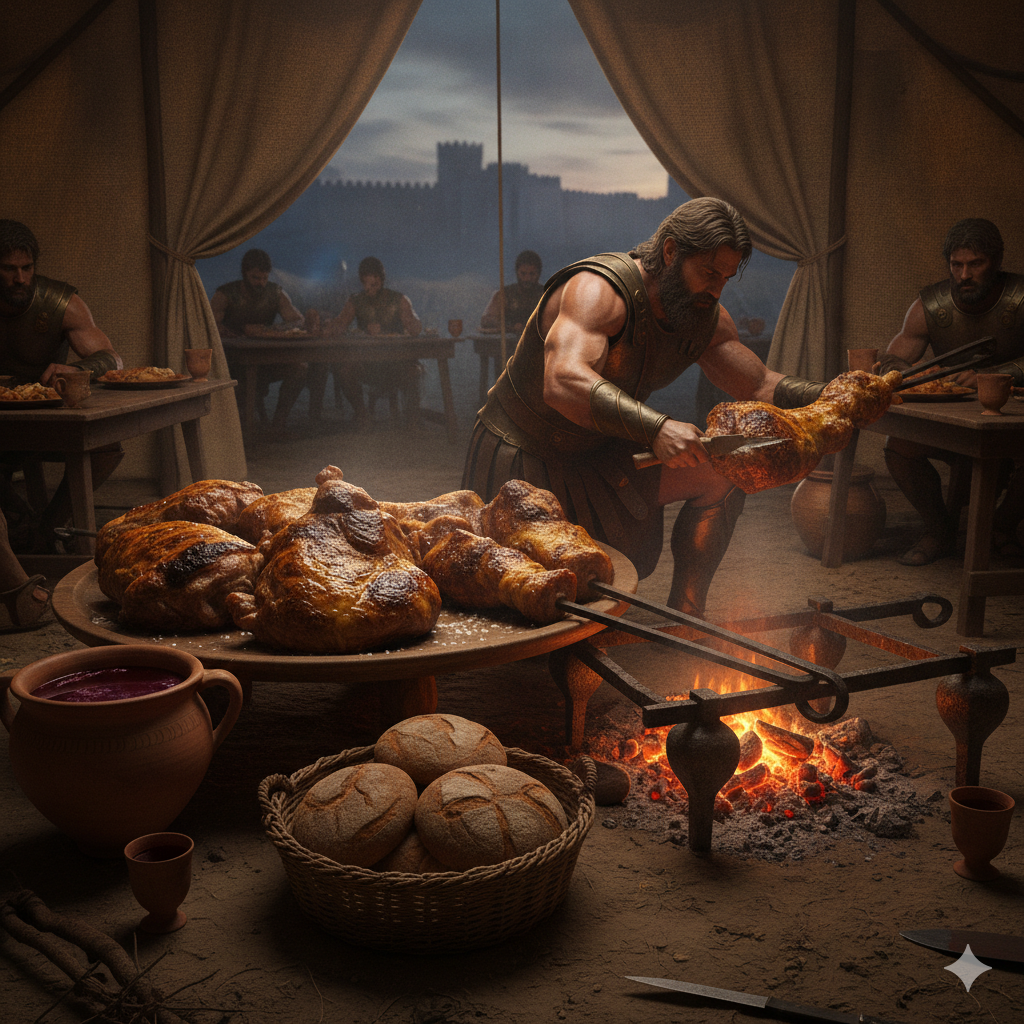
Why this dish? In the Homeric Hymn to Hermes, the newborn god steals Apollo's cattle, slaughters two, and divides the roasted meat into twelve equal portions — one for each god. This, the myth says, is the first sacrifice: Hermes invents the festive sharing of meat.
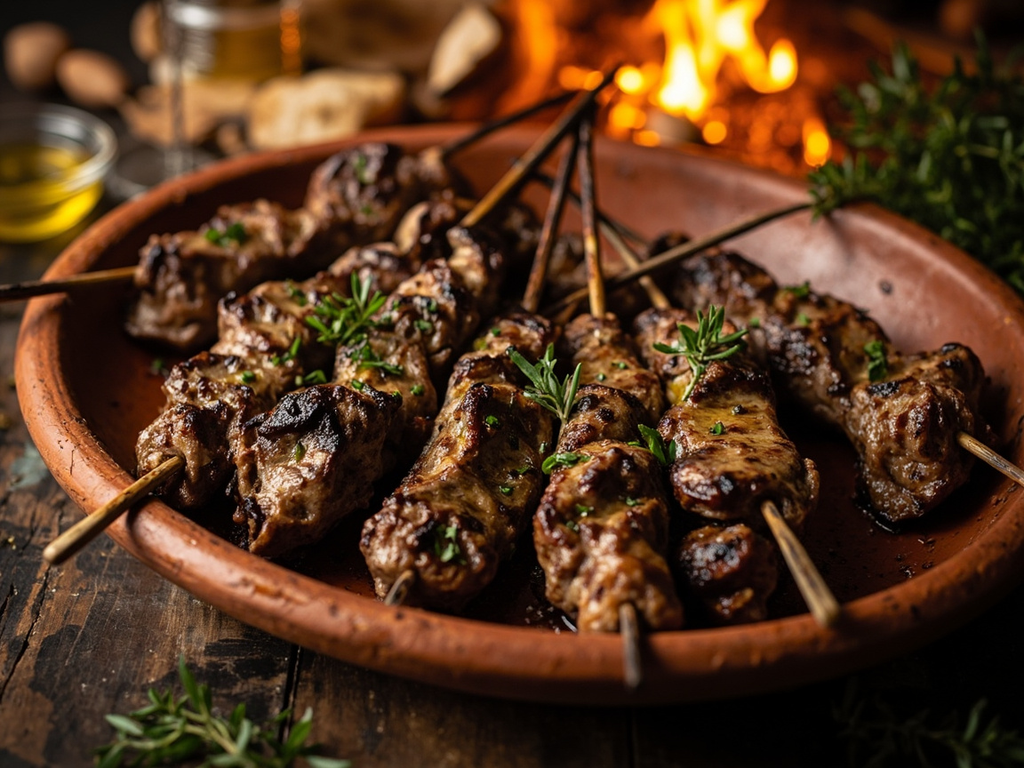
Lamb pieces skewered and roasted over a flame, rubbed with oil, salt, and thyme, then divided into equal portions for the banquet. Smoky, meaty, deeply savory: the meat of great days, rare in a city where it was eaten mainly at festivals.
Listen well, for on that night I was barely out of the cradle. I led the fine cattle of my brother Apollo out of the meadow — yes, I admit it, I am also the god of cunning — and near the river I built the fire. Two beasts, skewered, roasted to perfection; then I cut the flesh into twelve perfectly equal portions, one for each god, keeping no more for myself. Thus was sharing invented! So rub your meat with thyme and salt, turn it over the coals, and never forget: at table, divide into just portions.
- •Lamb (or beef) meat — good pieces (heart of the feast)
- •Olive oil — to coat (roasting, sheen)
- •Sea salt — generous (seasoning)
- •Fresh thyme — several sprigs (garrigue scent)
- •Wild oregano — a handful (aroma)
The Twelve Portions of the Sacrifice: Thyme-Roasted Lamb
Lamb pieces skewered and roasted over a flame, rubbed with oil, salt, and thyme, then divided into equal portions for the banquet. Smoky, meaty, deeply savory: the meat of great days, rare in a city where it was eaten mainly at festivals.
Why this dish? In the Homeric Hymn to Hermes, the newborn god steals Apollo's cattle, slaughters two, and divides the roasted meat into twelve equal portions — one for each god. This, the myth says, is the first sacrifice: Hermes invents the festive sharing of meat.
Listen well, for on that night I was barely out of the cradle. I led the fine cattle of my brother Apollo out of the meadow — yes, I admit it, I am also the god of cunning — and near the river I built the fire. Two beasts, skewered, roasted to perfection; then I cut the flesh into twelve perfectly equal portions, one for each god, keeping no more for myself. Thus was sharing invented! So rub your meat with thyme and salt, turn it over the coals, and never forget: at table, divide into just portions.
Ingredients (period version)
- Lamb (or beef) meat — good pieces (heart of the feast)
- Olive oil — to coat (roasting, sheen)
- Sea salt — generous (seasoning)
- Fresh thyme — several sprigs (garrigue scent)
- Wild oregano — a handful (aroma)
Ingredients
- Boneless lamb leg or shoulder — 1.2 kg (main piece)
- Olive oil — 4 tbsp (marinade, cooking)
- Salt — 2 tsp (seasoning)
- Fresh thyme — 6 sprigs (scent)
- Dried oregano — 1 tbsp (aroma)
- Garlic — 3 cloves, crushed (piquancy (ancient Greek use))
Method
- Cut the lamb into large, even cubes and marinate for 1 hour with oil, salt, stripped thyme, oregano, and garlic.
- Thread onto skewers (or place on a grill).
- Roast over hot coals or under a broiler, turning, for 12–15 minutes, until a nice golden crust and rosy center.
- Let rest a few minutes, then divide into equal portions — the spirit of the twelve portions.
- Serve with a drizzle of oil and fresh thyme.
How it was made : In the Greek city-state, meat was rarely eaten: it was mainly consumed at public sacrifices, where the animal was slaughtered, roasted, and the flesh shared among participants — the "smoked" portion (bones and fat) going up to the gods. The sacrificial banquet was as much a religious act as a community feast.
The contemporary twist : Present on a large board in twelve portions each marked with a sprig of thyme — "the gods' share" — and invite each guest to choose theirs.
Sources : Homeric Hymn to Hermes · Marcel Detienne & Jean-Pierre Vernant, The Cuisine of Sacrifice among the Greeks (1979)
Hermes · Charactorium