 flip
flipHamaguri to Wakame no Shiomono — Clams and Seaweed in a Sea Broth
Hamaguri to Wakame no Shiomono — Clams and Seaweed in a Sea Broth
Why this dish? The shell mounds (kaizuka) scattered across protohistoric Japan attest to massive shellfish consumption. On the shores of Himiko's kingdom, clams and seaweed boiled in seawater formed a comforting broth, a direct ancestor of Japanese soup.
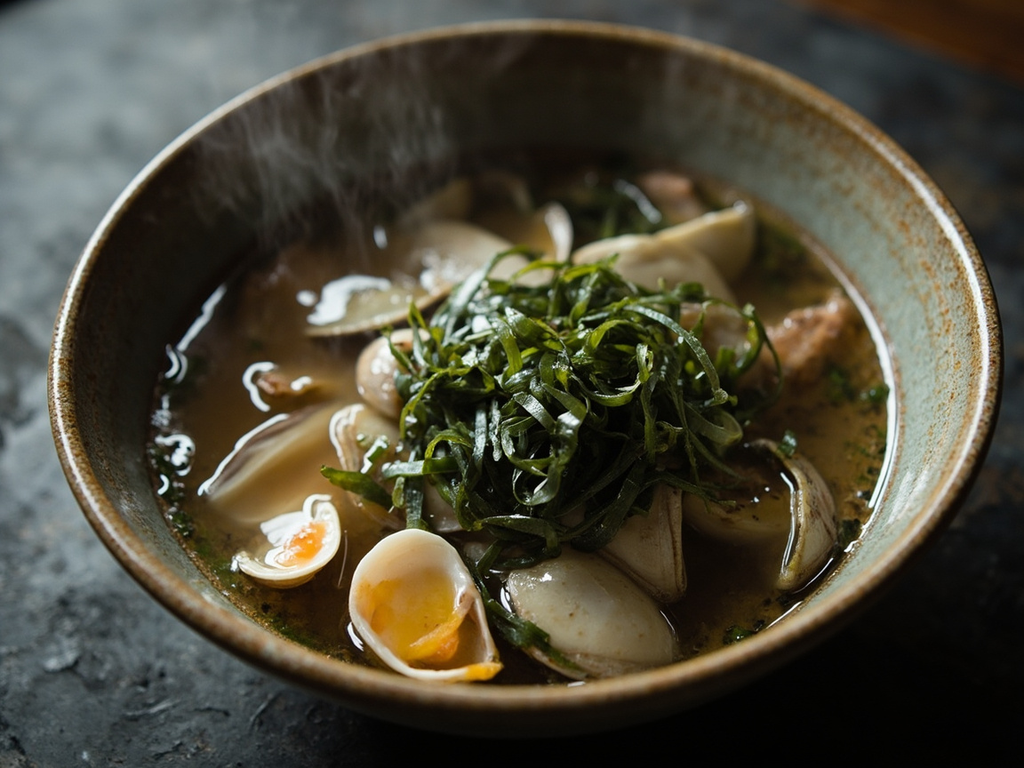
Clams opened in a light broth of seawater perfumed with seaweed. Clear liquid, deeply iodized and marine, where the natural umami of the shellfish is sufficient unto itself. The humble, luminous ancestor of dashi.
When the mist rises from the sea, nothing beats this broth. We gather shellfish at low tide, throw them into salted water with a bit of seaweed picked from the rocks, and wait for them to open like mouths that murmur. The juice that comes out is the soul of the sea itself. Drink it burning hot between your hands, and you will feel the strength of the shores of my kingdom.
- •Fresh clams/shellfish, gathered — a good handful per bowl (heart, umami)
- •Fresh sea seaweed (wakame, wild kombu) — a few fronds (sea fragrance)
- •Seawater (or salted water) — as needed (broth)
Hamaguri to Wakame no Shiomono — Clams and Seaweed in a Sea Broth
Clams opened in a light broth of seawater perfumed with seaweed. Clear liquid, deeply iodized and marine, where the natural umami of the shellfish is sufficient unto itself. The humble, luminous ancestor of dashi.
Why this dish? The shell mounds (kaizuka) scattered across protohistoric Japan attest to massive shellfish consumption. On the shores of Himiko's kingdom, clams and seaweed boiled in seawater formed a comforting broth, a direct ancestor of Japanese soup.
When the mist rises from the sea, nothing beats this broth. We gather shellfish at low tide, throw them into salted water with a bit of seaweed picked from the rocks, and wait for them to open like mouths that murmur. The juice that comes out is the soul of the sea itself. Drink it burning hot between your hands, and you will feel the strength of the shores of my kingdom.
Ingredients (period version)
- Fresh clams/shellfish, gathered — a good handful per bowl (heart, umami)
- Fresh sea seaweed (wakame, wild kombu) — a few fronds (sea fragrance)
- Seawater (or salted water) — as needed (broth)
Ingredients
- Fresh clams, purged — 500 g (heart, umami)
- Dried wakame, rehydrated (or kombu) — 1 tbsp (sea fragrance)
- Water — 750 ml (broth)
- Sea salt — to taste (seasoning)
- Spring onion (scallion) — 1 stalk (freshness (optional))
Method
- Purge the clams in salted water for 1-2 hours to expel sand, then rinse.
- Bring water to a simmer with a piece of kombu (remove just before boiling to avoid bitterness).
- Add the clams and cover; cook until they open (3-5 minutes). Discard any that remain closed.
- Add the rehydrated wakame, adjust salt (the clams already add plenty).
- Serve piping hot in bowls, garnished with sliced scallion.
How it was made : The immense shell mounds of Japan (some dating back to Jōmon and continuing into Yayoi) prove the importance of shellfish. Without metal pots, cooking was done in earthenware vessels (doki) placed on the fire, using seawater directly as a salty, umami base — the principle of dashi before dashi.
The contemporary twist : Served in a rough stoneware bowl with a single wakame frond spread on the surface, like a frozen wave.
Sources : Habu, Junko — Ancient Jomon of Japan (Cambridge University Press, 2004) — shell mounds · Ishige, Naomichi — The History and Culture of Japanese Food (Routledge, 2001)
Himiko · Charactorium