 flip
flipKumara rōhi (Fire-roasted kumara)
Kumara rōhi (Fire-roasted kumara)
Why this dish? Kumara (sweet potato) was the most prestigious staple food of the Māori and a marker of wealth for a chief like Hone Heke. The Ngāpuhi of the Bay of Islands cultivated extensive kumara plantations, and the harvest was accompanied by ceremonies. For a rangatira, offering kumara to his warriors or visitors was an act of mana.
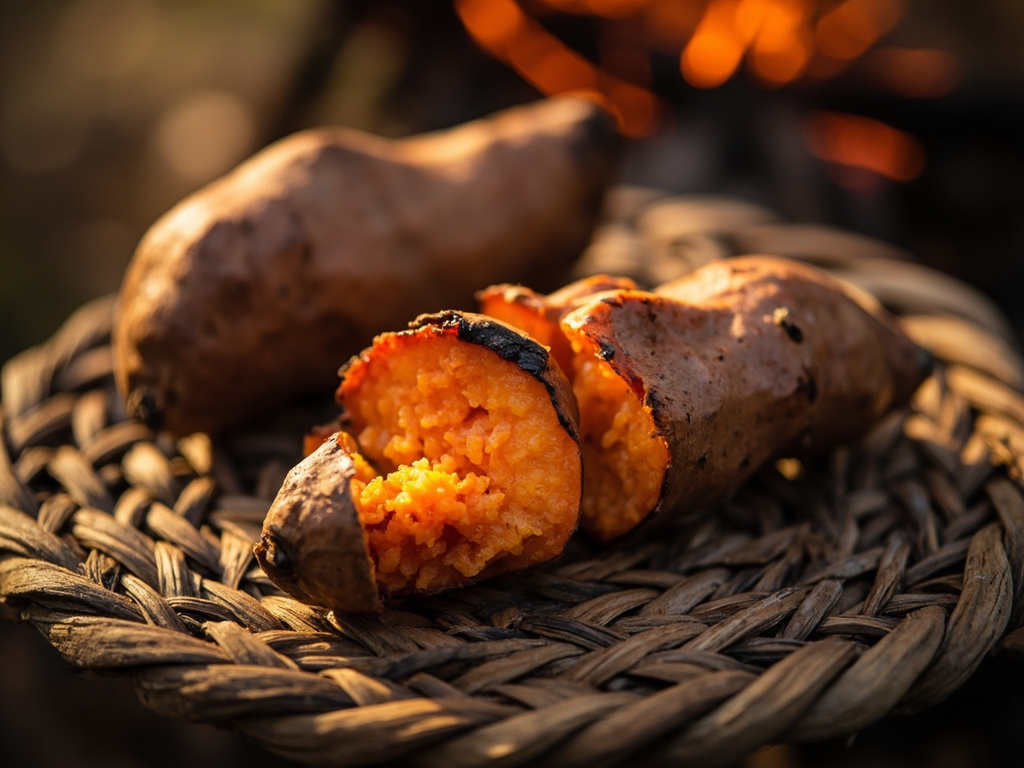
Kumara simply roasted in the embers of a fire, an everyday Māori technique. The slow heat caramelizes the orange flesh, making it tender and sweet. Served as is, it is the basic accompaniment to any meal, from the humblest to the most ceremonial.
Kumara is the taonga of the land — the treasure our tūpuna brought from Hawaiki in their waka. When my men return from battle, when Kawiti's warriors come to discuss the next fight against the red soldiers, kumara is what we bring out first. We place it in the embers, turn it when the skin blackens, and the flesh inside is sweet as the Pākehā's honey. A chief who cannot feed his people kumara is no chief. I, Heke, my kūmara are the sign that this land still feeds us — and that it is ours.
- •Kumara (sweet potato) — Several good-sized tubers (Single ingredient)
Kumara rōhi (Fire-roasted kumara)
Kumara simply roasted in the embers of a fire, an everyday Māori technique. The slow heat caramelizes the orange flesh, making it tender and sweet. Served as is, it is the basic accompaniment to any meal, from the humblest to the most ceremonial.
Why this dish? Kumara (sweet potato) was the most prestigious staple food of the Māori and a marker of wealth for a chief like Hone Heke. The Ngāpuhi of the Bay of Islands cultivated extensive kumara plantations, and the harvest was accompanied by ceremonies. For a rangatira, offering kumara to his warriors or visitors was an act of mana.
Kumara is the taonga of the land — the treasure our tūpuna brought from Hawaiki in their waka. When my men return from battle, when Kawiti's warriors come to discuss the next fight against the red soldiers, kumara is what we bring out first. We place it in the embers, turn it when the skin blackens, and the flesh inside is sweet as the Pākehā's honey. A chief who cannot feed his people kumara is no chief. I, Heke, my kūmara are the sign that this land still feeds us — and that it is ours.
Ingredients (period version)
- Kumara (sweet potato) — Several good-sized tubers (Single ingredient)
Ingredients
- Orange-fleshed sweet potatoes — 800 g (4 medium) (Base)
- Sea salt (optional) — 1 pinch (Seasoning)
Method
- Preheat the oven to 200 °C. Wash the sweet potatoes without peeling.
- Prick them in several places with a fork to let steam escape.
- Place them directly on the oven rack (or on a baking sheet lined with parchment paper).
- Bake for 45 to 60 minutes depending on size, until very tender when pierced.
- Remove from the oven, split lengthwise, and serve immediately, plain.
How it was made : Māori cultivated kumara long before European contact, having brought it from Eastern Polynesia during their migrations. It was cooked directly in the ashes of the hearth or in a small family hāngi. Ancient varieties (taputini, hutihuti) were smaller and more fibrous than modern kumara. Kumara held an almost sacred status: its planting and harvest were surrounded by rituals and chants (karakia).
The contemporary twist : Serve the roasted kumara split open, topped with a herb butter (parsley, chives) as a nod to the cross-cultural blend of Māori and European influences that characterized the Bay of Islands in the 1840s.
Sources : Best, Elsdon. “Food Products of Tuhoeland”. Transactions and Proceedings of the New Zealand Institute, vol. 35, 1902. · Leach, Helen. “The Kumara Economy of Pre-Contact New Zealand”. In 1,000 Years of Gardening in New Zealand, 2005.
Hone Heke · Charactorium