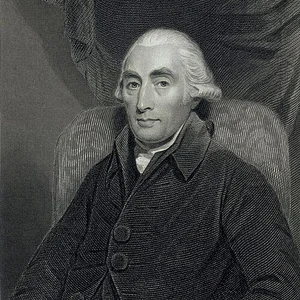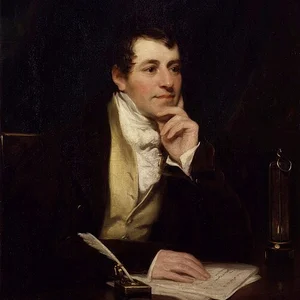

Humphry Davy was a British chemist and a pioneer of electrochemistry. He isolated several elements using electrolysis and invented the safety lamp for miners.
Humphry Davy(1778 — 1829)
Humphry Davy
royaume de Grande-Bretagne, Royaume-Uni de Grande-Bretagne et d'Irlande
6 min read
Frequently asked questions
Famous Quotes
« Nothing is so fatal to the progress of the human mind as to suppose that our views of science are ultimate.»
Key Facts
- In 1807, he isolated potassium and sodium through electrolysis
- In 1808, he isolated calcium, magnesium, barium and strontium
- Around 1799, he studied nitrous oxide (laughing gas) and its effects
- In 1815, he invented the safety lamp (Davy lamp) for miners
- In 1812, he was knighted and became one of the most famous chemists of his time
Works & Achievements
Pioneering study of the physiological effects of laughing gas, which later suggested its use as an anaesthetic.
First decomposition of potash and soda by electrolysis, revealing two previously unknown alkali metals.
A series of discoveries that considerably enriched the table of known chemical elements.
Davy proved that chlorine is an element in its own right and not a compound, correcting a widespread error.
A landmark treatise that systematised the principles of the modern chemistry of his day.
An invention that considerably reduced firedamp explosions in coal mines and saved many lives.
Anecdotes
In 1799, Humphry Davy experimented on himself with the effects of nitrous oxide, which he nicknamed “laughing gas.” He inhaled large quantities of it, noting the fits of laughter and euphoria it caused, and even organised social gatherings where his poet friends tried the gas.
Davy refused to take out a patent on his safety lamp, invented in 1815 to protect miners from firedamp explosions. He believed his duty to humanity came before profit, and declared that he would be rewarded enough by the good it brought to the workers.
In 1813, the young Michael Faraday, a humble bookbinder passionate about science, sent Davy his carefully transcribed lecture notes. Davy hired him as a laboratory assistant: Faraday would become one of the greatest physicists in history, surpassing his master.
Within a few years, Davy isolated a cascade of chemical elements through electrolysis: potassium and sodium in 1807, then calcium, magnesium, barium and strontium in 1808. When he first saw beads of potassium catch fire on contact with water, he is said to have danced for joy in his laboratory.
Despite the war between France and England, Napoleon allowed Davy to travel across France in 1813 to receive a scientific prize and continue his research. Knowledge was then regarded as belonging to all humanity, above the conflicts between nations.
Primary Sources
“The sensation of pleasure was at first local, felt in the lips and around the chest; but soon it spread throughout the whole body, and during the greater part of the experiment was intense and almost divine.”
“When the current of a powerful battery is passed through molten potash, small globules of metallic appearance, displaying a bright lustre, appear at the negative pole.”
“By surrounding the flame with a fabric of fine iron wire, light may be safely carried into an explosive atmosphere, for the heat of the flame is dissipated by the metal before it can ignite the gas outside.”
“Chemistry, in its broadest sense, is the science that deals with the changes of composition produced in bodies by the particular actions they exert upon one another.”
Key Places
Davy's birthplace, a fishing port in southwest England. It was here that he was apprenticed to an apothecary and discovered chemistry.
Institute where Davy studied the medical properties of gases from 1798, and where he experimented with nitrous oxide.
Research and lecture centre where Davy made his great electrochemical discoveries and gave famous lectures that made him popular.
Learned society of which Davy was elected president in 1820, the pinnacle of scientific recognition in his time.
City where Davy, weakened by illness, died in 1829 while travelling. He is buried there in the Cimetière des Rois (Plainpalais).
Typical Objects

Oil lamp whose flame is enclosed in a cylinder of fine wire gauze. The mesh dissipates the heat and stops the flame from igniting firedamp, saving countless miners.

A stack of discs of different metals separated by soaked cloth. Davy built enormous versions to produce the powerful currents needed for electrolysis.

A device made of electrodes plunged into a molten or dissolved substance and connected to a battery. Davy used it to break down potash and soda and to isolate new metals.

A pouch of oiled silk used to breathe gases during the Bristol experiments. Davy stored in it the “laughing gas” he tested on himself and his friends.

A precision beam balance for weighing very small quantities of matter. Essential for measuring the isolated elements and establishing the proportions of reactions.

Heat-resistant vessels of glass or refractory clay, used to heat, melt and distil substances in the laboratory.
School Curriculum
Vocabulary & Tags
Key Vocabulary
Tags
Daily Life
Morning
Davy rose early to get to his laboratory at the Royal Institution, where he set up his electrical apparatus and chemical preparations. Mornings were devoted to delicate electrolysis experiments, which demanded patience and meticulous observation.
Afternoon
In the afternoon, he wrote up his notes, corresponded with other scholars, and prepared the public lectures that made his reputation. He also received visitors curious to see his spectacular demonstrations.
Evening
In the evening, Davy frequented the salons of London high society, where his brilliant conversation and his passion for poetry were appreciated. A lover of literature, he composed verses himself and discussed ideas with Romantic writers.
Food
Davy ate according to the habits of the British middle class: meat, bread, vegetables, and tea. A keen angler, he enjoyed the fresh fish he caught himself during his excursions to the countryside.
Clothing
He wore the dress of an early nineteenth-century gentleman: a frock coat, waistcoat, high-collared shirt, and knotted cravat. In his laboratory, he put on an apron to protect himself from acids and splashes.
Housing
Davy lived for a long time in apartments connected to the Royal Institution in London, at the heart of the capital. Having become wealthy and knighted, he then led a comfortable life, traveling across Europe.
Historical Timeline
Period Vocabulary
Liens externes & ressources
Références
Œuvres
Recherches sur le protoxyde d'azote
1800
Isolement du potassium et du sodium
1807
Isolement du calcium, magnésium, baryum et strontium
1808
Démonstration de la nature élémentaire du chlore
1810
Elements of Chemical Philosophy
1812
Lampe de sûreté (lampe Davy)
1815