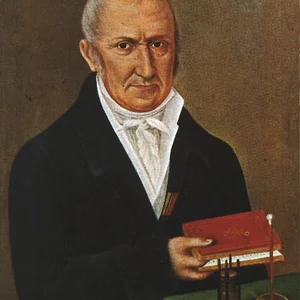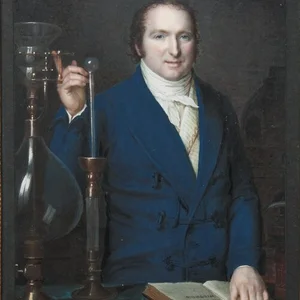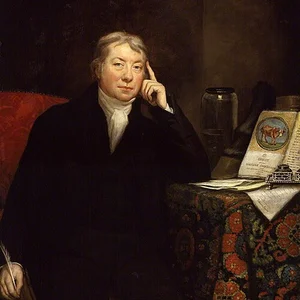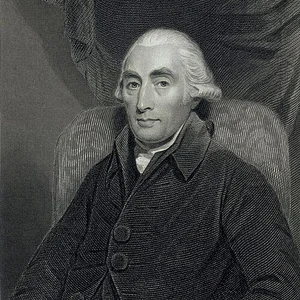

Joseph Black (1728-1799) was a Scottish chemist and physicist, a major figure of the Enlightenment. He discovered “fixed air” (carbon dioxide) and formulated the concepts of latent heat and specific heat, laying the foundations of thermodynamics.
Joseph Black(1728 — 1799)
Joseph Black
royaume de Grande-Bretagne
5 min read
Frequently asked questions
Key Facts
- Born on 16 April 1728 in Bordeaux and died on 6 December 1799 in Edinburgh
- Discovered “fixed air” (carbon dioxide) around 1754-1756 during his work on white magnesia
- Formulated the concept of latent heat around 1761 while studying the melting of ice and the boiling of water
- Defined the notion of specific heat, distinct from temperature
- A professor at the University of Glasgow and later Edinburgh, he influenced and supported James Watt's work on the steam engine
Works & Achievements
Medical thesis containing the discovery of fixed air and the systematic use of the balance; the founding act of quantitative chemistry.
Paper identifying carbon dioxide as a gas distinct from air; the first rigorous characterization of a chemical gas.
Discovery that melting and boiling absorb heat without a rise in temperature; a foundation of thermodynamics.
Observation that different substances require different amounts of heat to warm up by the same degree; a key notion in thermal physics.
His ideas on the heat of steam guided Watt in designing the separate condenser, the engine of the Industrial Revolution.
Posthumous collection of his lectures edited by John Robison, long the standard textbook of Scottish chemistry.
Anecdotes
To study "fixed air," Joseph Black heated chalk (calcium carbonate) and observed that it lost weight while releasing a gas that extinguished candles and killed small animals. It was the first time anyone had identified a gas chemically distinct from ordinary air: carbon dioxide.
Black noticed that a block of ice took surprisingly long to melt, even near a fire: the heat seemed to "disappear." From this he deduced the concept of latent heat, the energy absorbed by the ice to become water without its temperature rising.
Black was a close friend of the engineer James Watt, who worked at the University of Glasgow. His ideas about the latent heat of steam helped Watt understand why his steam engine wasted so much energy, contributing to the decisive improvement of 1765.
Renowned for the precision of his weighings, Black is said to have been one of the first chemists to systematically use the balance to track the transformations of matter. This quantitative approach foreshadowed the modern chemistry of Lavoisier.
A much-admired professor in Edinburgh, Black drew hundreds of students to his lectures, where he performed spectacular demonstrations. Yet he published very little during his lifetime, preferring to teach rather than write.
Primary Sources
Chalk and lime differ only because the former contains a great quantity of air, which, when it escapes, leaves the lime pure and caustic.
A considerable quantity of heat enters into the water that forms from melting ice, without thereby raising its temperature; this heat is, in a sense, latent.
Observing changes of state led me to regard the heat absorbed during melting as hidden within the liquid body.
Key Places
French city where Joseph Black was born in 1728, his father working there in the wine trade.
Where he studied and then held his first professorship, developing the concept of latent heat and befriending James Watt.
Where Black taught chemistry for thirty years, drawing many students with his demonstrations.
Capital of the Scottish Enlightenment where Black spent his final years and died in 1799.
Cemetery where Joseph Black was buried, in the heart of Edinburgh's old town.
Typical Objects

A beam instrument for finely weighing substances before and after a reaction. Black made it the central tool of his quantitative chemistry.

A device used to measure the quantities of heat exchanged during changes of state. Black relied on the melting of ice to quantify heat.

Glass vessels used to heat, distill and collect the gases released. They made it possible to isolate the fixed air given off by chalk.

A graduated instrument that measures temperature precisely. Essential for distinguishing latent heat from an actual change in temperature.

A soft rock that Black heated to release fixed air and obtain lime. The raw material of his discovery of carbon dioxide.

Carefully prepared lesson notes that Black read aloud to his students. Many of his ideas survived only thanks to these manuscripts.
School Curriculum
Vocabulary & Tags
Key Vocabulary
Tags
Daily Life
Morning
Black rose early and often devoted his mornings to the meticulous preparation of his lectures and demonstrations. Methodical, he would check his instruments and weigh his substances before each experiment.
Afternoon
In the afternoon, he taught before a lecture hall packed with students who had come from all over Europe. He performed spectacular experiments in chemistry and heat, explaining each step with clarity.
Evening
In the evening, Black frequented the learned clubs of Edinburgh, conversing with David Hume, Adam Smith, and James Hutton. These conversations fed the intellectual ferment of the Scottish Enlightenment.
Food
In fragile health, Black watched his diet and favored light meals, especially milk and bread. The plainness of his table reflected his reserved temperament and his taste for moderation.
Clothing
He wore the plain, neat attire of the eighteenth-century Scottish gentleman: a dark frock coat, waistcoat, breeches, stockings, and a powdered wig. His dress was elegant without ostentation.
Housing
Black lived in an Edinburgh town house near the university. His orderly interior housed his cabinet of instruments, his balances, and his scientific library.
Historical Timeline
Period Vocabulary
Liens externes & ressources
Références
Œuvres
Thèse sur la magnesia alba (De humore acido a cibis orto, et magnesia alba)
1754
Experiments upon Magnesia Alba, Quicklime, and some other Alcaline Substances
1756
Concept de chaleur latente
1761
Concept de chaleur spécifique
1760
Collaboration scientifique avec James Watt
1765
Lectures on the Elements of Chemistry
1803