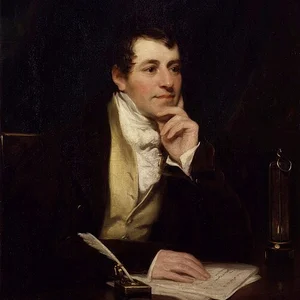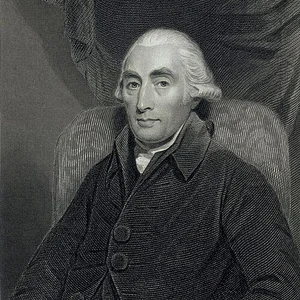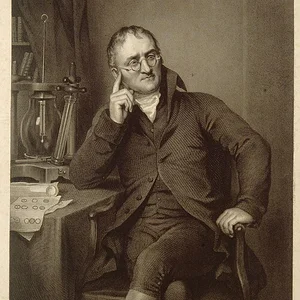

John Dalton was a British chemist, physicist and meteorologist. He is regarded as the father of modern atomic theory, according to which matter is made up of indivisible atoms specific to each element. He also described colour blindness, a condition he himself had.
John Dalton(1766 — 1844)
John Dalton
Royaume-Uni de Grande-Bretagne et d'Irlande
6 min read
Frequently asked questions
Key Facts
- Born in 1766 in Eaglesfield, England, into a modest Quaker family
- Published in 1794 the first scientific description of colour blindness (Daltonism), a condition he suffered from
- Stated around 1803 his law of partial pressures of gases (Dalton's law)
- Formulated from 1808 his atomic theory in 'A New System of Chemical Philosophy'
- Died in 1844 in Manchester
Works & Achievements
Dalton's first book, based on his daily weather records. In it he already tackles the nature of air and water vapour.
The first scientific description of colour blindness, drawn from his own case. The condition is named after him today.
The statement that, in a mixture of gases, each one exerts a pressure as if it were alone. A fundamental law of gas physics.
The discovery that elements combine in simple ratios of masses, a key argument in favour of the existence of atoms.
Dalton assigned relative masses to the elements, using hydrogen as a reference. It was a first in the history of chemistry.
A major work setting out atomic theory: matter is made of indivisible atoms, identical for a given element. The birth certificate of modern chemistry.
Anecdotes
John Dalton himself suffered from a colour blindness that he was the first to describe scientifically in 1794: he confused red and green, and believed that the fluid in his eye was tinted blue. It is in his honour that this condition is now called “Daltonism” (colour blindness).
Before he died, Dalton asked that his eyes be examined after his death to understand the origin of his colour blindness. In 1995, nearly 150 years later, researchers analysed the DNA of a preserved fragment of his eye and proved that he lacked the pigment sensitive to green.
Born into a modest Quaker family, Dalton became a teacher at the age of twelve in a small village school. Largely self-taught, he never attended university, which was closed to non-Anglicans in his day.
A keen meteorologist, Dalton kept a journal of weather observations almost every day for 57 years, accumulating more than 200,000 readings up until the day before his death.
At his death in 1844, Dalton was honoured as a national hero: more than 40,000 people filed past his coffin as it lay in state at Manchester Town Hall.
Primary Sources
The character by which colours appear to me must be in part distinct from that by which they appear to other persons; and it seems probable that the difference depends on the colour of the medium of the eye.
The ultimate particles of all homogeneous bodies are perfectly alike in weight, figure, etc. In other words, every particle of water is like every other particle of water.
Why does water not dissolve in all gases in the same way? I believe it depends on the weight and number of the ultimate particles of the different gases.
The quantity of a gas absorbed by water is, for each gas, proportional to the pressure it exerts; each gas in a mixture behaves as if it were alone.
Key Places
Village where John Dalton was born in 1766 into a family of Quaker weavers. It was there that he received his early education.
Town where Dalton ran a school with his brother and, as a self-taught scholar, deepened his knowledge of mathematics and natural philosophy.
Industrial city where Dalton spent most of his life, taught, and carried out his research on gases and atoms. He died there in 1844.
Learned society where Dalton presented most of his work and held important responsibilities. It was there that he set out his atomic theory.
British scientific academy that elected Dalton in 1822 and awarded him its Royal Medal in 1826.
Typical Objects

Dalton invented a system of small circles marked with dots, lines, or letters to represent the atoms of each element. It is the ancestor of modern chemical formulas.

An instrument measuring atmospheric pressure, essential to Dalton's daily weather records. He used it to study the behavior of gases and air.

Dalton recorded the temperature each day in his weather journal. The instrument also helped him study the expansion of gases by heat.

A graduated container used to measure the amount of rain that has fallen. Dalton used it for his observations on evaporation and the water cycle.

To establish relative atomic weights, Dalton had to carefully weigh the quantities of substances that combined. The balance was at the heart of his quantitative method.

A notebook in which Dalton recorded more than 200,000 weather observations over 57 years. This data fueled his thinking about gases and the atmosphere.
School Curriculum
Vocabulary & Tags
Key Vocabulary
Tags
Daily Life
Morning
Dalton rose early, true to Quaker simplicity, and often began by recording his temperature, his barometer reading and the state of the sky. He noted these observations in his weather journal before any other activity.
Afternoon
His afternoons were divided between the private lessons he gave to earn a living and his experiments on gases and chemical compounds. He weighed, measured and methodically recorded his results.
Evening
In the evening, Dalton attended the Manchester Literary and Philosophical Society, where he discussed science and presented his work. He also enjoyed reading and preparing his future papers.
Food
As a good Quaker, Dalton led a frugal life without excess, eating simple meals. He avoided ostentation and drink, in keeping with his religious convictions.
Clothing
He wore the plain, dark clothes of the Quakers, without ornament or bright colours. In an irony of his colour blindness, he could barely tell shades apart and once appeared dressed in red without realising it.
Housing
For decades, Dalton lodged modestly with friends in Manchester, occupying rented rooms where he also set up his equipment. He lived without luxury, unmarried and entirely devoted to science.
Historical Timeline
Period Vocabulary
Liens externes & ressources
Références
Œuvres
Meteorological Observations and Essays
1793
Description du daltonisme (Extraordinary facts relating to the vision of colours)
1794
Loi des pressions partielles (loi de Dalton)
1801
Loi des proportions multiples
1803
Première table des poids atomiques
1803
A New System of Chemical Philosophy
1808