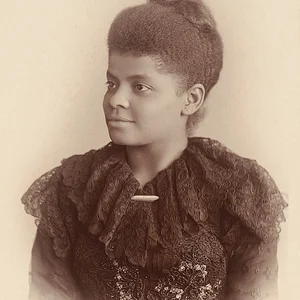

African American journalist and activist born into slavery in 1862, Ida B. Wells conducted rigorous investigations into lynching in the United States and co-founded the NAACP. A pioneering figure in investigative journalism and the civil rights movement.
Ida B. Wells(1862 — 1931)
Ida B. Wells
États-Unis
9 min read
Frequently asked questions
Famous Quotes
« Silence does not protect women — it protects their aggressors.»
« The only way to stop lynching is to rise up against it.»
Key Facts
- 1862: born in Holly Springs, Mississippi, into a family of enslaved people freed at the end of the Civil War
- 1884: refused to give up her seat in a whites-only train car, seven years before the Rosa Parks case
- 1892: publication of 'Southern Horrors', a pioneering investigation into lynching in the United States
- 1909: co-founder of the NAACP (National Association for the Advancement of Colored People)
- 1931: died in Chicago after a lifetime devoted to fighting segregation and women's suffrage
Works & Achievements
Ida B. Wells's first major investigation into lynching, published after the murder of her friend Thomas Moss. She demonstrates that most rape accusations against Black men were pretexts to eliminate economic or political rivals.
The first systematic statistical count of lynchings in the United States between 1892 and 1894: more than 2,500 documented cases with names, dates, and alleged motives. This work of investigative journalism is still used by historians today.
An investigation into the New Orleans race riots, in which Wells documents police violence and white mob violence against the Black community. She demands a federal commission of inquiry.
Wells was one of the founding figures of the NAACP, an organization still active today that fights for the civil rights of African Americans. She was one of the few Black women to sign the founding manifesto.
Memoirs written in the final years of her life, published posthumously by her daughter. This book is the primary firsthand source on the life and activism of Ida B. Wells.
Anecdotes
In 1878, a yellow fever epidemic claimed the lives of Ida B. Wells's parents and one of her brothers. She was only sixteen years old. To prevent her siblings from being separated into foster families, she lied about her age and got herself hired as a schoolteacher, becoming the sole provider for all her brothers and sisters.
In 1884, Ida B. Wells purchased a first-class ticket for the train between Memphis and Nashville. The conductor ordered her to move to the “colored car,” a crowded, smoke-filled carriage. She refused and clung to her seat. Forcibly ejected, she filed a lawsuit and initially won: the lower court awarded her $500 in damages. The Tennessee Supreme Court would overturn that ruling five years later.
In March 1892, her friend Thomas Moss, the owner of a grocery store in Memphis, was lynched by a white mob jealous of his business success. Wells investigated and published scathing editorials in her newspaper. In retaliation, her printing press was destroyed and she received death threats. She would never be able to return to the South. This episode convinced her to dedicate her life to exposing the crime of lynching.
Ida B. Wells carried a revolver in her purse. She stated plainly: “A Winchester rifle in every Negro home would do more to settle the lynching question than all the conferences in the world.” For her, the right to self-defense was not an option but a vital necessity in segregationist America.
In 1913, during the great suffragette march in Washington, D.C., the white organizers asked Black women to march separately, at the back of the procession. Wells refused and waited on the sidewalk. When the Illinois delegation passed in front of her, she stepped forward and took her place among the other marchers. No one dared stop her.
Primary Sources
Nobody in this section of the country believes the old thread-bare lie that Negro men rape white women. If Southern white men are not careful, they will over-reach themselves and public sentiment will have a reaction; a conclusion will then be reached which will be very damaging to the moral reputation of their women.
In slave times the Negro was kept subservient and submissive by the frequency and severity of the scourging, but, with freedom, a new system of intimidation came into vogue; the Negro was not only whipped and scourged; he was killed.
I had already determined to sell my one-third interest in the Free Speech and use the money to go on an extended trip to investigate and write about the lynching evil, but I had not yet made any definite plans. The destruction of my paper and the threats of death changed that. I went to New York.
This is not a defense of any crime, but a record of the barbarism of mob law which, within the past thirty years, has executed without judge or jury more than ten thousand men, women and children.
The colored people of Chicago are not looking for social equality with white people. They are simply asking for the same protection under the law that other citizens enjoy.
Key Places
Ida B. Wells's birthplace, where she was born into slavery on July 16, 1862. Her parents, freed at the end of the Civil War, were taken by a yellow fever epidemic in 1878, leaving Ida solely responsible for her six younger siblings.
Wells settled here as a schoolteacher, then as a journalist and co-owner of the newspaper *Free Speech*. It was here that she conducted her first investigations into lynchings — and where she was forced to flee in 1892 after her printing press was destroyed.
Exiled from the South, Wells settled in Chicago, where she became a leading figure in the African American community. She founded the Negro Fellowship League, campaigned for women's suffrage, and died here in 1931.
Wells undertook two lecture tours of England (1893 and 1894) to raise British awareness of lynching. Her strategy of international public diplomacy pressured American media into covering an issue they had largely ignored until then.
Wells took part in the 1913 suffrage march here and petitioned the U.S. Congress on multiple occasions to pass a federal anti-lynching law — legislation that was never enacted during her lifetime.
Typical Objects

Wells conducted her investigations with the rigor of a journalist, collecting testimonies, dates, and victims' names. Her notebooks formed the raw material of her statistical reports on lynching — a groundbreaking method for the era.

Wells carried a revolver when she traveled and urged Black communities to arm themselves in self-defense. In her view, faced with the violence of white mobs and the inaction of law enforcement, self-defense was a fundamental right.
📷 CC BY 2.5 · Wikimedia Commons ↗
Wells co-edited the newspaper 'Free Speech and Headlight' in Memphis. Her press was destroyed by a mob in 1892 in retaliation for her editorials. That act of violent censorship only deepened her determination to keep writing.

In 1884, Wells deliberately purchased a first-class ticket to challenge railway segregation. This act of civic resistance — seventy years before Rosa Parks — marks the beginning of her public activism.

For 'The Red Record' (1895), Wells painstakingly compiled tables recording lynchings by state, by year, and by alleged motive. These hard figures gave her arguments irrefutable force against authorities who consistently downplayed the scale of the violence.

Wells distributed her investigative pamphlets during speaking tours of England (1893 and 1894), where she worked to rally British public opinion against lynching, hoping that international pressure would compel the United States to act.
School Curriculum
Vocabulary & Tags
Key Vocabulary
Tags
Daily Life
Morning
In the 1890s in Memphis, Ida B. Wells rose early to read dispatches and local newspapers, watching for news of racial incidents. She wrote her editorials in the morning, often standing at a desk, before heading to the 'Free Speech' newsroom. The day sometimes began with correspondence with witnesses or lawyers she was consulting for her investigations.
Afternoon
Her afternoons were split between managing the newsroom, interviewing witnesses, and traveling to gather information in the field. After 1892, from New York or Chicago, she met journalists, pastors, and African American elected officials, patiently building an activist network. She also prepared her public lectures, which she often gave in the evenings.
Evening
Wells regularly gave lectures in churches and community halls, before Black audiences or, during her British tours, mixed ones. After her talks, she would discuss at length with the audience. At home in the evenings, she read, annotated documents, and kept her diary, written with journalistic precision.
Food
Like the majority of African American families in the South at that time, her diet in her youth was simple: corn, garden vegetables, and poultry. In Chicago, her more comfortable circumstances allowed for greater variety. She welcomed activists and intellectuals such as W.E.B. Du Bois and Frederick Douglass at her table.
Clothing
Wells dressed with the bourgeois rigor expected of educated Black women of her era, who knew that their appearance was a political act: dark long dress, closed collar, impeccable chignon. In photographs, she always appears elegant and dignified, refusing any degrading stereotype. During her expulsion from the train in 1884, it was dressed in first-class attire that she stood her ground against the conductor.
Housing
After the destruction of her press in Memphis (1892), Wells was never able to own property in the South. In Chicago, she settled with her family in the Black neighborhood of Bronzeville, first in an apartment and then a house. Her Chicago home, where she spent the last decades of her life, is today a National Historic Landmark.
Historical Timeline
Period Vocabulary
Liens externes & ressources
Références
Œuvres
Southern Horrors: Lynch Law in All Its Phases
1892
The Red Record
1895
Mob Rule in New Orleans
1900
Co-fondation de la NAACP (National Association for the Advancement of Colored People)
1909
Crusade for Justice (autobiographie)
1928 (publié en 1970)