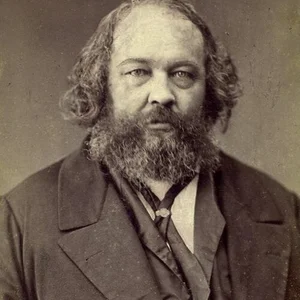

Russian revolutionary and philosopher, a major figure of anarchism and libertarian socialism in the 19th century. An opponent of Marx within the First International, he advocated the abolition of the State and of all authority in favor of a federalist and collectivist society.
Mikhail Bakunin(1814 — 1876)
Mikhail Bakunin
France, Empire russe
6 min read
Frequently asked questions
Famous Quotes
« Freedom without socialism is privilege and injustice; socialism without freedom is slavery and brutality.»
« The passion for destruction is also a creative passion.»
Key Facts
- Born in 1814 into a Russian noble family in Pryamukhino
- Took part in the revolutions of 1848-1849 (Prague, Dresden), arrested and handed over to Russia
- Deported to Siberia, he escaped in 1861 and made his way back to Western Europe
- Rivalry with Karl Marx leading to his expulsion from the First International in 1872
- Died in 1876 in Bern, leaving behind a body of work foundational to anarchism
Works & Achievements
A foundational text setting out his vision of a federalist society, without State or God, opposed to all centralized authority.
Bakunin's most famous work, a scathing critique of religion and the State in the name of human freedom.
A major work in which he criticizes Marxism and defends anarchism; in it he formulates his famous opposition between liberty and authoritarian socialism.
An organization with an anarchist orientation that rivaled the Marxist leadership within the First International.
A long autobiographical text addressed to Tsar Nicholas I from prison, a valuable document on his revolutionary journey.
A program setting out the principles of social revolution and freedom grounded in federalism and atheism.
A vast work criticizing the German and Russian State, from which the fragment known as God and the State is drawn.
Anecdotes
Born into a family of the Russian nobility, Bakunin was first an officer in the tsar's artillery before resigning to study philosophy. He left Russia in 1840 and would not return until years later, as a prisoner.
During the revolutions of 1848-1849, Bakunin took part in the Dresden uprising alongside the composer Richard Wagner. Arrested, he was sentenced to death twice (in Saxony, then in Austria) before finally being handed over to Russia.
Imprisoned in the grim Peter and Paul Fortress in Saint Petersburg, he was asked by Tsar Nicholas I to write a confession. Bakunin produced a long, ambiguous text, then was exiled to Siberia, from which he escaped in 1861 by way of an extraordinary journey across Japan and the United States before returning to Europe.
His rivalry with Karl Marx within the First International was fierce: in 1872, at the Hague Congress, Marx's supporters had Bakunin expelled from the organization, triggering a lasting split between Marxists and anarchists.
Endowed with legendary physical strength and eloquence, Bakunin lived in constant disorder, penniless, sleeping little, smoking heavily, and stirring crowds with his fiery speeches on freedom.
Primary Sources
If God really existed, it would be necessary to abolish him. All authority, divine or human, is a negation of the freedom of man.
Liberty without socialism is privilege and injustice; socialism without liberty is slavery and brutality.
A text written in captivity in the Peter and Paul Fortress, in which Bakunin addresses the Tsar to lay out his revolutionary journey.
The State is nothing but this devouring abstraction of the life of the people; it is the perpetual sacrifice of the masses to a small number of the privileged.
Key Places
Family estate where Bakunin was born, within the Russian rural nobility. It was here that his early intellectual sensibility took shape.
Political prison of the tsarist regime where Bakunin was held after his extradition. There he wrote his famous Confession to the Tsar.
City where Bakunin took part in the uprising of May 1849 alongside Richard Wagner. His arrest there marked the beginning of his years of captivity.
Place of Bakunin's exile after his years in prison, from which he escaped in 1861 on a long journey around the world.
Center of Bakunin's militant activity in the 1860s and 1870s, where he organized his anarchist networks and confronted the Marxists of the International.
City where Bakunin spent his final years and died in 1876, ill and penniless.
Liens externes & ressources
Références
Œuvres
Fédéralisme, socialisme et antithéologisme
1867
Dieu et l'État
rédigé en 1871, publié à titre posthume en 1882
Étatisme et anarchie
1873
Fondation de l'Alliance internationale de la démocratie socialiste
1868
La Confession
1851
Catéchisme révolutionnaire
vers 1866
L'Empire knouto-germanique et la Révolution sociale
1871