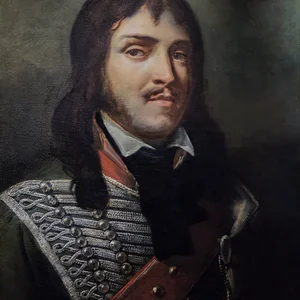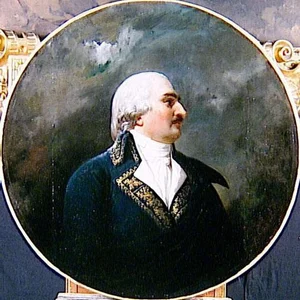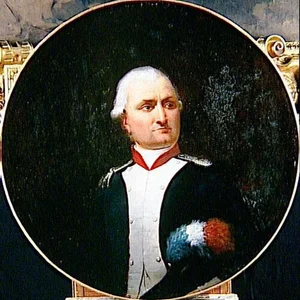

French general (1740–1792), commander of Verdun during the Prussian invasion of 1792. Refusing to surrender, he died on September 2, 1792, rather than sign the capitulation of the fortress. His sacrifice became a symbol of revolutionary patriotism.
Nicolas-Joseph Beaurepaire(1740 — 1792)
Nicolas-Joseph Beaurepaire
France
9 min read
Frequently asked questions
Key Facts
- Born in 1740 in Thouars (Deux-Sèvres), a career officer under the Ancien Régime
- Commanded the Verdun garrison during the Austro-Prussian invasion of summer 1792
- On September 2, 1792, refused to sign Verdun's capitulation and died (suicide or violent death)
- The National Convention voted to transfer his remains to the Panthéon in recognition — a decree never carried out
- His death preceded the September Massacres of 1792 by a few hours and galvanized the patriotic surge
Works & Achievements
Command of the resistance of the fortress of Verdun against the coalition troops. Beaurepaire refused all capitulation until his death, making this siege a founding act of republican patriotism and an enduring symbol in national memory.
Letters and military reports sent to the revolutionary government on the state of Verdun's fortifications and the garrison's needs, reflecting his awareness of the strategic importance of the Lorraine frontier.
A major political and moral act: before the municipal council of Verdun assembled to vote on surrender, Beaurepaire issued a categorical and public refusal, choosing death over dishonor.
By decree, the Legislative Assembly ordered that honors be rendered to Beaurepaire and that his heart be carried to the Panthéon — the institution created to receive the great men of the nation — enshrining him in republican memory.
Anecdotes
On the night of September 1st to 2nd, 1792, as Prussian shells rained down on Verdun, the town council called an emergency meeting to vote on surrender. Beaurepaire took the floor and opposed it vehemently, declaring that a French officer could not sign such a disgrace. Outvoted by the city's notables, he refused to initial the capitulation document and left the room under the stunned eyes of the councillors.
On the morning of September 2nd, 1792, Beaurepaire was found dead from a bullet to the head in his command quarters. The heroic version — widely spread by the Legislative Assembly and then the Convention — holds that he shot himself rather than see his flag lowered before the enemy. Some historians have nonetheless raised doubts: he may have died of an attack, or been killed in the confusion of the siege. This very uncertainty testifies to the speed with which the Revolution transformed his death into a founding myth.
As early as September 4th, 1792, just two days after his death, the Legislative Assembly decreed that Beaurepaire had well deserved of the fatherland. His heart was symbolically carried to the Panthéon, making him one of the very first official heroes of the nascent Republic, honored alongside the great men of the nation.
The fall of Verdun triggered immediate panic in Paris: the news that the Prussians had broken through toward the capital set off the infamous September Massacres (September 2–6, 1792), during which frenzied crowds stormed the prisons and killed more than a thousand inmates. Beaurepaire, who had died that very day, unwittingly became the symbolic spark for one of the darkest episodes of the Revolution.
Born into a family of minor Angevin nobility, Beaurepaire had served in the royal army well before the Revolution. At the Fête de la Fédération on July 14th, 1790, he was among the officers who swore an oath to the nation, the law, and the king on the Champ-de-Mars. His trajectory illustrates that of many officers of the *Ancien Régime* who sincerely embraced the revolutionary ideals and committed their very lives to them.
Primary Sources
The Legislative Assembly declares that Commander Beaurepaire has well deserved of the fatherland, and orders that his heart be carried to the Panthéon as a token of national gratitude.
The commander of the garrison declared that he could not consent to any capitulation and formally opposed it, stating that it was impossible for him to sign an act so contrary to the honor of French arms.
The garrison of Verdun, under the orders of Commander Beaurepaire, withstood the bombardment with steadfastness. The commander never ceased to urge the troops to resist, refusing any negotiation with the enemy until his last breath.
I shall defend Verdun to the last extremity; the honor of the Republic and of my arms demands it. I cannot bring myself to agree to a capitulation that would cover the French name in shame.
Boldness, more boldness, always boldness, and France is saved! The entire nation must henceforth become the army of the fatherland.
Key Places
Birthplace of Nicolas-Joseph Beaurepaire, born in 1740 in this small town in Anjou. His family belonged to the minor local nobility, a social class that supplied most of the officers in the royal army at the time.
The Lorraine fortress where Beaurepaire commanded the garrison during the Prussian siege of August–September 1792. It was here that he died on **2 September 1792**, refusing to sign the city's surrender to the coalition armies.
The republican mausoleum where Beaurepaire's heart was symbolically enshrined by decree of the Legislative Assembly in September 1792. This official gesture confirmed his status as a hero and martyr of the French Revolution.
The first French fortress to fall to the Prussian invasion, on **23 August 1792**, just days before Verdun. Its capture illustrates the military collapse against which Beaurepaire attempted to mount a heroic resistance.
Typical Objects

A sword with a bronze or polished steel guard carried by officers of the royal and later revolutionary army. A symbol of honor and command, it accompanied the officer in all circumstances, from parade to combat.

A single-shot sidearm worn on a baldric by high-ranking officers. According to patriotic tradition, this is the weapon Beaurepaire used to take his own life rather than sign the surrender of Verdun.

A circular blue, white, and red fabric badge worn on the hat or jacket from 1789 onward. A sign of allegiance to the revolutionary cause, it was mandatory for every soldier and patriotic citizen.

A blue coat with red lapels and cuffs, gold epaulettes, white breeches, and black boots, in keeping with the military regulations of 1792. It gradually replaced the white dress of the Ancien Régime.

A hand-drawn or engraved topographic map showing the fortifications, roads, and troop positions around Verdun. An essential tool for the garrison commander to organize the defense and track enemy movements.

A banner in the national colors (blue, white, red) that replaced the royal white flags from 1790 onward. Entrusted to each regiment, it embodied the unit's honor and was never to fall into enemy hands.
School Curriculum
Vocabulary & Tags
Key Vocabulary
Daily Life
Morning
In the early days of the siege, Beaurepaire rises before dawn to inspect the ramparts of Verdun, built according to **Vauban**'s plans the previous century. He reviews the national volunteers and line soldiers, checks the condition of the cannons and the powder supply. His officers' reports on Prussian positions are read and discussed over a simple breakfast of bread, cheese, and wine.
Afternoon
The afternoon is devoted to directing operations: reinforcing the bastions, organizing watch rounds, receiving dispatches from Paris or forward posts. Beaurepaire dictates his orders, keeps a siege journal, and confers with military engineers on the weak points of the fortifications. He also receives delegates from the municipal council, with whom tensions rise as the bombardment intensifies.
Evening
In the evening, officers and municipal council representatives gather by candlelight to assess the military situation. Beaurepaire stubbornly defends the necessity of holding out, refusing to consider any negotiation. At night, Prussian bombardments make sleep difficult; he sleeps fully dressed, ready to rush back to the ramparts at the first sign of an assault.
Food
Like all those under siege, Beaurepaire shares the military rations: often stale bread, vegetable soup, salted meat, and dried beans. Wine cut with water remains the main drink of the Lorraine soldiers. As commander, he can access a few extra provisions — local cheeses, *eau-de-vie* — but supplies dwindle rapidly as the weeks of siege wear on.
Clothing
Beaurepaire wears the regulation uniform of a brigade general: a blue coat with red lapels and facings, gold epaulettes, white breeches, and black turned-top boots. On his bicorne hat, the tricolor cockade is prominently displayed, signaling his commitment to revolutionary principles. In moments of crisis, he no longer removes his uniform, even to sleep.
Housing
Beaurepaire lodges in the command headquarters of the **Verdun** citadel, a military building with thick walls inherited from **Vauban**'s engineers. His room is simply furnished: a camp bed, a desk cluttered with maps and reports, and a wardrobe holding his dress uniform. The windows look out onto the ramparts, a constant reminder of the Prussian threat encircling the city.
Historical Timeline
Period Vocabulary
Liens externes & ressources
Références
Œuvres
Défense de Verdun face à l'armée prussienne du duc de Brunswick
Août-septembre 1792
Correspondance officielle avec le ministre de la Guerre Servan
Été 1792
Refus public de signer l'acte de capitulation
2 septembre 1792
Cénotaphe au Panthéon (décret de l'Assemblée législative)
4 septembre 1792