 flip
flipChapon rôti, sauce au verjus
Chapon rôti, sauce au verjus
Why this dish? Having become historiographer to the king and received at Versailles, Racine knew the great tables of the court. The roast—a piece of meat roasted on a spit—is the highlight of a festive meal, and the capon is its star. The verjus sauce, lively and refined, signals classical taste: brilliance without heaviness.
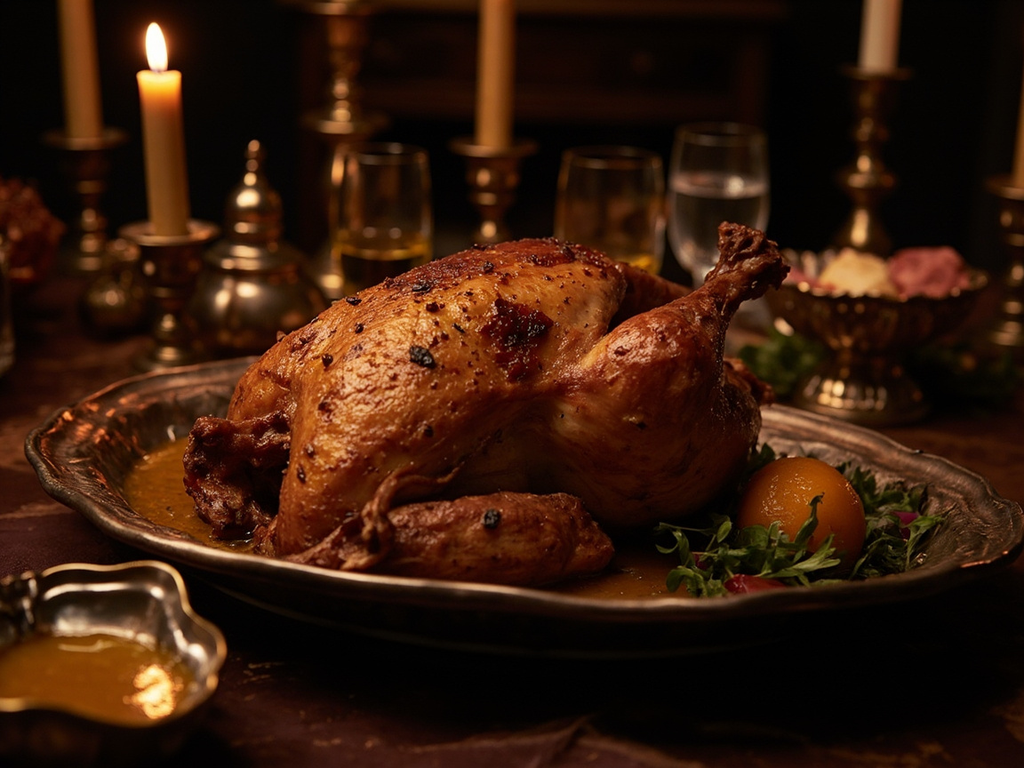
A beautiful capon golden from the spit, its skin crispy, coated with a short verjus and butter sauce. It is the showpiece dish for Sundays and feast days, brought with ceremony at the second service.
Ah, here is a dish worthy of a table where one entertains! At court, I was served capon perfectly golden, the skin crackling under the tooth. The secret, I assure you, lies entirely in the sauce: you deglaze the roasting juices with a dash of verjus—that green grape juice that pricks without burning—and then mount it all with a good piece of butter. Beware of excessive spices, which smack of old times; a hint of sweet-and-sour is enough to lift the flesh. That is the whole art of our century: measure in magnificence.
- •Chapon (ou belle volaille engraissée) — une pièce (viande de fête, rôtie à la broche)
- •Barde de lard — quelques bardes (garde la chair moelleuse à la cuisson)
- •Verjus — un demi-gobelet (acidité de la sauce, signature)
- •Beurre frais — un bon morceau (lie et adoucit la sauce)
- •Bouquet d'herbes (thym, persil, laurier) — un petit bouquet (parfum du rôt)
- •Sel — à discrétion (assaisonnement)
Chapon rôti, sauce au verjus
A beautiful capon golden from the spit, its skin crispy, coated with a short verjus and butter sauce. It is the showpiece dish for Sundays and feast days, brought with ceremony at the second service.
Why this dish? Having become historiographer to the king and received at Versailles, Racine knew the great tables of the court. The roast—a piece of meat roasted on a spit—is the highlight of a festive meal, and the capon is its star. The verjus sauce, lively and refined, signals classical taste: brilliance without heaviness.
Ah, here is a dish worthy of a table where one entertains! At court, I was served capon perfectly golden, the skin crackling under the tooth. The secret, I assure you, lies entirely in the sauce: you deglaze the roasting juices with a dash of verjus—that green grape juice that pricks without burning—and then mount it all with a good piece of butter. Beware of excessive spices, which smack of old times; a hint of sweet-and-sour is enough to lift the flesh. That is the whole art of our century: measure in magnificence.
Ingredients (period version)
- Chapon (ou belle volaille engraissée) — une pièce (viande de fête, rôtie à la broche)
- Barde de lard — quelques bardes (garde la chair moelleuse à la cuisson)
- Verjus — un demi-gobelet (acidité de la sauce, signature)
- Beurre frais — un bon morceau (lie et adoucit la sauce)
- Bouquet d'herbes (thym, persil, laurier) — un petit bouquet (parfum du rôt)
- Sel — à discrétion (assaisonnement)
Ingredients
- Free-range chicken or capon — 1 piece (≈2 kg) (centerpiece)
- Bard of lard or smoked belly slices — 2-3 slices (moisture)
- Verjus (or substitute: white grape juice + lemon juice) — 150 ml (sauce acidity)
- Butter — 50 g (sauce binder)
- Bouquet garni (thyme, parsley, bay leaf) — 1 (flavor)
- Salt, pepper — to taste (seasoning)
Method
- Preheat oven to 200 °C. Season the capon inside and out with salt, place the bouquet garni in the cavity.
- Bard the breast with lard slices, place the bird on a rack over a roasting pan.
- Roast for about 1 hour 15 to 1 hour 30 (approx. 40 min per kg), basting regularly with the rendered juices; remove the barding at the end to brown the skin.
- Keep the capon warm. Degrease the pan, set it on the stove and deglaze with verjus, scraping up the browned bits.
- Reduce by one-third, then mount the sauce with cold butter off the heat, whisking to make it shiny.
- Carve the capon, nap with verjus sauce, and serve immediately.
How it was made : In the Grand Siècle, meats were cooked on a spit in front of the fire, the turning often entrusted to a child or a weight mechanism. The capon—a castrated and fattened young rooster—was the prestige poultry for grand occasions. Verjus, ubiquitous in kitchens, played the role that lemon or fine vinegar plays today.
The contemporary twist : For a "classical tragedy" nod, serve the capon on a large oval platter, sauce on the side in a sauceboat, and call it "Andromache's Roast" on your menu.
Sources : François Pierre de La Varenne, Le Cuisinier françois, 1651 · Nicolas de Bonnefons, Les Délices de la campagne, 1654
Jean Racine · Charactorium