 flip
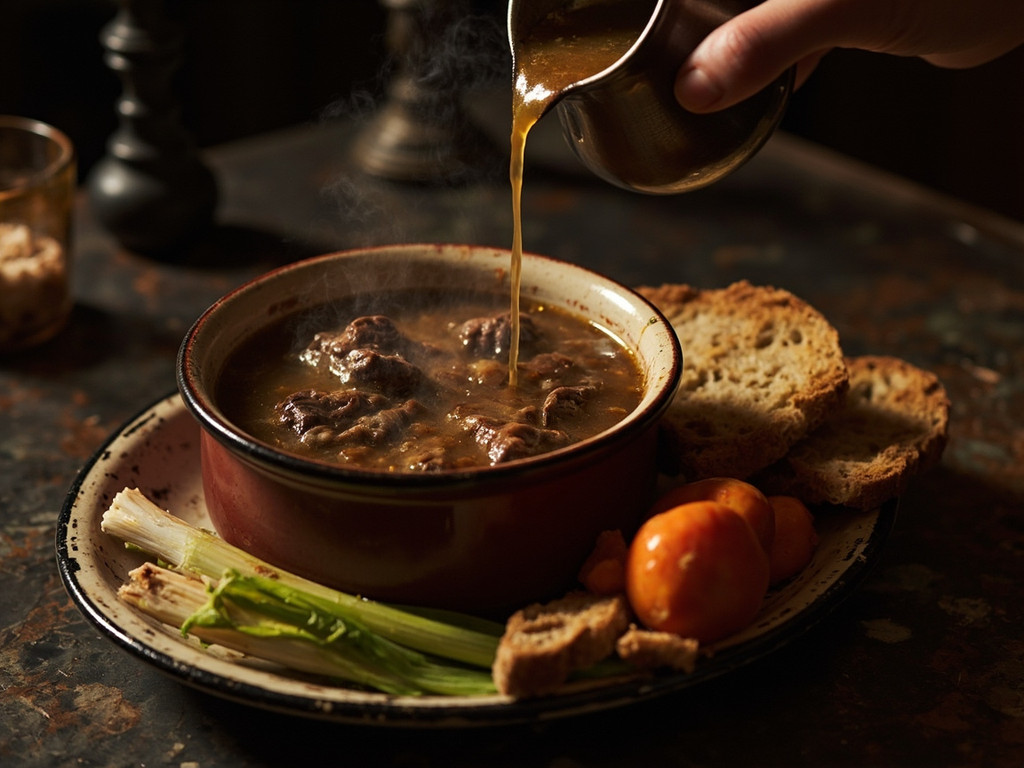
flipThe Gargote Broth with Boiled Beef
The Gargote Broth with Boiled Beef
Why this dish? This is the everyday fare of lean days: Jeanne, like all Bohemians of the Latin Quarter, shares soup, boiled meat, and bread at the cheap eateries, according to the coins that come in. This broth was drunk standing at the counter in the narrow streets of the Île Saint-Louis.
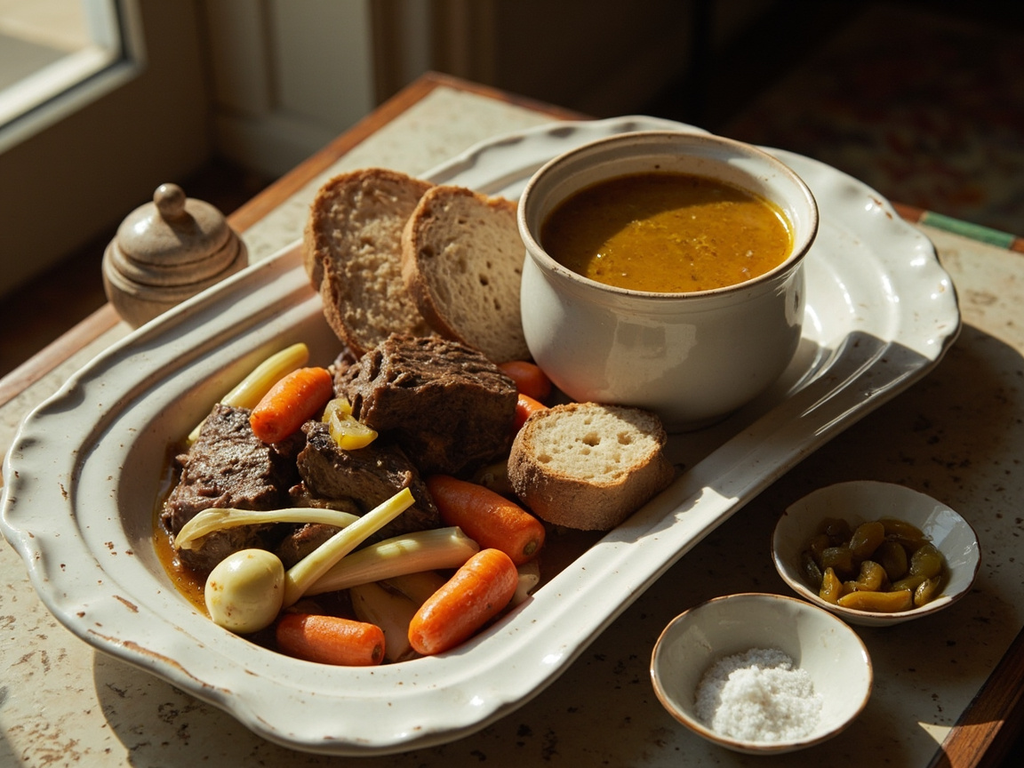
A poor man's pot-au-feu: a piece of boiling beef simmered long with a few root vegetables, from which one first draws a comforting broth served on stale bread, then the meat as a second course. Nothing is wasted, everything nourishes.
Go on, I won't shame you with manners: when the purse is flat, you keep body and soul together with what you have. I would ask the cook for a big bowl of his broth, dip yesterday's bread in it, and believe me, on winter evenings on the Île Saint-Louis, that warms you better than a madrigal. The meat we kept for later, with a little coarse salt — that was two meals from one pot, and we were well content with it.
- •Boiling beef (gîte) — a good piece (meat and broth base)
- •Leeks, carrots, turnip — whatever is at market (pot vegetables)
- •Onion stuck with a clove — one (flavoring)
- •Stale bread — a few slices (broth support)
- •Coarse salt — to taste (seasoning)
The Gargote Broth with Boiled Beef
A poor man's pot-au-feu: a piece of boiling beef simmered long with a few root vegetables, from which one first draws a comforting broth served on stale bread, then the meat as a second course. Nothing is wasted, everything nourishes.
Why this dish? This is the everyday fare of lean days: Jeanne, like all Bohemians of the Latin Quarter, shares soup, boiled meat, and bread at the cheap eateries, according to the coins that come in. This broth was drunk standing at the counter in the narrow streets of the Île Saint-Louis.
Go on, I won't shame you with manners: when the purse is flat, you keep body and soul together with what you have. I would ask the cook for a big bowl of his broth, dip yesterday's bread in it, and believe me, on winter evenings on the Île Saint-Louis, that warms you better than a madrigal. The meat we kept for later, with a little coarse salt — that was two meals from one pot, and we were well content with it.
Ingredients (period version)
- Boiling beef (gîte) — a good piece (meat and broth base)
- Leeks, carrots, turnip — whatever is at market (pot vegetables)
- Onion stuck with a clove — one (flavoring)
- Stale bread — a few slices (broth support)
- Coarse salt — to taste (seasoning)
Ingredients
- Beef brisket or shin — 800 g (meat and broth base)
- Leeks — 2 (pot vegetable)
- Carrots — 3 (pot vegetable)
- Turnip — 1 (pot vegetable)
- Onion + 1 clove — 1 (flavoring)
- Stale country bread — 4 slices (broth support)
- Coarse salt, pepper, bouquet garni — to taste (seasoning)
Method
- Place the beef in a large pot, cover generously with cold water, and bring slowly to a simmer.
- Skim off the gray scum that rises, then add the clove-studded onion, bouquet garni, and a pinch of coarse salt.
- Simmer gently for 2 hours, then add carrots, leeks, and turnip and continue for 45 minutes.
- Place the stale bread slices in the bottom of bowls, pour the boiling broth over them, and serve.
- Then present the drained meat and vegetables with coarse salt and a little mustard.
How it was made : In Second Empire Paris, pot-au-feu was the king of common people's meals: first the broth was drawn (sold separately in popular soup kitchens and eateries), then the boiled meat was eaten. Impoverished artists lived on these fixed-price table d'hôtes, sitting elbow to elbow.
The contemporary twist : Serve the broth in a cup, with shredded meat on the side with a touch of old-fashioned mustard and cornichons — a 'deconstructed pot-au-feu' that owns its counter origins.
Sources : Louis-Eustache Audot, La Cuisinière de la campagne et de la ville (rééditions XIXe s.)
Jeanne Duval · Charactorium