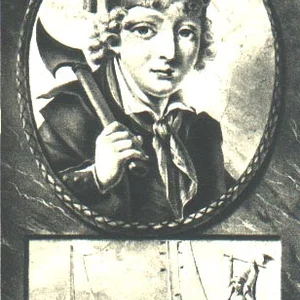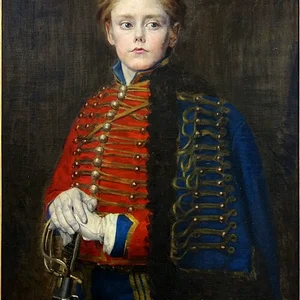

A drummer boy for the Republic at age 13, Joseph Bara was killed by Vendée rebels in 1793. Robespierre held him up as an exemplary martyr of revolutionary youth, and the Convention voted to transfer his remains to the Panthéon — a decree that was never carried out.
Joseph Bara(1779 — 1793)
Joseph Bara
France
8 min read
Frequently asked questions
Key Facts
- Born in 1779 in Palaiseau
- Enlisted as a drummer in the Republican army at age 13 (1793)
- Killed on 7 December 1793 at Jallais by Vendée insurgents
- Robespierre presented him to the Convention as a hero of the Republic
- His transfer to the Panthéon was decreed in 1794 but never carried out
Works & Achievements
At twelve years old, Bara enlisted as a drummer in the armies of the Republic by lying about his age. He took part in campaigns against the Vendéan insurrection, relaying orders through his drumrolls under enemy fire.
The Convention solemnly voted to admit Bara to the Panthéon, officially consecrating his status as a martyr of the Republic. This decree, though never carried out, illustrates the extent to which his death was seized upon as a political symbol.
Commissioned for the national celebration planned on 10 Thermidor, the painting depicts a naked, dying Bara as an antique hero. Never completed due to the fall of Robespierre, it is now held at the Musée Calvet in Avignon.
This founding speech constructed the myth of Bara: a pure young hero sacrificed for the fatherland, a model for all French youth. It called for a great national celebration in his honor and officially instituted his cult.
Several poems and songs were composed in Bara's honor to fuel revolutionary propaganda and be performed at civic festivals. These works helped spread his image throughout republican France.
Anecdotes
On December 7, 1793, near Jallais in the Vendée, the young drummer boy Joseph Bara found himself surrounded by royalist insurgents who ordered him to shout “Long live the King.” According to the version popularized by Robespierre, he defiantly refused, crying “Long live the Republic!” and was shot on the spot. While the reality was likely more prosaic — he may have been killed resisting the seizure of army horses — his courage was unanimously praised by his fellow soldiers.
To join the republican army at the age of twelve, Bara had lied about his age. The son of a deceased soldier, he had enlisted to support his mother and sisters back in Palaiseau. This social dimension — a child of the people sacrificing his life for the Republic — was carefully emphasized by the revolutionaries to make him a moral role model accessible to all young French citizens.
Robespierre made Bara the perfect symbol of youth sacrificed for the Republic. On 28 Prairial Year II (June 16, 1794), he delivered a lyrical speech before the Convention about this “hero of fourteen” (in reality thirteen), presenting him as the embodiment of republican virtues: love of the homeland, contempt for death, moral purity. Revolutionary propaganda immediately seized upon this narrative to galvanize new recruits.
The National Convention decreed in June 1794 that Joseph Bara would be interred in the Panthéon alongside the great men of the nation. The painter Jacques-Louis David was commissioned to create a large painting to immortalize his death, but the work was never completed. This unfinished canvas, depicting the dying young boy, is today held at the Musée Calvet in Avignon.
The planned grand national celebration in honor of Bara and Joseph Agricol Viala, another young republican martyr, was scheduled for 10 Thermidor Year II — but Robespierre's fall on 9 Thermidor (July 27, 1794) brought the project to an end. Bara was never enshrined in the Panthéon. His body, buried somewhere in the Vendée, was never found.
Primary Sources
Bara, as he breathed his last, pressed the tricolor cockade to his heart. He gave his life with the enthusiasm that love of country inspires. Young Frenchmen, follow Bara's example! He died at fourteen for the Republic.
The National Convention decrees that the honors of the Panthéon shall be rendered to Joseph Bara and Joseph Agricol Viala, who sacrificed their lives in defense of liberty and the Republic.
A child of thirteen, named Bara, a drummer in the republican cavalry, perished at the hands of the Vendéen brigands after refusing to betray the Republic. His exemplary courage deserves to be brought to the attention of the entire Nation.
My son sacrificed himself for the Republic with a courage that fills me at once with grief and pride. I beseech the Nation to recognize this sacrifice and not to abandon the family he has left behind in need.
Key Places
Birthplace of Joseph Bara, born on **30 July 1779**. The son of a soldier from a modest family, Bara grew up in this small town near Paris before enlisting in the Republican army to support his mother.
A commune in the Vendée region where Joseph Bara was killed on **7 December 1793** during a military operation against Royalist insurgents. A commemorative stele now marks the approximate site of his death.
The republican temple where the Convention decreed in June 1794 that Bara would be interred alongside the great men of the nation. The fall of Robespierre on **9 Thermidor** prevented this plan from being carried out; Bara was never transferred there.
A region in western France gripped since March 1793 by a Royalist and Catholic insurrection against the Republic. It was amid this particularly brutal civil war — fought through ambushes and reprisals — that Bara served and died.
Typical Objects

A percussion instrument made of wood and stretched animal skin, worn on a shoulder strap at hip height. Drum rolls transmitted orders on the battlefield and kept the troops' march in rhythm.

Blue coat (the color of the “Blues,” republican soldiers) with lapels, woolen trousers, and a bicorne hat. Young drummers wore a simplified and often ill-fitting version of the regulation uniform.

A circular badge in blue, white, and red — the symbol of the French Revolution. According to the legend of Bara, he clutched his cockade to his heart at the moment of his death rather than surrendering it to the enemy.

The standard-issue musket of the French army, long and heavy, difficult to handle for a teenager. Drummers were not meant to fight directly, but they were constantly exposed to enemy fire.

Prints depicting the young martyr were distributed in thousands of copies to fuel the republican cult. These images circulated in Jacobin clubs and schools to exemplify the patriotic virtue of youth.

Hard bread, dried legumes, and sometimes salted meat made up the republican soldier's daily fare. For young recruits like Bara, this rudimentary food was often insufficient during the long operations in the Vendée.
School Curriculum
Vocabulary & Tags
Key Vocabulary
Daily Life
Morning
At dawn, the military reveille sounded through the Republican camp. Bara himself beat the drum to rouse the soldiers from sleep, a signal that organized the entire life of the troop. After a quick wash and a frugal ration of bread and soup, the troops set off marching to the rhythm of his drumrolls.
Afternoon
Afternoons were devoted to military operations: reconnaissance, convoy escorts, securing villages. During rest periods, the drummers maintained their instruments and practiced regulation drumrolls. The War in the Vendée, fought through ambushes among hedgerows and bocage countryside, left little respite.
Evening
In the evenings, soldiers settled into makeshift camps or were billeted with requisitioned local inhabitants. Around the fires, they sang patriotic songs and spoke of Paris and news from the Convention. Bara, like the other young recruits, slept in precarious conditions, far from his family.
Food
The Republican soldier's ration consisted of often-stale campaign bread, dried vegetable soup, and occasionally boiled meat. In the Vendée campaign, resupply was difficult and soldiers regularly went without food, also suffering from diseases brought on by poor sanitary conditions.
Clothing
Bara wore the blue uniform of the soldiers of the Republic: a coat with lapels, woolen trousers, white gaiters, and a bicorne hat adorned with the obligatory tricolor cockade. The uniform, often ill-fitting on the body of a thirteen-year-old, wore out quickly during campaigns in difficult terrain.
Housing
On campaign, soldiers slept in tents or requisitioned barns and peasant houses. In occupied villages, the troops were billeted with local inhabitants. Hygiene conditions were rudimentary, and diseases — dysentery, fevers — decimated the troops as much as the fighting itself.
Historical Timeline
Period Vocabulary
Liens externes & ressources
Références
Œuvres
Service comme tambour de la cavalerie républicaine
1792-1793
Décret de Panthéonisation voté par la Convention nationale
28 Prairial an II (1794)
La Mort de Bara — tableau inachevé de Jacques-Louis David
1794
Discours de Robespierre érigeant Bara en figure tutélaire de la jeunesse républicaine
28 Prairial an II (16 juin 1794)
Hymnes et chants patriotiques à la gloire de Bara
1793-1794