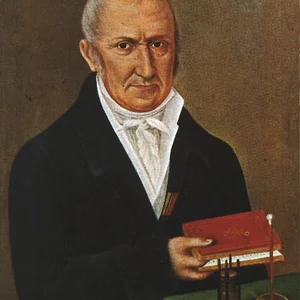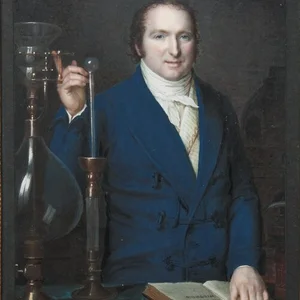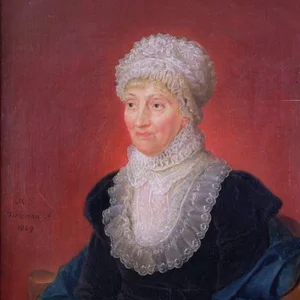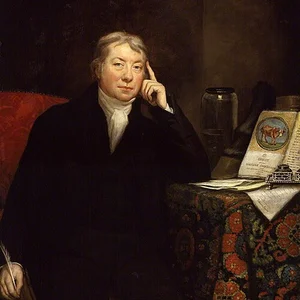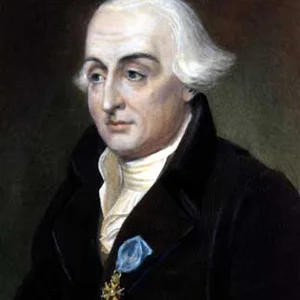

Franco-Sardinian mathematician and astronomer (1736–1813), considered one of the greatest mathematicians of the 18th century. He revolutionized mechanics with his analytical formulation and founded the calculus of variations.
Joseph-Louis Lagrange(1736 — 1813)
Joseph-Louis Lagrange
France, royaume de Sardaigne
8 min read
Frequently asked questions
Famous Quotes
« Algebra is generous; she often gives more than is asked of her.»
Key Facts
- Born in Turin in 1736, he developed the calculus of variations at the age of 19
- Published the Mécanique analytique in 1788, reformulating all of Newton's mechanics without geometric figures
- Director of the Berlin Academy of Sciences from 1766 to 1787, succeeding Euler
- Contributed to the creation of the decimal metric system in France from 1790
- Died in Paris in 1813, having been made a count of the Empire by Napoleon
Works & Achievements
Lagrange's absolute masterpiece, this work reformulates all of classical mechanics in terms of algebraic equations, without a single diagram. The “Lagrange equations” it contains are still taught today in advanced university-level physics and mathematics courses.
A founding paper in the calculus of variations, a discipline largely invented by Lagrange. This branch of mathematics, which seeks the optimal form of a curve, is used today in quantum physics and robotics.
By analyzing why classical methods fail to solve fifth-degree equations, Lagrange laid the groundwork for what would become group theory — work that Galois and Abel would develop fifty years later.
Lagrange attempts to eliminate infinitesimals from differential calculus by grounding it entirely in power series. Although this approach would eventually be superseded, it deeply influenced the development of rigorous analysis in the 19th century.
A series of papers on the perturbations of planetary orbits, the oscillations of the Moon, and the three-body problem. This work led in particular to the discovery of libration points, now known as “Lagrange points.”
A systematic treatise on the approximate solution of algebraic equations, which contributed to the standardization of numerical methods used by astronomers and engineers.
Anecdotes
At just 19 years old, Lagrange sent Euler a letter outlining a new mathematical method for solving certain problems involving curves. Euler, deeply impressed, immediately recognized the young man's genius and delayed publishing his own work on the subject so that all the credit would go to Lagrange.
When Frederick II of Prussia sought a successor to Euler at the Berlin Academy, Euler himself recommended Lagrange in these words: 'The greatest king in Europe ought to have the greatest mathematician in Europe at his court.' Lagrange joined Berlin in 1766 and spent twenty fruitful years there.
During the French Revolution, nearly all foreign scholars were expelled from France, but Lagrange was explicitly protected thanks to the intervention of Lavoisier and his colleagues at the Academy. He played a key role in the creation of the decimal metric system, serving on the committee on weights and measures.
Napoleon held a deep admiration for Lagrange and heaped honors upon him: Count of the Empire, senator, Grand Cross of the Legion of Honor. He described him as the 'lofty pyramid of the mathematical sciences.' Lagrange died just a few days after revising for the last time the new edition of his *Mécanique analytique*.
Lagrange sometimes suffered from bouts of melancholy that prevented him from working for months at a time. In Berlin, he wrote to d'Alembert that he found mathematics 'exhausted.' Yet each time he bounced back with a groundbreaking memoir, as though the creative crisis had forced him to deepen his thinking.
Primary Sources
No figures will be found in this work. The methods I set forth require neither constructions nor geometrical or mechanical reasoning, but solely algebraic operations subjected to a regular and uniform procedure.
I have found a general method for solving all problems of this kind, without needing to resort to any particular geometrical construction, and assuming only the rules of differential and integral calculus.
The aim of this work is to give the principles of differential calculus, free from any consideration of infinitely small or vanishing quantities, of limits or fluxions, and reduced to the algebraic analysis of finite quantities.
I communicate to you, Sir, a new method for determining curves that enjoy certain properties of maximum or minimum. This method seems to me simpler and more general than those employed hitherto.
The problem of solving algebraic equations has not yet been resolved in its full generality… I propose here to examine the various known methods for this resolution, and to seek their true principles.
Key Places
Lagrange's birthplace, where he studied and taught at the Royal School of Artillery from 1755 to 1766. He co-founded the scientific society that became the Royal Academy of Sciences of Turin.
Lagrange headed its mathematics class from 1766 to 1787, producing his most groundbreaking memoirs on the calculus of variations, celestial mechanics, and number theory.
Lagrange joined the Academy in 1787 at the invitation of Louis XVI. After the Revolution, he continued to serve within its successor, the Institut national, until his death in 1813.
Founded in 1794, the École Polytechnique counted Lagrange among its first professors of analysis. His teaching there shaped generations of French scientists and engineers.
Appointed senator under the Napoleonic Empire, Lagrange sat in the Conservative Senate housed at the Palais du Luxembourg — a symbol of the honors Napoleon bestowed upon him.
Typical Objects

Lagrange wrote his memoirs with a quill pen, filling sheets with algebraic formulas in careful handwriting. His manuscripts, preserved at the Bibliothèque de l'Institut, bear witness to rigorous thinking and elaborate calligraphy.

An indispensable tool for every mathematician and astronomer of the 18th century, these tables made it possible to perform complex calculations on planetary orbits and the motions of the Moon — an area in which Lagrange excelled.

As an astronomer, Lagrange used optical instruments to observe celestial bodies, particularly in connection with his work on planetary perturbations and celestial mechanics.

Paradoxically, Lagrange made little use of them: his purely algebraic approach to mechanics was designed precisely to eliminate geometric constructions from mathematical physics.

Lagrange kept copies of his own works in which he noted corrections and extensions. The second edition of 1811 benefited from annotations accumulated over more than twenty years.

Like most scholars of his era, Lagrange often worked in the evening by artificial light, extending his calculation sessions well past sunset, particularly during his Berlin years.
School Curriculum
Vocabulary & Tags
Key Vocabulary
Daily Life
Morning
Lagrange rose early and devoted his mornings to reading recent scientific memoirs and corresponding with scholars across Europe. In Berlin as in Paris, he regularly received letters from Euler, d'Alembert, and Laplace, which he answered carefully before beginning his own work.
Afternoon
Afternoons were reserved for mathematical work proper: Lagrange would settle at his desk and fill sheet after sheet with algebraic calculations, sometimes for six to eight hours without interruption. According to witnesses, he worked slowly but never crossed anything out, as though he composed everything mentally before setting pen to paper.
Evening
Evenings in Berlin, under the reign of Frederick II, often included dinners at court or meetings of the Academy. In Paris, Lagrange frequented scientific salons, notably those of Lavoisier and Condorcet. As he grew older, he preferred quiet evenings with family, playing chess or listening to music.
Food
Like many scholars of his era, Lagrange led a sober lifestyle. He was fond of the Piedmontese cuisine of his youth, and in Paris adapted to French habits: soup, roasted meat, vegetables, and wine diluted with water. He was known for eating little, his mind absorbed in thought even at the table.
Clothing
As a prominent member of the Royal Academy of Berlin and later of Paris, Lagrange wore the standard court dress of the eighteenth century: an embroidered coat, breeches, silk stockings, and a powdered wig in his younger years. Under the Empire, he donned the senator's uniform along with his Napoleonic decorations, including the Legion of Honor.
Housing
In Berlin, Frederick II provided him with comfortable lodgings near the Academy. In Paris, Lagrange first lived at the Louvre, where the Royal Academy housed its eminent members, then in bourgeois apartments on the Left Bank. His personal library, rich in scientific treatises, was the heart of his home.
Historical Timeline
Period Vocabulary
Liens externes & ressources
Références
Œuvres
Mécanique analytique
1788
Essai sur un nouveau méthode pour les maxima et minima des formules intégrales
1762
Réflexions sur la résolution algébrique des équations
1771
Théorie des fonctions analytiques
1797
Mémoires sur la mécanique céleste
1766–1783
Résolution des équations numériques de tous les degrés
1798