 flip
flipKalua puaʻa (imu-cooked pork)
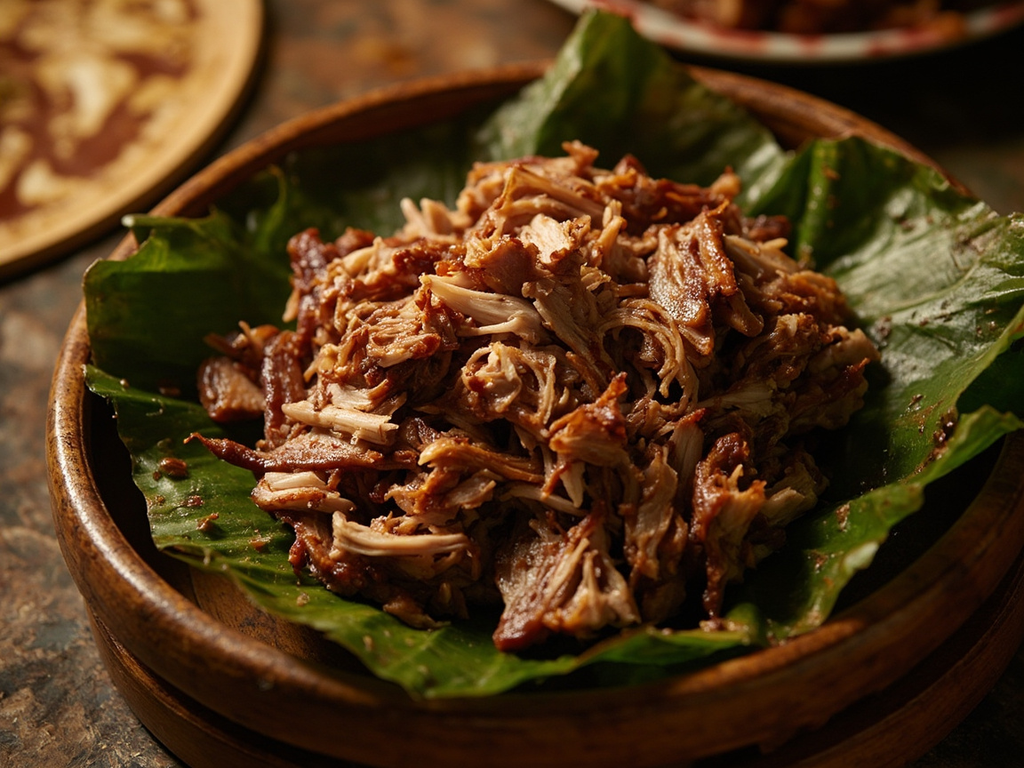
Kalua puaʻa (imu-cooked pork)
Why this dish? Kalua puaʻa was the centerpiece of Kamehameha's great ʻahaʻaina (feasts), especially during Makahiki celebrations (Lono's annual festival) and after his military victories. The Battle of Nuʻuanu Pali (1795), which gave him Oʻahu, was followed by a memorable feast. Pork, reserved for men under kapu, was the ultimate prestige food of the aliʻi.
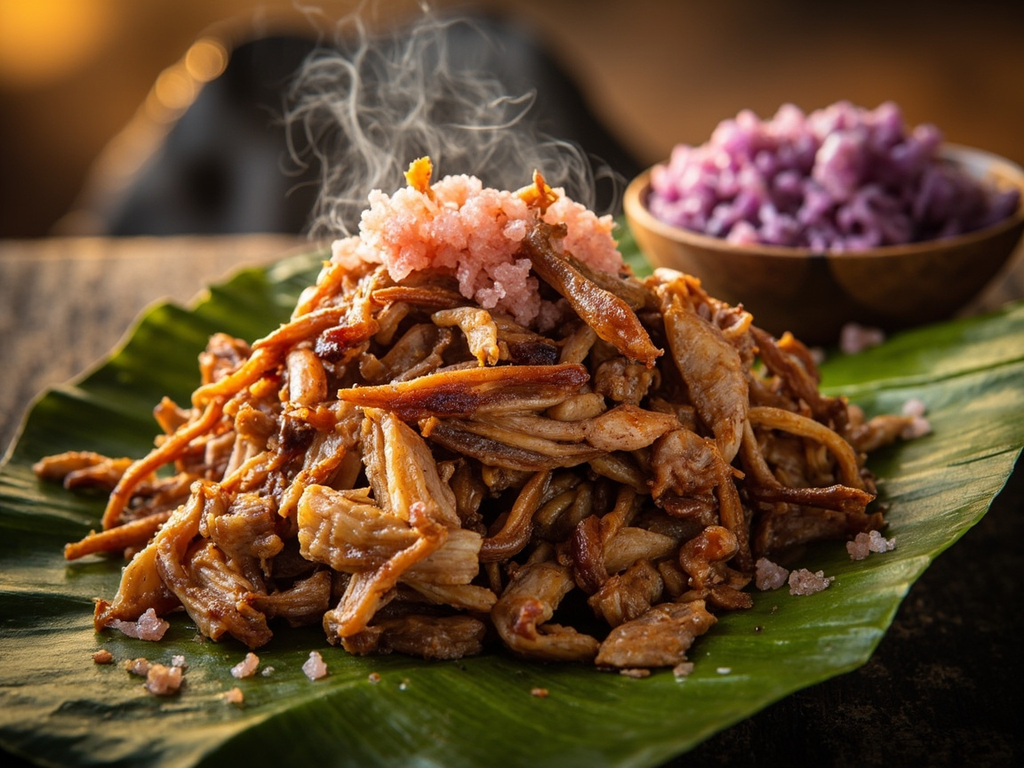
Whole pig or pork shoulder wrapped in ti and banana leaves, cooked overnight in an imu — an earth oven heated by volcanic stones. The slow steam-roasting yields tender, smoky, salty meat that pulls apart at the touch.
When I take an island, I have an imu dug that honors the victory. At Nuʻuanu, after Oʻahu's warriors were driven over the cliffs, my men opened the earth and heated the stones until they glowed red. The pig is laid on those stones, wrapped in kī leaves like a chief in his cloak. You cover it with earth, and the night does its work. In the morning, when the imu is opened, the smoke rises like a prayer to Kū. That meat that falls apart under the fingers is the taste of sovereignty.
- •Whole pig (puaʻa) — One good-sized young pig (Centerpiece of the feast)
- •Hawaiian sea salt (paʻakai) — Generously rubbed (Seasoning and preservation)
- •Ti leaves (kī) — Several layers (Cooking wrap)
- •Banana leaves — Several layers (Protective wrap)
- •Volcanic stones — As many as the imu holds (Heat source)
Kalua puaʻa (imu-cooked pork)
Whole pig or pork shoulder wrapped in ti and banana leaves, cooked overnight in an imu — an earth oven heated by volcanic stones. The slow steam-roasting yields tender, smoky, salty meat that pulls apart at the touch.
Why this dish? Kalua puaʻa was the centerpiece of Kamehameha's great ʻahaʻaina (feasts), especially during Makahiki celebrations (Lono's annual festival) and after his military victories. The Battle of Nuʻuanu Pali (1795), which gave him Oʻahu, was followed by a memorable feast. Pork, reserved for men under kapu, was the ultimate prestige food of the aliʻi.
When I take an island, I have an imu dug that honors the victory. At Nuʻuanu, after Oʻahu's warriors were driven over the cliffs, my men opened the earth and heated the stones until they glowed red. The pig is laid on those stones, wrapped in kī leaves like a chief in his cloak. You cover it with earth, and the night does its work. In the morning, when the imu is opened, the smoke rises like a prayer to Kū. That meat that falls apart under the fingers is the taste of sovereignty.
Ingredients (period version)
- Whole pig (puaʻa) — One good-sized young pig (Centerpiece of the feast)
- Hawaiian sea salt (paʻakai) — Generously rubbed (Seasoning and preservation)
- Ti leaves (kī) — Several layers (Cooking wrap)
- Banana leaves — Several layers (Protective wrap)
- Volcanic stones — As many as the imu holds (Heat source)
Ingredients
- Pork shoulder (bone-in) — 2 kg (Main meat cut)
- Coarse sea salt or Hawaiian pink salt — 2 tbsp (Seasoning)
- Liquid smoke — 2 tbsp (Replicate imu flavor)
- Banana leaves (or aluminum foil) — 3-4 large leaves (Cooking wrap)
- Water — 125 ml (Moisture for slow cooking)
Method
- Rub the pork shoulder on all sides with coarse salt and liquid smoke.
- If using banana leaves: quickly pass them over a flame to soften. Line the bottom of a heavy pot or Dutch oven with the leaves.
- Place the pork on the leaves, pour water into the bottom, then fold the leaves over to wrap the meat.
- Cover tightly and cook in a 150 °C oven for 5 to 6 hours, until the meat falls apart with a fork.
- Remove the pork, discard excess fat from the cooking juices. Shred the meat with two forks, moistening with a few spoonfuls of the juices.
- Serve on ti or banana leaves, accompanied by poi.
How it was made : A traditional imu could be several meters long for a great feast. The whole pig was placed inside, stuffed with hot stones in the abdominal cavity, then wrapped in successive layers of ti leaves, banana leaves, and mats. Everything was covered with earth and cooked for 12 to 24 hours. This cooking method existed throughout Polynesia (Māori hāngi, Samoan umu) and dates back over a thousand years.
The contemporary twist : Shred the pork and serve on a fresh banana leaf with poi, a few grains of Hawaiian black salt, and a touch of habanero pepper for the adventurous — a nod to post-contact culinary fusion.
Sources : Samuel M. Kamakau, Ka Poʻe Kahiko: The People of Old, Bishop Museum Press, 1964 · Mary Kawena Pukui & Samuel H. Elbert, Hawaiian Dictionary, University of Hawaii Press, 1986 · Patrick V. Kirch, Feathered Gods and Fishhooks: An Introduction to Hawaiian Archaeology and Prehistory, University of Hawaii Press, 1985
Kamehameha I · Charactorium