 flip
flipAfternoon Tea Scones with Cream and Jam
Afternoon Tea Scones with Cream and Jam
Why this dish? Bragg took his afternoon tea at college or at home, between sessions at the Cavendish; the warm scone, split, spread with cream and jam, is the constant companion of this English ritual he practiced all his life from Cambridge to London.
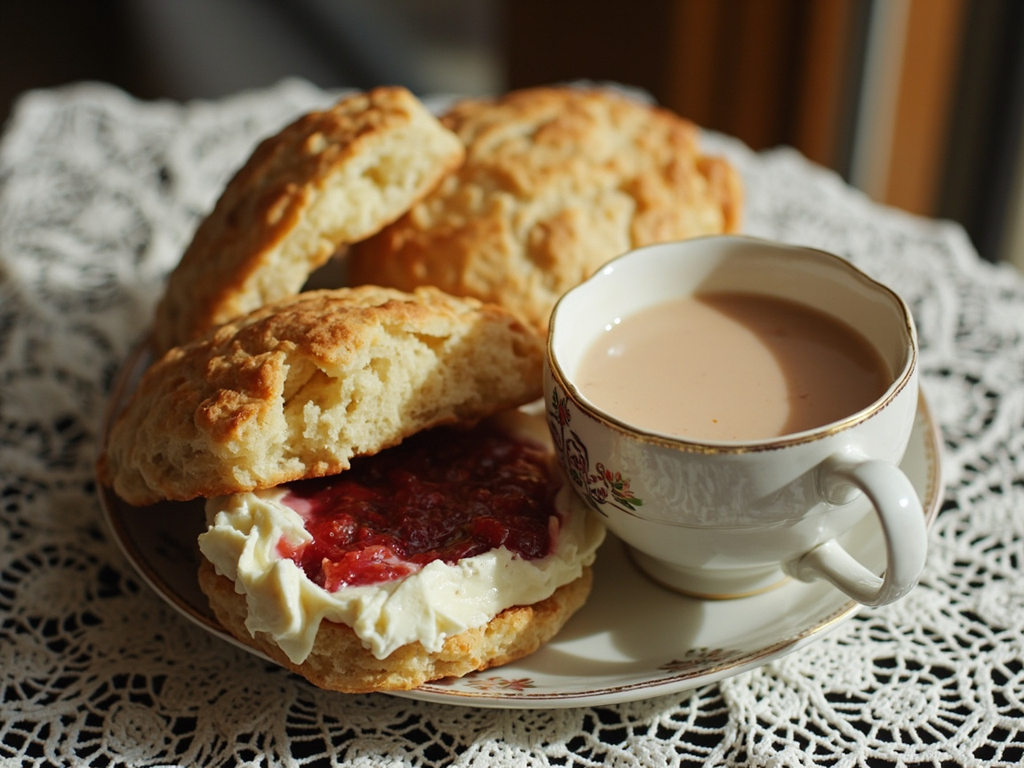
Small brioche-like buns, golden on top and soft inside, broken by hand (never with a knife) to spread with clotted cream and strawberry jam. The tender heart of five-o'clock tea.
You see, at the stroke of five, all serious work stops: it is teatime, and one does not argue with such an institution. I recommend you break your scone with your fingers, never with a blade — my father insisted on that — then add the cream and the jam; on the order of the two, England still quarrels, and I shall leave you to judge. A good cup of Assam alongside, and the mind is set right again to think of crystals until dinner.
- •Wheat flour — a good pound (base)
- •Fresh butter — a knob (fat)
- •Milk — enough to bind (liquid)
- •Baking powder — a spoonful (leavening)
- •Sugar — a pinch (flavor)
- •Clotted cream and strawberry jam — as much as you like (topping)
Afternoon Tea Scones with Cream and Jam
Small brioche-like buns, golden on top and soft inside, broken by hand (never with a knife) to spread with clotted cream and strawberry jam. The tender heart of five-o'clock tea.
Why this dish? Bragg took his afternoon tea at college or at home, between sessions at the Cavendish; the warm scone, split, spread with cream and jam, is the constant companion of this English ritual he practiced all his life from Cambridge to London.
You see, at the stroke of five, all serious work stops: it is teatime, and one does not argue with such an institution. I recommend you break your scone with your fingers, never with a blade — my father insisted on that — then add the cream and the jam; on the order of the two, England still quarrels, and I shall leave you to judge. A good cup of Assam alongside, and the mind is set right again to think of crystals until dinner.
Ingredients (period version)
- Wheat flour — a good pound (base)
- Fresh butter — a knob (fat)
- Milk — enough to bind (liquid)
- Baking powder — a spoonful (leavening)
- Sugar — a pinch (flavor)
- Clotted cream and strawberry jam — as much as you like (topping)
Ingredients
- All-purpose flour — 350 g (base)
- Cold butter — 85 g (fat)
- Milk — 175 ml (liquid)
- Baking powder — 1 sachet (11 g) (leavening)
- Sugar — 30 g (flavor)
- Salt — 1 pinch (seasoning)
- Clotted cream (or very thick crème fraîche) and strawberry jam — as much as you like (topping)
Method
- Mix flour, baking powder, sugar, and salt. Rub in cold butter with your fingertips until the mixture resembles coarse crumbs.
- Gradually add milk and gather into a ball without over-kneading (the dough should remain soft).
- Roll out to 2.5 cm thickness and cut out rounds with a cutter.
- Brush tops with milk, bake at 220°C for 12-15 minutes until nicely golden.
- Serve warm, split in half, with clotted cream and jam, accompanied by black tea with milk.
How it was made : Afternoon tea, popularized in the 19th century, was in Bragg's time a deeply ingrained social custom in colleges and educated households. Scones were baked at home or prepared by college staff, served on tiered stands.
The contemporary twist : Add a hint of lemon zest to the dough and a homemade strawberry-rhubarb jam to brighten things up.
Sources : Mrs Beeton's Book of Household Management (1861)
Lawrence Bragg · Charactorium