 flip
flipCrusader's Frumenty
Crusader's Frumenty
Why this dish? Louis IX led two crusades (Egypt in 1248, where he was taken prisoner at Mansourah; Tunis in 1270, where he died). Cracked wheat boiled into a porridge—frumenty—was a field and pilgrimage food: transportable as dry grain, it was reconstituted at camp into a filling pottage that sustained soldiers and crusaders.
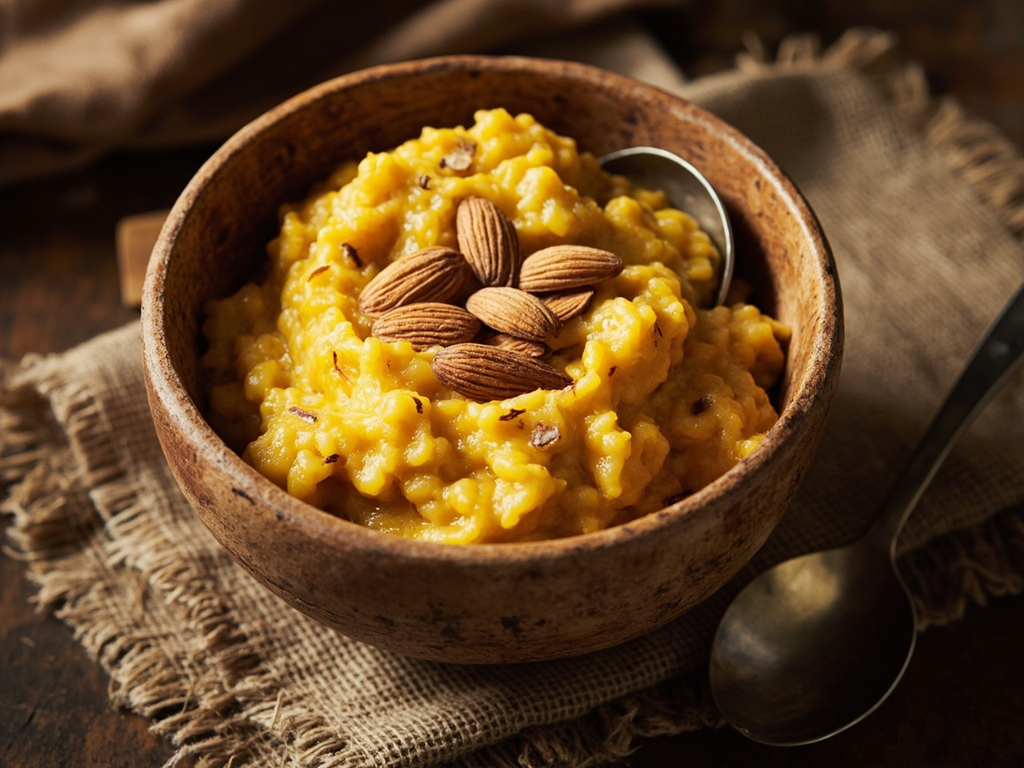
Cracked wheat long-simmered in broth, enriched with almond milk and colored with saffron: a thick, comforting pottage, ancestor of our porridges, food for long journeys.
When I led my barons toward the Holy Land, there were no banquets under the tent: every mouth depended on what could be carried far without spoiling. Wheat, we carry dry in sacks, and come evening we boil it long until it thickens into good frumenty. I had them add a little almond milk and saffron to gild it. Believe me, after a hard day in the heat of Egypt, no royal dish comforted my men as much as this humble wheat porridge.
- •Cracked wheat — a measure (nourishing base)
- •Broth — as needed (cooking liquid)
- •Almond milk — a part (richness, lean day)
- •Saffron — a few threads (golden color)
- •Salt — as needed (seasoning)
Crusader's Frumenty
Cracked wheat long-simmered in broth, enriched with almond milk and colored with saffron: a thick, comforting pottage, ancestor of our porridges, food for long journeys.
Why this dish? Louis IX led two crusades (Egypt in 1248, where he was taken prisoner at Mansourah; Tunis in 1270, where he died). Cracked wheat boiled into a porridge—frumenty—was a field and pilgrimage food: transportable as dry grain, it was reconstituted at camp into a filling pottage that sustained soldiers and crusaders.
When I led my barons toward the Holy Land, there were no banquets under the tent: every mouth depended on what could be carried far without spoiling. Wheat, we carry dry in sacks, and come evening we boil it long until it thickens into good frumenty. I had them add a little almond milk and saffron to gild it. Believe me, after a hard day in the heat of Egypt, no royal dish comforted my men as much as this humble wheat porridge.
Ingredients (period version)
- Cracked wheat — a measure (nourishing base)
- Broth — as needed (cooking liquid)
- Almond milk — a part (richness, lean day)
- Saffron — a few threads (golden color)
- Salt — as needed (seasoning)
Ingredients
- Cracked wheat (or spelt / coarse bulgur) — 200 g (base)
- Chicken or vegetable broth — 800 ml (cooking liquid)
- Almond milk (almond flour + water) — 200 ml (richness)
- Saffron — 1 pinch (color)
- Salt — to taste (seasoning)
- Egg yolk (optional) — 1 (final binder)
Method
- Rinse the cracked wheat, then simmer it in the broth with the saffron over low heat for 40–50 minutes, until tender and thick (add hot liquid if needed).
- Stir in the almond milk, add salt, and continue cooking for 10 minutes, stirring.
- Off the heat, optionally bind with a beaten egg yolk (medieval style) for a creamier texture.
- Serve hot, as a thick pottage, with a spoon.
How it was made : Frumenty (frumenty) often accompanied meats at feasts, but its dry, reconstitutable form also made it a military and pilgrimage food. Wheat, a staple and Eucharistic symbol, was the quintessential Christian food—a meaning not lost on a crusader king.
The contemporary twist : Serve it like a "wheat risotto," topped with toasted almonds and a drizzle of oil: the medieval savory porridge is making a comeback on today's tables.
Sources : Jean de Joinville, Vie de saint Louis (account of the Egyptian crusade) · Le Viandier, attributed to Taillevent (frumenty)
Louis IX (Saint Louis) · Charactorium