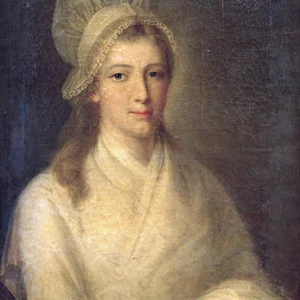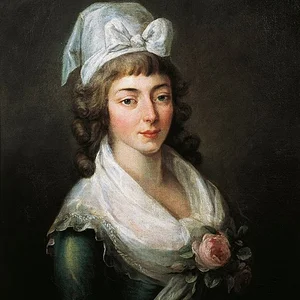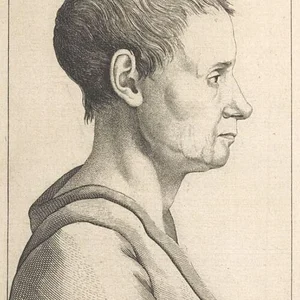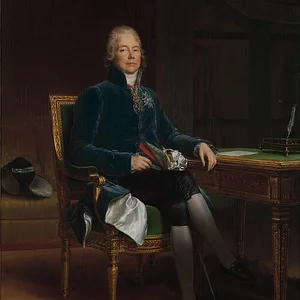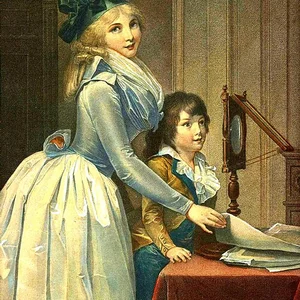

Second wife of Georges Danton, whom she married in 1793 at the age of sixteen after caring for his children. A figure in the intimate circle of a major actor of the French Revolution, she lived through the Terror and then remarried after Danton's execution.
Louise Gély(1776 — 1856)
Louise Sébastienne Danton
France
5 min read
Frequently asked questions
Key Facts
- Born in 1776 in Paris, daughter of a clerk at the Ministry of the Navy who was a neighbor of the Dantons
- Helped raise Danton's children after the death of his first wife Gabrielle in 1793
- Married Georges Danton in June 1793, at about sixteen years old, insisting on a religious ceremony performed by a refractory priest
- Became a widow when Danton was guillotined on 5 April 1794 during the Terror
- Remarried in 1797 with Claude Dupin and died in 1856
Works & Achievements
After the death of Danton's first wife, Louise took charge of his two young boys, ensuring the continuity of the household.
Her union with one of the leading figures of the Revolution placed her at the heart of the inner circle of revolutionary power.
She insisted on a Catholic ceremony performed by a nonjuring priest, a bold act of faith at the height of dechristianization.
Her testimony and that of her family later informed biographers, shedding light on the tribune's intimate life beyond the political platforms.
Now Baroness Dupin, she rebuilt a stable existence and quietly weathered the successive regimes up to the Second Empire.
Anecdotes
Louise Gély was only about sixteen years old when she married Georges Danton in 1793: he was then more than twice her age. Before the marriage, she had already helped look after the tribune's two young sons, who had been left motherless after the death of Antoinette Gabrielle, Danton's first wife.
Deeply pious, Louise is said to have set a surprising condition for a revolutionary who had, after all, fought against the Church: she wanted to be married by a refractory priest, that is, a priest who refused to swear an oath to the Republic. According to her biographers, Danton agreed to this clandestine religious ceremony, which was very dangerous at the time, to please his young wife.
The Gély family lived in the same neighborhood as Danton, around the Cour du Commerce-Saint-André in Paris: Louise thus grew up almost before the very eyes of the man she would eventually marry. Louise's father was a modest clerk, far removed from the turmoil of the revolutionary podiums.
Widowed at seventeen after Danton's execution on 5 April 1794, Louise outlived the Revolution by many years. She remarried in 1797 to Claude Dupin, who became a baron under Napoleon, and died only in 1856, under the Second Empire, having lived through nearly sixty years of French history.
Primary Sources
The certificate unites citizen Georges-Jacques Danton, a widower, with citizen Louise Sébastienne Gély, aged sixteen, the daughter of a Parisian clerk: it officially records the second marriage of the Convention deputy.
The biographer, who collected the family's testimony, reports that Louise, deeply religious, arranged for her union with Danton to be secretly blessed by a priest who had not taken the oath demanded by the Revolution.
Three years after Danton's death, the civil registry records the new marriage of the young widow, who would later become Baroness Dupin under the Empire.
Key Places
City where Louise was born in 1776 and died in 1856: nearly her entire life unfolded there.
Neighborhood where the Gély and Danton families lived as next-door neighbors; this is where their story took shape.
Danton's hometown, where the couple stayed; the orator loved to retreat there, far from the bustle of Paris.
Prison where Danton was held before his trial by the Revolutionary Tribunal in April 1794.
Place where Danton was guillotined on April 5, 1794, leaving Louise a widow at seventeen.
Typical Objects

A devout Catholic, Louise was determined to practice her faith amid the revolutionary dechristianization; these discreet objects recall her insistence on a religious marriage.

A document kept secret attesting to the union blessed by a refractory priest, risky proof kept far from the eyes of the Convention.

Before her marriage, Louise cared for Danton's two young sons, left motherless; tending to the children shaped her daily routine.

A blue-white-red badge that everyone had to wear during the Revolution; it was pinned to one's cap or clothing to show civic loyalty.

Women gave up the splendor of the Ancien Régime for plain attire; Louise dressed according to this more austere fashion of the Republican era.

Handwritten correspondence connected Danton, often away on mission or at the Assembly, to his Parisian home and his young wife.
School Curriculum
Vocabulary & Tags
Key Vocabulary
Daily Life
Morning
A young woman from a comfortable but not especially luxurious Parisian household, Louise began the day with household chores and caring for the children. The home, close to the centers of revolutionary power, kept pace with the news circulating around the neighborhood.
Afternoon
In the afternoon, she managed the running of the household: difficult shopping in a time of shortages, watching over the children, visits from relatives. Outside, Paris buzzed with rumors of the Convention, of arrests and trials.
Evening
In the evening, the home might welcome Danton's political friends around a meal and lively conversation. When the orator was present, the table blended family life with discussions about the fate of the Revolution.
Food
Their diet relied on bread, the foundation of every meal, supplemented with vegetables, soups, and sometimes meat. The war and the shortages of 1793 made certain foodstuffs scarce and expensive, despite the laws setting a maximum on prices.
Clothing
Louise wore plain outfits in keeping with revolutionary fashion, far from the splendor of the Ancien Régime: simple dresses, a muslin fichu, and a bonnet. The tricolor cockade, a required sign of civic loyalty, often completed the outfit.
Housing
The couple lived in a middle-class apartment in the cour du Commerce-Saint-André neighborhood, on the Left Bank of the Seine. This comfortable, though not lavish, home stood at the very heart of revolutionary Paris.
Historical Timeline
Period Vocabulary
Liens externes & ressources
Références
Œuvres
Soin des fils orphelins de Danton
1793
Mariage avec Georges Danton
1793
Obtention d'un mariage religieux clandestin
1793
Transmission de la mémoire privée de Danton
après 1794
Remariage et vie sous l'Empire
1797