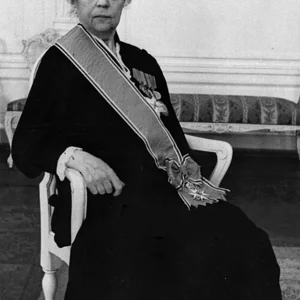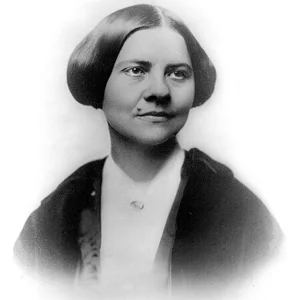

Lucy Stone (1818-1893) was one of the first American activists to fight simultaneously for the abolition of slavery and women's right to vote. The first woman from Massachusetts to earn a college degree, she refused to take her husband's name after marriage.
Lucy Stone(1818 — 1893)
Lucy Stone
États-Unis
8 min read
Frequently asked questions
Famous Quotes
« In education, in marriage, in religion, in everything, disappointment is the lot of women.»
« I expect to plod on, and expect nothing.»
Key Facts
- 1818: Born in West Brookfield, Massachusetts
- 1847: First woman from Massachusetts to graduate from Oberlin College
- 1855: Married Henry Blackwell; she kept her maiden name
- 1870: Co-founded the American Woman Suffrage Association with her family
- 1893: Died in Dorchester, Massachusetts
Works & Achievements
A weekly journal founded by Lucy Stone and Henry Blackwell in Boston, which became the leading publication of the American suffragist movement and continued to be published for forty-seven years after its founder's death.
A public document written with her husband Henry Blackwell to denounce the marriage laws that stripped women of their rights; widely circulated in the press, it became a landmark in the history of American feminism.
A founding speech delivered at the first national suffragist convention, which helped expand the movement well beyond Seneca Falls and establish it as an organized national cause.
A suffragist organization created by Lucy Stone and Henry Blackwell, advocating a state-by-state strategy to win women's right to vote — a pragmatic approach that would ultimately prove the most effective.
Lecture tours across the United States on the abolition of slavery and women's rights, which made Lucy Stone one of the most celebrated and best-paid speakers of her era.
Anecdotes
At her marriage to Henry Blackwell in 1855, Lucy Stone categorically refused to take her husband's name — a revolutionary act for the time. Both spouses publicly read a joint protest denouncing the laws that gave husbands control over their wives' property and person. Her supporters soon became known as the “Lucy Stoners.”
In 1847, Lucy Stone became the first woman in Massachusetts to earn a college degree, at Oberlin College in Ohio. To fund her studies, she had worked as a schoolteacher for years, saving every penny. Ironically, Oberlin initially denied her the right to read her own graduation speech, deeming it improper for a woman to speak in public.
Without the right to vote, Lucy Stone believed it was unjust to impose taxes on her. She refused to pay her property taxes, invoking the principle of “no taxation without representation” inherited from the American Revolution. The authorities seized and sold her furniture to recover the debt, but she persisted in her refusal year after year.
In 1850, Lucy Stone co-organized the very first National Women's Rights Convention in Worcester, drawing more than a thousand participants from eight states. Her speech, of remarkable eloquence, was reprinted in the national press and helped transform the suffragist cause into a mass movement.
In 1869, a serious rift erupted between Lucy Stone and Susan B. Anthony over the 15th Amendment, which granted Black men the right to vote but not women. Stone supported the amendment out of abolitionist solidarity; Anthony and Stanton opposed it. This rupture divided the suffragist movement into two rival organizations for twenty years.
Primary Sources
We believe that the current laws of marriage deny the legal recognition of a woman as a rational and responsible being. We protest against these laws in the name of justice and humanity, and declare our resolution not to obey them.
The question is not whether a woman can be named in laws and charters, but whether she will be recognized as a human being with the same inalienable rights as man. We claim these rights in the name of eternal justice.
This journal will be devoted to the interests of women — to their industrial, legal, and political education — and in particular to their right of suffrage. We believe that this right belongs to them as fully as to any man.
I must speak of the condition of women as long as I have a voice. It is not right that half of the human race should be kept in such dependence and such silence.
Key Places
Lucy Stone's birthplace, where she grew up on a farm and became aware at a very young age of the inequalities between herself and her brothers — notably that her father placed far greater value on the boys' education than on hers.
A coeducational and abolitionist institution where Lucy Stone earned her degree in 1847, making her a pioneer in women's access to higher education in the United States.
The city where Lucy Stone co-organized the first National Woman's Rights Convention in October 1850, a founding event that transformed American suffragism into a nationally organized movement.
The city where Lucy Stone settled permanently, founded *The Woman's Journal* in 1870, and led the American Woman Suffrage Association from its headquarters — making Boston the center of moderate suffragism.
The Boston neighborhood where Lucy Stone spent her final years and died in 1893. She was cremated there — an extremely rare practice in the United States at the time and one last act of nonconformity.
Typical Objects

An indispensable tool for an activist and journalist, Lucy Stone wrote speeches, editorials, and extensive correspondence every day to defend women's rights and the abolitionist cause.

A weekly newspaper she founded in 1870 that became the leading platform of the American suffragist movement for more than fifty years, continuing publication well after her death.

Lucy Stone adopted practical, simple clothing, rejecting the corsets and crinolines imposed by Victorian fashion, in keeping with her convictions about the emancipation of the female body.

A devoted reader of Scripture in a deeply Protestant America, Stone drew on religious and moral arguments to justify equal rights, annotating the passages she quoted from the podium.

A symbolic document of her refusal to pay taxes without the right to vote, embodying the principle of “no taxation without representation” that she invoked against local authorities to denounce the injustice of her situation.

Celebrated for her exceptional eloquence, Lucy Stone traveled the country for decades to deliver speeches that convinced thousands of Americans and made her one of the highest-paid orators of her era.
School Curriculum
Vocabulary & Tags
Key Vocabulary
Tags
Daily Life
Morning
Lucy Stone rose early, a habit inherited from her farm childhood. She devoted the first part of the morning to her extensive correspondence: letters to activists, journalists, and elected officials. After 1870, she would often join the editorial team of the Woman's Journal in Boston to oversee the weekly edition.
Afternoon
Her afternoons were often spent preparing speeches or attending meetings of the American Woman Suffrage Association. During her major lecture tours, she would take the train to the next city, sometimes in uncomfortable conditions. In Boston, she received activists and journalists who came seeking advice and support.
Evening
Evenings were frequently occupied by lectures in community halls, churches, or universities, where her oratorical talent allowed her to hold the attention of large audiences for several hours. At home, she read the press, annotated documents, and discussed politics with her husband Henry Blackwell.
Food
Lucy Stone's diet was simple and consisted mainly of local produce: whole-grain bread, vegetables, seasonal fruits, and little meat. Like many reformers of her era, she was attentive to public health issues and shared the temperance ideals widespread in abolitionist and suffragist circles.
Clothing
Lucy Stone deliberately adopted a plain and practical style of dress, breaking with the conventions of Victorian fashion. She rejected restrictive corsets and cumbersome crinolines that limited women's movement. Her dresses, often made of dark wool or cotton, were cut more loosely, in keeping with her convictions about women's liberation.
Housing
After years of modest life as a traveling activist — often staying with local families during her tours — Lucy Stone settled with Henry Blackwell in a house in Dorchester, a suburb of Boston. This home also served as an informal gathering space for suffragist activists in the region.
Historical Timeline
Period Vocabulary
Liens externes & ressources
Références
Œuvres
The Woman's Journal
1870-1917
Protestation de mariage (Marriage Protest)
1er mai 1855
Discours à la Convention nationale des droits des femmes de Worcester
23-24 octobre 1850
Fondation de l'American Woman Suffrage Association (AWSA)
1869
Campagnes de conférences publiques (lyceum circuit)
1847-1870