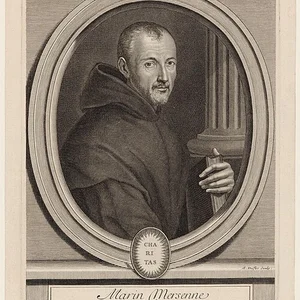

Marin Mersenne was a French Minim friar, mathematician, and physicist of the 17th century. The driving force behind a vast scholarly network across Europe, he was a forerunner of the scientific academy and a pioneer of acoustics.
Marin Mersenne(1588 — 1648)
Marin Mersenne
France
6 min read
Frequently asked questions
Key Facts
- Born in 1588 in the Sarthe region, he entered the Order of the Minims in 1611
- From the 1620s onward, he ran from his Parisian monastery a correspondence network linking Descartes, Fermat, Gassendi, Galileo, and Pascal
- In 1636 he published the Harmonie universelle, a major work on acoustics and music theory
- He studied the 'Mersenne numbers' (of the form 2^n − 1), still used today in the search for large prime numbers
- He died in Paris in 1648; his correspondence foreshadowed the creation of the Academy of Sciences (1666)
Works & Achievements
A defense of the certainty of scientific knowledge against skepticism; argues that mathematics and experiment provide solid knowledge.
A major founding work of acoustics: laws of vibrating strings, the study of instruments, and music theory.
Formulation of the relationships between a string's frequency and its length, tension, and mass — the basis of the physics of sound.
The first experimental estimate of the speed of sound in air, a pioneering achievement in physics.
A mathematical and physical compendium in which he states the Mersenne primes (2^p − 1).
A vast exchange of letters connecting Descartes, Galileo, Pascal, Fermat, Huygens, and Torricelli; a true academy before its time.
Organizing the collective critique of Descartes's work, a model of open scientific debate.
Anecdotes
Having joined the Minims, a very austere religious order, Marin Mersenne turned his cell in the convent on the Place Royale in Paris into a true laboratory and scientific crossroads. The greatest scholars of Europe came there to meet him, so much so that people said writing to Mersenne meant writing to all of learned Europe.
Mersenne took an interest in prime numbers of a particular form, of the type 2 to the power p minus 1. These numbers, which we call today the “Mersenne numbers,” are still studied: the largest prime numbers ever discovered by computer are almost all Mersenne numbers.
Passionate about sound, Mersenne was the first to measure the speed of sound in air and studied the vibration of strings. He discovered that the pitch of a note depends on the length, the tension and the thickness of the string: these are the famous “Mersenne's laws,” the founding principles of scientific acoustics.
A loyal friend of René Descartes, whom he had known at the Jesuit college of La Flèche, Mersenne was his chief correspondent and his defender. It was he who circulated Descartes's *Meditations* among the greatest thinkers to gather their objections before publication.
Wary of pseudoscience, Mersenne ardently fought the astrology, alchemy and magic of his time. He sought to base knowledge on experiment and calculation rather than on superstitions, which makes him a true forerunner of the scientific method.
Primary Sources
The strings must be equally thick, equally long, and equally taut in order to produce sounds in unison.
Perfect numbers are so rare that only eleven of them have been found so far, that is to say, no other can be encountered among the numbers identified.
The sciences are so certain and so true that those who deny them deceive themselves and fight against their own reason.
I share your thoughts with all the clever men I know, so that you may receive their objections and the truth may thereby be better illuminated.
Key Places
Village in the Maine region where Marin Mersenne was born in 1588, into a modest rural family.
Prestigious college where the young Mersenne studied, attended at the same time by René Descartes.
Parisian convent where Mersenne lived and held his famous scholarly circle, a crossroads of European science.
Minim house where Mersenne served as corrector and taught theology and philosophy before returning to Paris.
Capital where Mersenne led the gatherings that foreshadowed the Royal Academy of Sciences, founded in 1666.
Typical Objects

An instrument with a single string stretched over a graduated soundbox, used to measure the ratios between string length and pitch. Mersenne used it to establish his laws of acoustics.

A coarse black wool robe worn by the Minim friars, a symbol of their vow of poverty and austerity. Mersenne wore it throughout his life as a member of the order.

Writing tools with which Mersenne maintained hundreds of letters across Europe. His correspondence was the true engine behind the circulation of scientific ideas.

Tubes and organs whose vibrations Mersenne studied to understand how sound is produced and propagated. His measurements yielded a first estimate of the speed of sound in air.

Time-measuring devices that Mersenne studied to time his experiments, notably the fall of bodies and the speed of sound. He exchanged ideas about the pendulum with Galileo and Huygens.

Large printed volumes such as the Harmonie universelle, spreading scientific and musical knowledge. The printing press allowed Mersenne to disseminate his research throughout Europe.
School Curriculum
Vocabulary & Tags
Key Vocabulary
Daily Life
Morning
Awake before dawn, Mersenne attended the religious services and prayers set by the strict rule of the Minims. The morning blended devotion, reading of the Scriptures and his first hours of study in his cell.
Afternoon
The afternoon was devoted to scientific experiments, mathematical calculations and the writing of his treatises. He often received visiting scholars to discuss music, physics or geometry.
Evening
In the evening, he went through and answered his abundant correspondence, writing to dozens of scholars across Europe. The gatherings of his circle sometimes carried the evening on into lively debates.
Food
Faithful to the Minims' vow of a “Lenten life,” Mersenne abstained year-round from meat, eggs and dairy. His frugal diet rested mainly on fish, vegetables, bread and water.
Clothing
He wore the black homespun habit of the Minims, a coarse woollen robe girded with a cord, a symbol of humility and poverty. His monk's garb never left him, even among the greatest scholars.
Housing
Mersenne lived in an austere cell of the Minims' convent on the Place Royale in Paris. Yet this modest room became one of the most important intellectual hubs of seventeenth-century Europe.
Historical Timeline
Period Vocabulary
Liens externes & ressources
Références
Œuvres
La Vérité des sciences contre les sceptiques
1625
Harmonie universelle
1636
Lois de Mersenne sur les cordes vibrantes
1636
Mesure de la vitesse du son
1636
Cogitata physico-mathematica
1644
Réseau de correspondance européen
1620-1648
Diffusion des objections aux Méditations de Descartes
1641