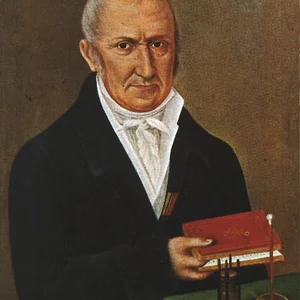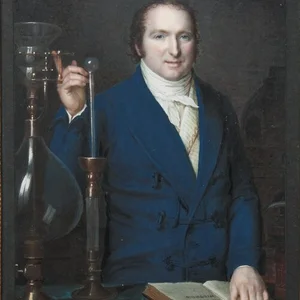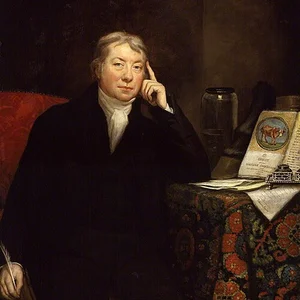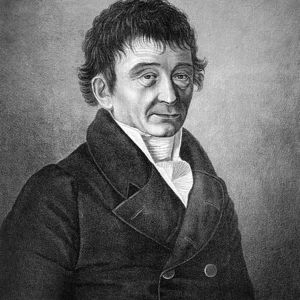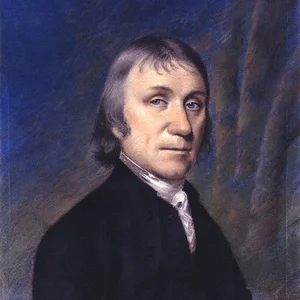

Eighteenth-century English chemist, theologian and philosopher, famous for isolating oxygen in 1774. A dissenting minister, he was also a liberal thinker forced into exile in the United States.
Joseph Priestley(1733 — 1804)
Joseph Priestley
Royaume-Uni, Royaume-Uni de Grande-Bretagne et d'Irlande
6 min read
Frequently asked questions
Key Facts
- Born in 1733 in Birstall, near Leeds in England
- Isolates “dephlogisticated air” (oxygen) in 1774
- Invents carbonated water by dissolving carbon dioxide in water (1772)
- His house and laboratory are ransacked during the Birmingham riots of 1791 because of his ideas
- Emigrates to the United States in 1794, where he dies in 1804
Works & Achievements
A landmark synthesis on eighteenth-century electricity, the fruit of his correspondence with Franklin; it opened the doors of the Royal Society to him.
A process for infusing water with carbon dioxide, the ancestor of fizzy drinks, rewarded with the Copley Medal in 1773.
Discovery of “dephlogisticated air,” which laid the foundations of the modern chemistry of gases and inspired Lavoisier's theory.
A vast compilation of his work on gases (oxygen, ammonia, nitrous oxide, etc.), a major contribution to pneumatic chemistry.
Experiments showing that plants restore stale air, a milestone toward understanding photosynthesis.
A major theological work of Unitarianism, defending a rational Christianity stripped of later dogmas.
A late defence of phlogiston against the new chemistry, reflecting his loyalty to the older paradigm.
Anecdotes
In 1774, Joseph Priestley heated mercury oxide using a large magnifying glass that concentrated the sun's rays, and collected a gas in which a candle burned with extraordinary brilliance. He called it “dephlogisticated air”: he had just isolated oxygen without yet understanding its true nature.
Priestley invented carbonated water! By bubbling carbon dioxide from a vat of beer through water, he obtained a fizzy drink. His discovery earned him a medal from the Royal Society in 1773 and would later inspire the soda industry.
A religious dissenter and sympathizer of the French Revolution, Priestley was hated by part of the English public. In 1791, an angry mob set fire to his house and laboratory in Birmingham during the “Priestley Riots,” destroying his instruments and manuscripts.
During his experiments, Priestley placed a mouse under a glass bell jar together with a plant: he observed that the plant “repaired” the stale air and allowed the animal to survive. Without realizing it, he demonstrated the role of photosynthesis in renewing the air.
Persecuted for his religious and political ideas, Priestley went into exile in 1794 in the United States, where he became friends with Thomas Jefferson and John Adams. He settled in Pennsylvania and continued his work there until his death in 1804.
Primary Sources
On 1 August 1774, I obtained air from red oxide of mercury, in which a candle burned with remarkable vigour; this air was five or six times better than common air for supporting combustion.
Water thus impregnated with fixed air acquires a pleasant and sharp taste, and may be readily prepared by anyone equipped with the proper apparatus.
Electricity opens a field of research as vast as it is new, and promises to reward abundantly the industry of those who cultivate it.
I have endeavoured to show how the simple doctrines of primitive Christianity were gradually corrupted by additions foreign to their original spirit.
Key Places
Yorkshire hamlet where Priestley was born in 1733 into a family of Dissenting cloth-makers.
Dissenting academy where Priestley taught languages and belles-lettres and began his scientific research.
Town where, living next to a brewery, Priestley studied fixed air and invented carbonated water in the early 1770s.
Home and laboratory of Priestley, a member of the Lunar Society, burned down during the 1791 riots.
It was here, in the service of Lord Shelburne, that Priestley isolated oxygen in 1774.
American town where Priestley went into exile from 1794 and where he died in 1804.
Typical Objects

A device for collecting gases over water or mercury, allowing different “airs” to be isolated and studied. Priestley refined its use with mercury to capture soluble gases.

A large magnifying glass used to focus the sun's rays to intensely heat a substance. It was with such a burning glass that Priestley decomposed mercuric oxide and obtained oxygen.

A transparent container turned upside down under which gases, plants, or animals were enclosed to observe their effects on the air. Priestley placed mice and sprigs of mint inside it to study the renewal of air.

A graduated tube used to measure the “goodness” of air, that is, its oxygen content. Priestley used it to compare the quality of the various airs he produced.

A long-necked glass vessel and its hearth, the chemist's basic instruments for distilling and heating substances. They were indispensable to the laboratory destroyed during the riots of 1791.

A device with a rubbed glass plate that produced electric charges, used for his research on electricity. It fed into his famous treatise of 1767.

As a Unitarian minister, Priestley ceaselessly studied sacred texts to defend a faith stripped of dogma. His theology books mattered as much as his laboratory instruments.
School Curriculum
Vocabulary & Tags
Key Vocabulary
Tags
Daily Life
Morning
Priestley rises early and devotes his mornings to writing and study, faithful to a rigorous discipline. A theologian as much as a scientist, he often begins by reading the Scriptures and preparing his sermons.
Afternoon
The afternoon is reserved for laboratory experiments: he heats substances, collects gases over the pneumatic trough and meticulously records his observations. He also corresponds with other scholars such as Franklin and Lavoisier.
Evening
In the evening, he hosts or joins the friends of the Lunar Society of Birmingham to discuss science, industry and politics. At home, he reads, writes his treatises and leads the conversations at his table.
Food
A sober and methodical man, Priestley eats simply, in keeping with his Puritan temperament. He drinks little alcohol and enjoys his own invention, carbonated water, which he believes to be beneficial to health.
Clothing
He wears the plain attire of English Dissenting ministers: a dark coat, a buttoned waistcoat, a white-collared shirt and a modest wig. His appearance reflects his role as a pastor more than that of a wealthy gentleman.
Housing
Priestley lives in the houses of pastors or tutors, always equipped with a study and a laboratory. His Fair Hill home in Birmingham included a richly equipped library and laboratory, destroyed in the 1791 riot.
Historical Timeline
Period Vocabulary
Liens externes & ressources
Références
Œuvres
The History and Present State of Electricity
1767
Invention de l'eau gazeuse
1772
Isolement de l'oxygène
1774
Experiments and Observations on Different Kinds of Air
1774-1786
Mise en évidence du rôle des plantes dans l'air
1772
An History of the Corruptions of Christianity
1782
Defence of the doctrine of phlogiston
1796