 flip
flipHoney, Walnut, and Rose Water Baklava
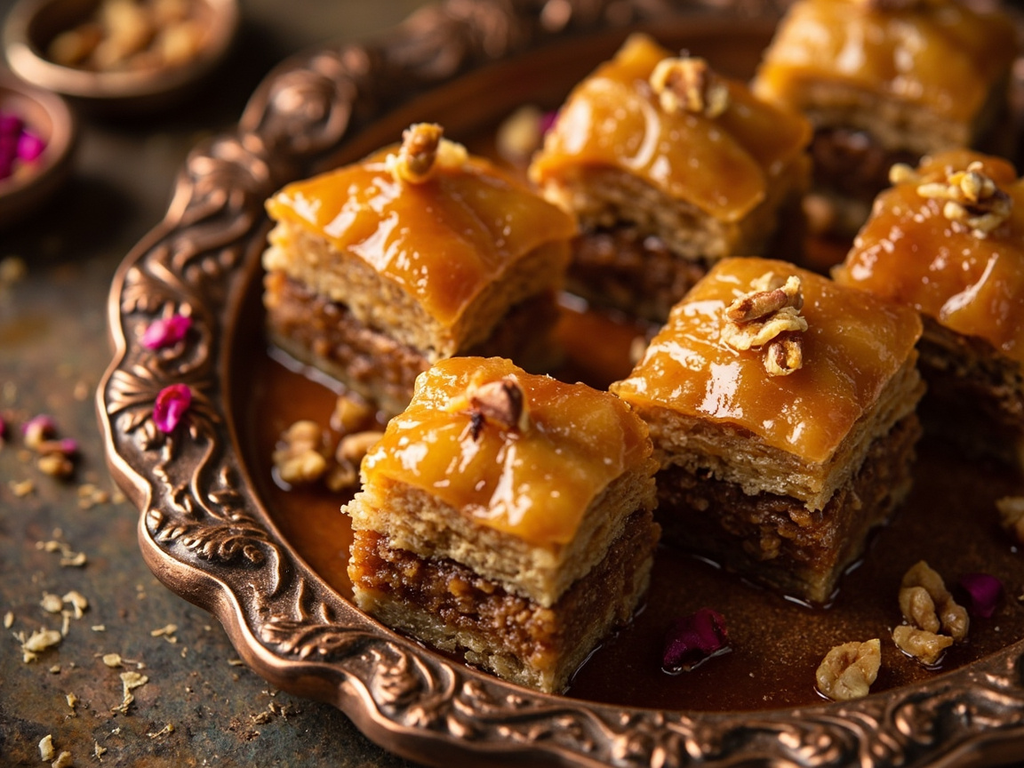
Honey, Walnut, and Rose Water Baklava
Why this dish? The kitchens of Topkapi, organized under Mehmed II, already included specialized pastry chefs; the earliest traces of baklava at the palace date from this period. A prestige pastry offered at major celebrations, it embodies the sugary splendor echoed in the bio (“honey and nut pastries”).
Layers of thin pastry, buttered, filled with ground walnuts and cinnamon, baked, then drenched in a honey and rose water syrup. Crisp, melting, intensely sweet: the royal sweet par excellence.
Save room for the end, for a sultan’s feast does not end without sweetness. My pastry chefs — I wanted for Topkapi kitchens such as no prince ever possessed — stretch the dough so thin you could read through it, butter it leaf by leaf, scatter it with ground walnuts and cinnamon. We bake it golden, then drown it in a honey syrup perfumed with rose water. Eat it warm, with your fingertips: that crackle and that honey are the taste of victory turned to sugar.
- •Very thin stretched dough (yufka) — many leaves (flaky structure)
- •Clarified butter — abundant (layering, browning)
- •Ground walnuts — a good measure (filling)
- •Cinnamon — to taste (spice)
- •Honey — generous (syrup)
- •Rose water — a few drops (aroma)
Honey, Walnut, and Rose Water Baklava
Layers of thin pastry, buttered, filled with ground walnuts and cinnamon, baked, then drenched in a honey and rose water syrup. Crisp, melting, intensely sweet: the royal sweet par excellence.
Why this dish? The kitchens of Topkapi, organized under Mehmed II, already included specialized pastry chefs; the earliest traces of baklava at the palace date from this period. A prestige pastry offered at major celebrations, it embodies the sugary splendor echoed in the bio (“honey and nut pastries”).
Save room for the end, for a sultan’s feast does not end without sweetness. My pastry chefs — I wanted for Topkapi kitchens such as no prince ever possessed — stretch the dough so thin you could read through it, butter it leaf by leaf, scatter it with ground walnuts and cinnamon. We bake it golden, then drown it in a honey syrup perfumed with rose water. Eat it warm, with your fingertips: that crackle and that honey are the taste of victory turned to sugar.
Ingredients (period version)
- Very thin stretched dough (yufka) — many leaves (flaky structure)
- Clarified butter — abundant (layering, browning)
- Ground walnuts — a good measure (filling)
- Cinnamon — to taste (spice)
- Honey — generous (syrup)
- Rose water — a few drops (aroma)
Ingredients
- Phyllo dough sheets — 1 package (about 12 sheets) (flaky structure)
- Melted butter — 200 g (layering, browning)
- Walnuts (halves) — 250 g, coarsely ground (filling)
- Ground cinnamon — 1 tsp (spice)
- Honey — 200 g (syrup)
- Water — 150 ml (syrup)
- Rose water — 1 tsp (aroma)
- Lemon juice — 1 tsp (syrup balance)
Method
- Mix the ground walnuts with cinnamon.
- Butter a baking dish, layer half the phyllo sheets, brushing each with butter.
- Spread the walnut mixture evenly, then cover with the remaining phyllo sheets, buttering each one.
- Pre-cut into diamond shapes with a knife, then bake at 170°C for 35 to 40 minutes until golden.
- Meanwhile, simmer honey, water, and lemon juice for 5 minutes; remove from heat and stir in rose water.
- Pour the warm syrup over the hot baklava and let absorb for at least 2 hours before serving.
How it was made : Topkapi Palace kept records and pastry traditions from the 15th century; the “baklava alayı” (procession of baklava offered to janissaries) is later but rooted in this court custom. At the time, sugar was rare, so honey dominated; local walnuts prevailed over pistachios depending on region.
The contemporary twist : Cut into small diamonds, sprinkled with crushed walnuts and a veil of dried rose petals: a “court baklava” in bite-sized pieces.
Mehmet II · Charactorium