 flip
flipPolo-ye Bokhârâ (Bukhara dried fruit pilaf)
Polo-ye Bokhârâ (Bukhara dried fruit pilaf)
Why this dish? The fruit-and-nut pilaf was the daily dish at the Samanid court of Bukhara, where Rûdakî lived and composed most of his work. Rice, a prestigious commodity in Transoxiana, was embellished with almonds, dried apricots, and raisins — the very fruits the poet sang of in his bucolic verses evoking the orchards of Samarkand.
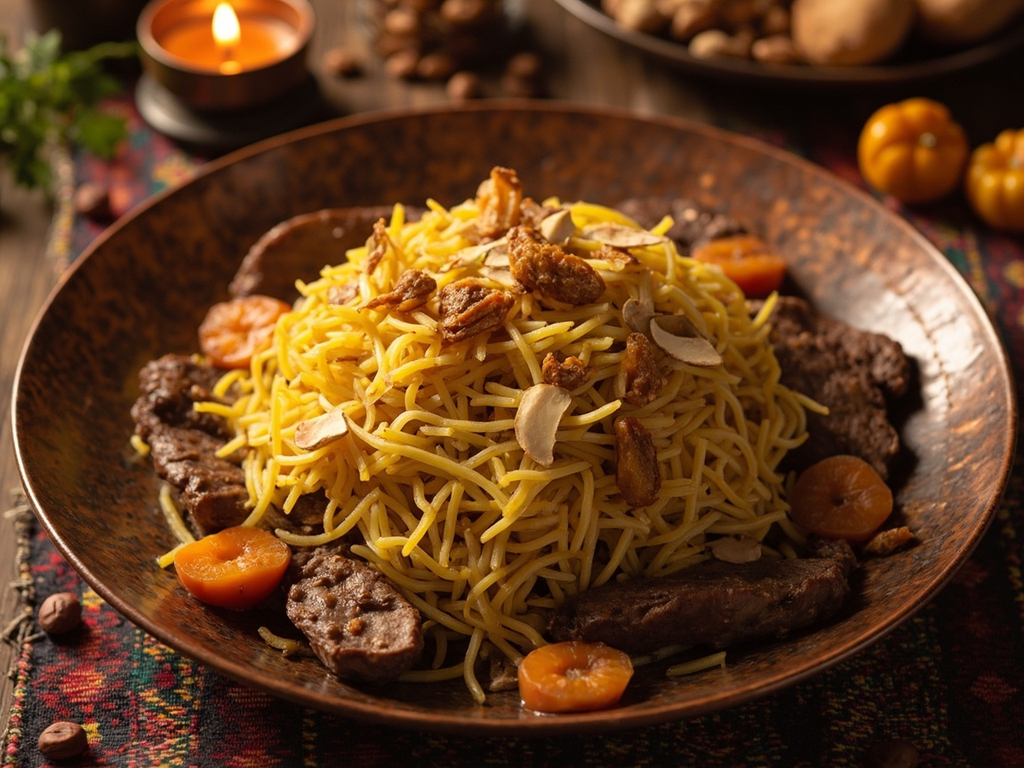
A long-grain rice perfumed with saffron, garnished with tender lamb strips and a profusion of caramelized dried fruits — apricots, raisins, and almonds. A dish that unites the sweetness of Central Asian orchards with the richness of the princely table.
Come near, friend, and breathe this saffron that gilds the rice as the sun gilds the domes of Bukhara. At Emir Nasr's table, no meal begins without this polo: servants pile the rice like a mountain on the copper platter, then nestle the apricots of Samarkand, golden in clarified butter, and the almonds of Fergana. I have sung a hundred times that the scent of polo surpasses that of musk — and my word was no ornament, but truth. The secret, you see, is to steam the rice in its own breath, covered, until each grain stands alone like a well-chiseled verse.
- •Long-grain rice from Transoxiana — one large measure (Base of the polo)
- •Lamb shoulder — a good piece, cut into strips (Meat garnish)
- •Dried apricots — a generous handful (Fruity sweetness)
- •Raisins — a handful (Complementary sweetness)
- •Blanched almonds — a handful (Crunch)
- •Saffron — a pinch infused in hot water (Color and aroma)
- •Clarified butter (roghan) — a good piece (Cooking and richness)
- •Onion — one, sliced (Aromatic base)
- •Salt — to taste (Seasoning)
- •Cinnamon and cumin — a pinch each (Warm spices)
Polo-ye Bokhârâ (Bukhara dried fruit pilaf)
A long-grain rice perfumed with saffron, garnished with tender lamb strips and a profusion of caramelized dried fruits — apricots, raisins, and almonds. A dish that unites the sweetness of Central Asian orchards with the richness of the princely table.
Why this dish? The fruit-and-nut pilaf was the daily dish at the Samanid court of Bukhara, where Rûdakî lived and composed most of his work. Rice, a prestigious commodity in Transoxiana, was embellished with almonds, dried apricots, and raisins — the very fruits the poet sang of in his bucolic verses evoking the orchards of Samarkand.
Come near, friend, and breathe this saffron that gilds the rice as the sun gilds the domes of Bukhara. At Emir Nasr's table, no meal begins without this polo: servants pile the rice like a mountain on the copper platter, then nestle the apricots of Samarkand, golden in clarified butter, and the almonds of Fergana. I have sung a hundred times that the scent of polo surpasses that of musk — and my word was no ornament, but truth. The secret, you see, is to steam the rice in its own breath, covered, until each grain stands alone like a well-chiseled verse.
Ingredients (period version)
- Long-grain rice from Transoxiana — one large measure (Base of the polo)
- Lamb shoulder — a good piece, cut into strips (Meat garnish)
- Dried apricots — a generous handful (Fruity sweetness)
- Raisins — a handful (Complementary sweetness)
- Blanched almonds — a handful (Crunch)
- Saffron — a pinch infused in hot water (Color and aroma)
- Clarified butter (roghan) — a good piece (Cooking and richness)
- Onion — one, sliced (Aromatic base)
- Salt — to taste (Seasoning)
- Cinnamon and cumin — a pinch each (Warm spices)
Ingredients
- Basmati rice — 400 g (Base of the polo)
- Boneless lamb shoulder — 300 g, cut into thin strips (Meat garnish)
- Soft dried apricots — 80 g (Fruity sweetness)
- Golden raisins — 50 g (Complementary sweetness)
- Slivered almonds — 40 g (Crunch)
- Saffron threads — a good pinch (0.2 g), infused in 3 tbsp hot water (Color and aroma)
- Clarified butter (ghee) — 60 g (Cooking and richness)
- Yellow onion — 1 medium, finely sliced (Aromatic base)
- Salt — 1 tsp (Seasoning)
- Ground cinnamon — ½ tsp (Warm spice)
- Ground cumin — ½ tsp (Warm spice)
Method
- Rinse the basmati rice in cold water until the water runs clear, then soak for 30 minutes. Drain.
- Melt half the ghee in a heavy pot. Brown the lamb strips with the sliced onion, cinnamon, and cumin until colored. Season with salt, cover with water, and simmer for 30 minutes until the meat is tender. Reserve the meat and cooking liquid separately.
- In a skillet, toast the almonds in a little ghee until golden, then add the apricots (halved) and raisins. Sauté for 2 minutes to lightly caramelize. Set aside.
- Bring a large pot of salted water to a boil. Cook the rice for 5 minutes (it should remain firm at the center). Drain.
- In the pot, layer a portion of rice, then the meat, then the dried fruits, then the remaining rice. Drizzle with the infused saffron and the remaining melted ghee.
- Cover tightly (a cloth under the lid helps trap steam). Cook over very low heat for 30–35 minutes.
- Turn the polo out onto a large serving platter, decorate with a few almonds and saffron threads.
How it was made : Pilaf is attested in medieval Persian culinary sources and in descriptions of Samanid banquets. Al-Warraq's Kitab al-Tabikh (10th century) mentions several recipes for rice with dried fruits and meat. The dami technique (steam cooking in a sealed pot) is characteristic of Persian cuisine and produced rice with separate, fragrant grains.
The contemporary twist : Serve the polo as a dome on an individual plate using an inverted bowl, with dried fruits arranged in a crown — a miniature Samanid banquet.
Sources : Nawal Nasrallah, Annals of the Caliph's Kitchens: Ibn Sayyār al-Warrāq's Tenth-Century Baghdadi Cookbook (Brill, 2007) · Charles Perry, A Baghdad Cookery Book (Prospect Books, 2005)
Rudaki · Charactorium