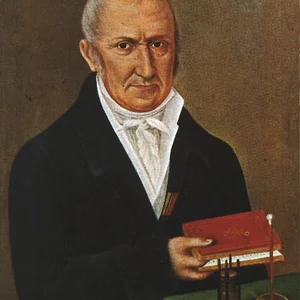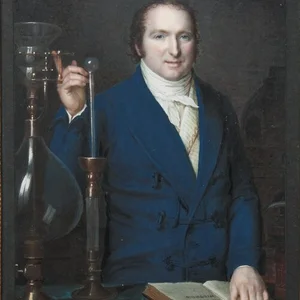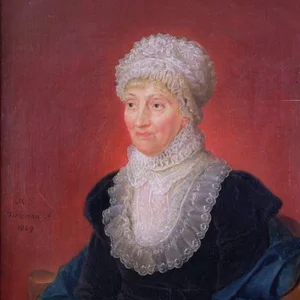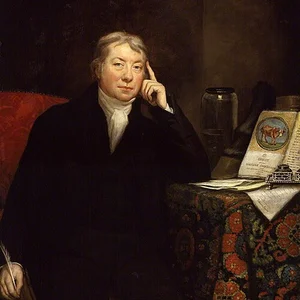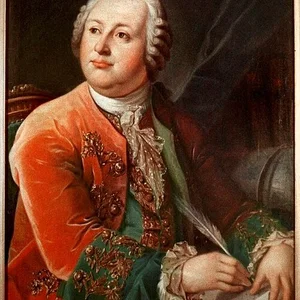

An 18th-century Russian scholar — chemist, physicist, and astronomer. A pioneer of Russian science, he formulated a principle of conservation of matter and helped found Moscow University.
Mikhail Lomonosov(1711 — 1765)
Mikhail Lomonosov
Empire russe
6 min read
Frequently asked questions
Key Facts
- Born in 1711 near Arkhangelsk into a family of Pomor fishermen
- Stated as early as 1748 a principle of conservation of mass in chemical reactions
- Observed in 1761 the transit of Venus across the Sun and deduced the existence of an atmosphere on Venus
- Founded Moscow University in 1755, which today bears his name
- Died in 1765 in Saint Petersburg
Works & Achievements
Formulation, in a letter to Euler, of the idea that matter is neither created nor destroyed during transformations, anticipating the work of Lavoisier.
He argued that heat results from the motion of particles of matter, and not from a fluid (the “caloric”), an idea far ahead of its time.
During the transit of Venus, he observed a luminous halo and concluded that the planet is surrounded by an atmosphere.
The first scientific grammar of Russian, which helped establish the modern literary and scholarly language.
His proposal and influence led to the creation of the first Russian university, today one of the most prestigious in the country.
A vast mosaic created in his workshop of colored glass, depicting the victory of Peter the Great and the revival of this art in Russia.
Author of solemn odes, such as the Ode on the Capture of Khotin (1739), he reformed Russian versification.
Anecdotes
The son of a fisherman from Russia's Far North, near Arkhangelsk, the young Lomonosov learned to read thanks to borrowed books. At 19, in December 1730, he secretly left his family's village and walked for weeks all the way to Moscow to study, claiming to be the son of a nobleman in order to be admitted to the Slavic Greek Latin Academy.
To state what would become a principle of the conservation of matter, he wrote in 1748 to his friend the mathematician Leonhard Euler that “nothing is created and nothing is lost”: whatever is added to one body is taken from another. This is one of the first clear formulations of the idea, half a century before Lavoisier's experiments.
Sent to study in Germany, in Marburg and then Freiburg, Lomonosov married his landlord's daughter there and ran up debts. Legend has it that he once had to give the slip to Prussian recruiters who had forcibly enlisted him in the army, escaping a fortress by night.
Passionate about the art of mosaic, he reopened a colored-glass factory and produced enormous mosaics himself, including one depicting the Battle of Poltava. He also composed solemn odes and ardently championed the Russian language as a language of science and poetry.
In 1761, while observing the planet Venus passing in front of the Sun, Lomonosov noticed a thin luminous halo around the planet's disc. He was the first to deduce from it that Venus has an atmosphere.
Primary Sources
All changes that occur in nature happen in such a way that whatever is added to one body is taken away from another. Thus, as much matter as is added to one body, that much is removed from another.
Heat consists in the internal rotational motion of the particles of the matter proper to bodies.
The planet Venus is surrounded by a remarkable airy atmosphere, as great as (if not greater than) the one that envelops our own terrestrial globe.
Charles V, the Holy Roman Emperor, used to say that it is fitting to speak Spanish with God, French with one's friends, German with one's enemies, and Italian with the ladies. But had he known Russian, he would have added that one may speak with dignity to all of them, for he would have found in it the magnificence of Spanish, the liveliness of French, and the strength of German.
Key Places
Lomonosov's native village, on the shores of the White Sea, where he grew up in a family of fishermen and accompanied his father out to sea.
The first major school where he studied after fleeing to Moscow in 1731, learning Latin and the humanities.
University where he studied science and philosophy under Christian Wolff starting in 1736.
The heart of his scientific activity: here he was a professor of chemistry, founded the first chemistry laboratory in Russia, and conducted his research.
An institution founded in 1755 thanks to his initiative; today it bears his name (Lomonosov Moscow State University).
Typical Objects

Glass and ceramic instruments he used in Russia's first chemistry laboratory to heat, weigh, and analyze substances. He carefully weighed materials before and after a reaction.

A refracting telescope with which he observed the transit of Venus in 1761. It was through this instrument that he spotted the halo revealing the planet's atmosphere.

Small cubes of colored glass (smalt) that he manufactured in his own factory to create large mosaics, such as the Battle of Poltava. He rediscovered techniques for coloring glass.

An instrument of weighing essential to his approach: by weighing substances before and after transformations, he showed that the total mass is conserved.

With his pen he wrote scientific treatises in Latin and Russian, solemn odes, and his Russian Grammar. He worked to make Russian a language of learning.

He took an interest in geography and Arctic navigation, designing instruments to explore the northern seas and envisioning a sea passage to the east.
School Curriculum
Vocabulary & Tags
Key Vocabulary
Daily Life
Morning
Lomonosov rose early and devoted his mornings to writing scientific treatises and papers, in Latin or Russian. He prepared his lectures and his communications for the Academy of Sciences.
Afternoon
His afternoons were spent in the chemistry laboratory, conducting experiments, weighing substances, and melting colored glass for his mosaics. He also supervised students and assistants.
Evening
In the evening, he continued his reading, corresponded with scholars such as Euler, or composed poetic odes. On clear nights, he could observe the sky with his astronomical instruments.
Food
Like the inhabitants of Saint Petersburg of his time, he ate rye bread, soups (cabbage shchi, borscht), fish — abundant in his native region — porridge, and root vegetables. Beer and kvass accompanied his meals.
Clothing
As a professor and member of the Academy, he wore eighteenth-century dress: a justaucorps, waistcoat, breeches, stockings, and a powdered wig for official ceremonies. In the laboratory, he put on simpler work clothes.
Housing
He lived in Saint Petersburg in a house assigned by the Academy, which housed his living quarters, his laboratory, and his mosaic workshop. The residence reflected his status as an established scholar.
Historical Timeline
Period Vocabulary
Liens externes & ressources
Références
Œuvres
Principe de conservation de la matière
1748
Théorie cinétique de la chaleur
1750
Découverte de l'atmosphère de Vénus
1761
Grammaire russe (Российская грамматика)
1755
Fondation de l'université de Moscou
1755
Mosaïque de la Bataille de Poltava
1762-1764
Odes et poésie russe
1739-1760